
Taiwan’s Coast Guard Puts Its Unmanned Mesh on Parade
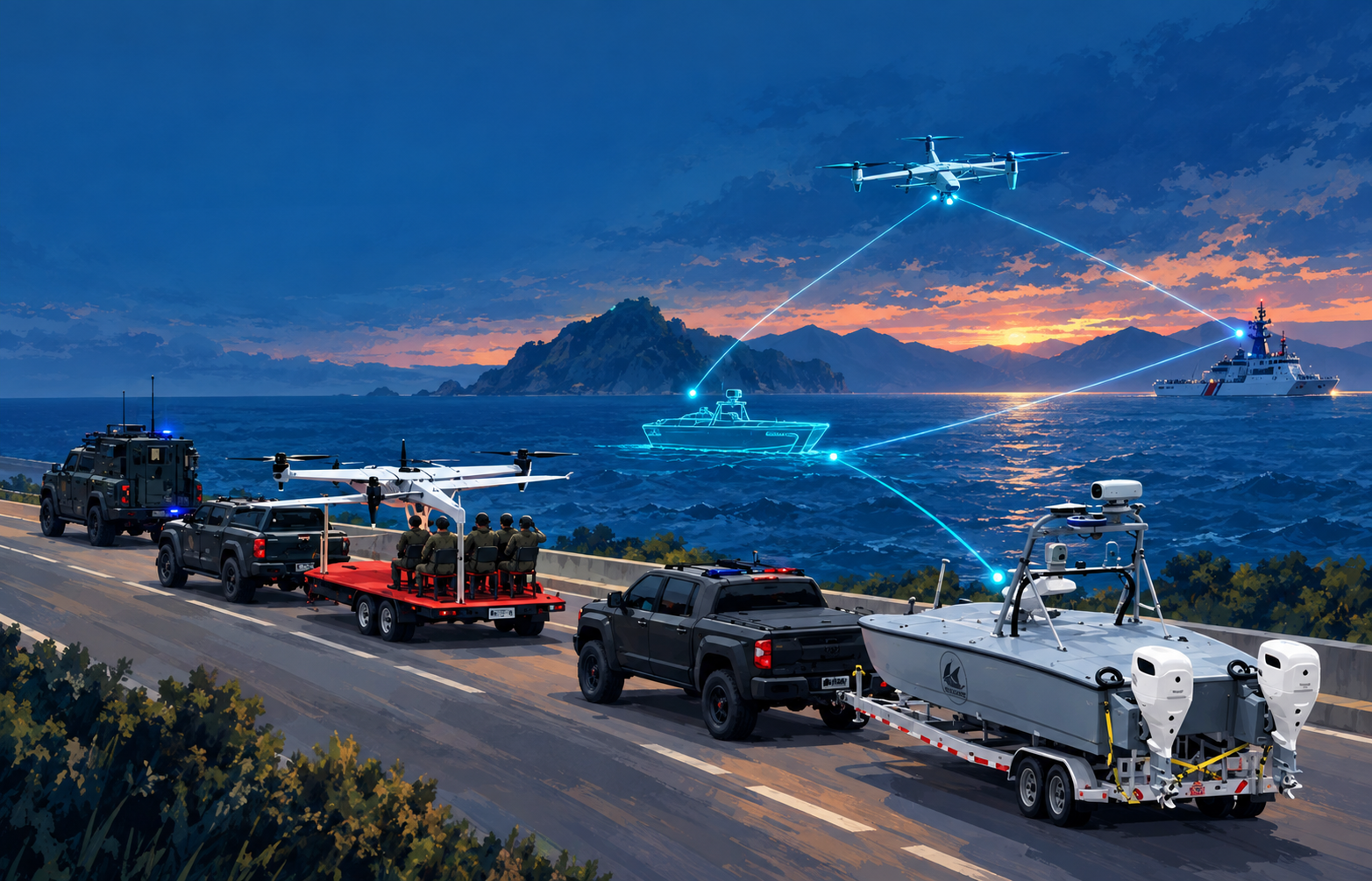
National Day parades are usually about display. This year, Taiwan’s Coast Guard Administration used the October 10 parade in Taipei to show something more consequential: the early shape of an air-sea unmanned network built around U.S. systems, co-development with Taiwan’s defense research establishment, and a deliberate shift from hull-centric patrol to networked maritime awareness.
According to Taiwan’s Ocean Affairs Council, this was the largest Coast Guard contingent in a National Day event since the service was founded. The Coast Guard organized it into three themed echelons (national security, law enforcement and public safety) under the parade’s overall theme of “resilience and unity.” The lineup included two special-operations assault boats, a MARTAC unmanned surface vessel, an AeroVironment Jump 20 vertical-takeoff drone, and vehicle-mounted radar and infrared thermal-imaging units.
The Rehearsal Reveal
The systems were first shown publicly at the October 6 rehearsal in front of the Presidential Office. As Taiwan News reported, drawing on CNA, the Coast Guard presented the Jump 20 for the first time alongside a MARTAC M18 drone boat.
The Jump 20 is not new to the Coast Guard. AeroVironment provided it in 2022 for maritime surveillance, and it is already in service. What is new is that Taiwan chose to show it publicly. The medium-class VTOL aircraft has a 5.7-meter wingspan and a maximum takeoff weight of 97.5 kg. AeroVironment says it can stay aloft for more than 13 hours at up to 17,000 feet, with a 185 km operating range (Taiwan News).
The MARTAC M18 is a 5.5-meter USV with a top speed of 50 knots, a range of up to 500 nautical miles and a 450 kg payload. It can carry surveillance equipment or high-explosive warheads. The Coast Guard has taken delivery, but the boat is still in training and will enter frontline service only after that training ends (Taiwan News; EBC).
Taipei Harbor: The Air-Sea Pairing
The more revealing event came on October 7 at the Coast Guard base at Taipei Harbor. Ocean Affairs Council Minister Kuan Bi-ling, Coast Guard Director-General Chang Chung-lung and National Security Council Secretary-General Joseph Wu watched a joint demonstration of MARTAC’s T-24 drone vessel and Shield AI’s V-BAT VTOL drone, then trained hands-on with the operator simulators (Taiwan News).
Kuan said the inspection focused on how the V-BAT and the MARTAC boats can coordinate in land-sea defense (Taiwan News). That is the point worth noticing. The story is the pairing, not either platform alone.
- The V-BAT has a 3.8-meter wingspan and a 75 kg maximum takeoff weight. Shield AI says it can fly for more than 13 hours without a signal link and carries all-weather cameras for open-ocean monitoring (Taiwan News). Kuan also confirmed that the first batch of V-BATs bought by the Coast Guard has arrived (EBC).
- The T-24 is an 8.4-meter coastal USV with burst speeds above 50 knots, a range of up to 600 nautical miles and an 816 kg payload. It can launch smaller T-12 drone boats “like a scaled-down aircraft carrier” and keep operating through signal interruption (Taiwan News).
Together, these systems give the Coast Guard a long-endurance aerial sensor that can work without a continuous link, paired with a surface mothership that can spread smaller unmanned boats across a wider area. Both are built to keep working when the electromagnetic environment turns hostile. In the gray-zone pressure Taiwan faces every day, that resilience matters as much as range or speed.
Co-Development, Not Just Purchase
The Taiwanese angle runs through the National Chung-Shan Institute of Science and Technology (NCSIST). NCSIST signed an MOU with MARTAC in 2025, and the two are working on AI tracking for drone boats, autonomous interception and fleet coordination (Taiwan News). The Coast Guard described the parade USV as a high-performance boat built under contract in cooperation with NCSIST (CNA).
This is the move from foreign military sales toward co-production. U.S. platforms are being brought into Taiwan’s own research and industrial base, so the autonomy, data and tactics can be developed where the force will actually operate.
A Three-Phase Transformation
Kuan framed the drones as part of a three-phase Coast Guard plan: fleet expansion through new shipbuilding, upgraded intelligence, surveillance and reconnaissance (ISR), and the integration of unmanned vehicles and AI (Taiwan News; Rti). The slogan used in Taiwanese coverage is “air-sea integration, an elite Coast Guard” (EBC).
The Coast Guard says the unmanned systems will be folded into its patrol fleets for routine operations around Taiwan. Working with patrol vessels, they are meant to form a cooperative strike and ISR network that provides all-weather maritime coverage with no blind spots (CNA; UDN).
Why It Matters
Three points stand out.
First, the Coast Guard is becoming a sensor-rich front line for Taiwan’s defense. Beijing’s pressure is applied first through coast guard, maritime militia and “law enforcement” activity. A Taiwanese Coast Guard that can persistently watch its approaches with long-endurance unmanned systems changes the gray-zone contest, and that data has obvious value for the wider defense enterprise.
Second, the parade showed a mesh rather than a platform. Manned assault boats, a mothership USV with smaller drone boats, two classes of VTOL drones, and mobile radar and thermal sensors were presented together, in sequence, as one system. That is the right way to think about maritime autonomy: the payoff comes from integrating sensing, command, and manned and unmanned assets, not from any single boat or aircraft.
Third, the U.S. role shows up through industry partnership as much as through arms transfer. AeroVironment, Shield AI and MARTAC are all here. The MARTAC–NCSIST partnership shows how U.S. technology can be adapted, sustained and eventually produced in Taiwan. In a crisis, a force that Taiwan can build, repair and regenerate on its own territory is far more credible than one that depends on a long transpacific supply line.
The National Day parade is a showcase.
Still, what the Coast Guard chose to showcase tells us where Taiwan sees its maritime defense going: toward a networked, attritable and locally sustained air-sea force operating from the shoreline outward.
Featured image: Shield AI V-BAT VTOL and MARTAC T-24 drone boat on display at Taipei Harbor. (Coast Guard Administration photo, via Taiwan News)
Sources
- Peter Liang, “Taiwan Coast Guard debuts drones at National Day rehearsal,” Taiwan News, October 7, 2026: https://www.taiwannews.com.tw/news/6453371
- Peter Liang, “Taipei Harbor Coast Guard prepares drones for National Day,” Taiwan News, October 8, 2026: https://www.taiwannews.com.tw/news/6454218
Beyond Arms Sales: Building the Taiwan Mesh Fleet Where the Fight Will Be