
The Paradigm Shift for Combat Pilot Training
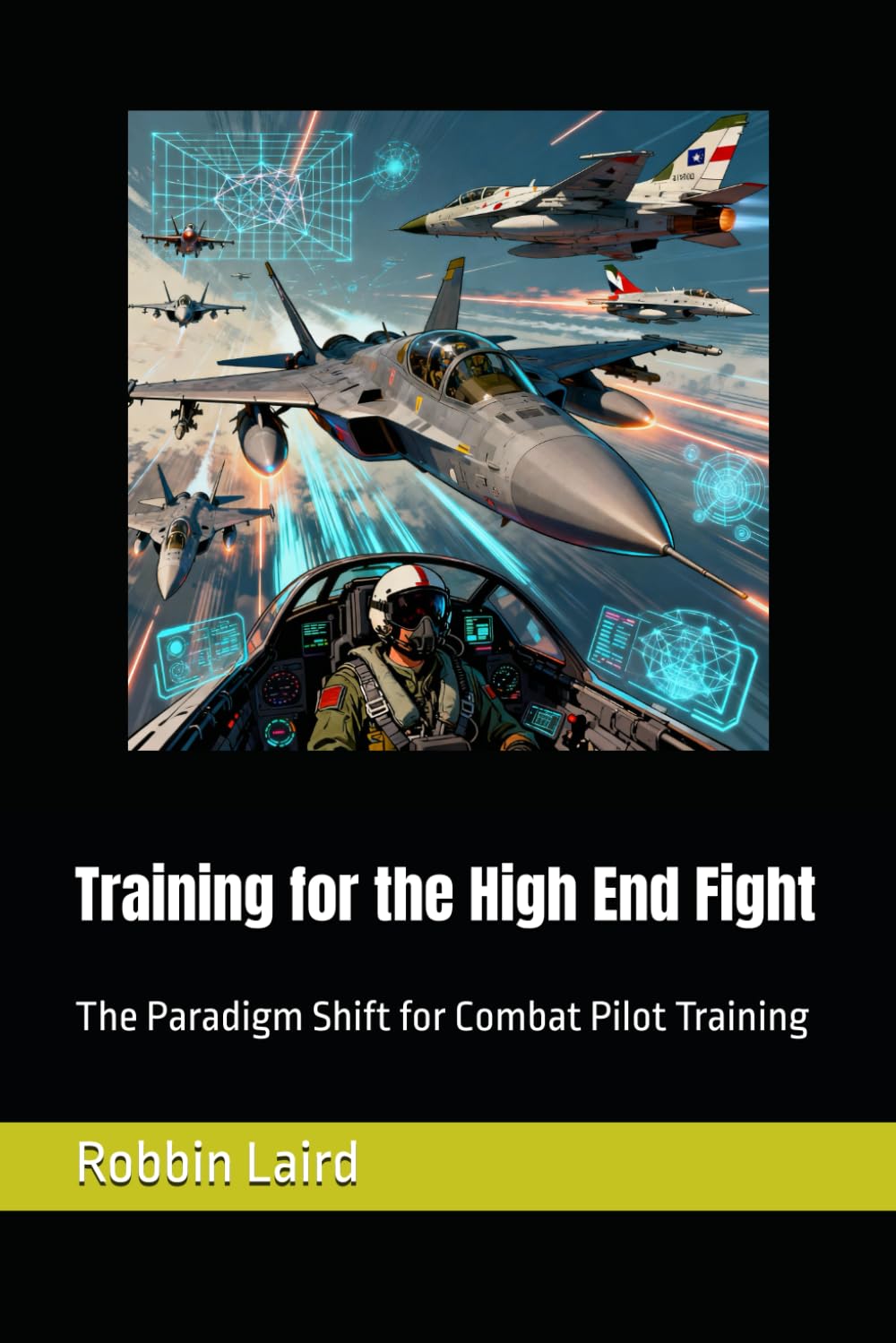
Military aviation stands at a decisive inflection point.
For most of the modern era, airpower assumed a world of crisis management: identifiable flashpoints, linear escalation, clear command chains, predictable timelines. That world is over. We now operate in what Robbin Laird has aptly described as chaos management simultaneous, overlapping crises across domains; information environments under attack; and decision timelines compressed to seconds. This new battlespace is not simply faster. It is structurally different.
In that environment, the question for an air force is no longer “Can you fly and execute the mission you were given?” The question is “Can you think, decide, and reconfigure the mission in real time when the situation no longer matches the plan?” That is the new standard. That is the new currency of deterrence. And that is why training has become strategic.
This book is about that transformation.
The pilot we are producing today is not the pilot of the last generation. In the past, we trained aviators to master a platform and execute a predefined role. In the emerging fight, the pilot is not just an operator. The pilot is a node of command.
Fifth-generation aircraft such as the F-35 are not simply “better fighters.” They are flying information systems: sensing, fusing, distributing, tasking, and coordinating effects across air, land, sea, space, and cyber. They sit inside what Laird describes as the kill web, a distributed, resilient battlespace architecture where any sensor can inform any shooter, and where no single point of failure can collapse the entire strike sequence. This is a historic break from the linear kill chain model of the past.
Operating inside a kill web demands a different mind.
The modern combat aviator must absorb and interpret a flood of data, coordinate with assets he may never see physically, fight across multiple domains at once, and make decisions with strategic consequence even without higher guidance. He or she must be technically fluent, tactically creative, and cognitively fast. We are no longer training “good pilots.” We are training war winners.
That is the shift Robbin Laird captures, and that is the shift Italy has chosen not only to understand, but to lead.
The International Flight Training School (IFTS) in Decimomannu, Sardinia, is not just an advanced training center. It is a live, functioning prototype of how air forces must now generate combat power. What makes it revolutionary is not one aircraft, one simulator, or one syllabus update. It is the creation of a fully integrated Live–Virtual–Constructive (LVC) combat preparation ecosystem.
In legacy approaches, you had three worlds: you flew live, you trained in a simulator, or you watched something on a screen. At IFTS, those worlds have been fused. The same software that runs in the aircraft also runs in every simulator, from the simplest desktop procedural trainer to the most immersive mission simulator. This “one simulation” principle eliminates negative training, accelerates adaptation, and allows synthetic forces and live forces to coexist in the same tactical problem.
The effect is profound. You can now take a single real aircraft in Sardinian airspace and drop it into a mission that feels like a full combat package. Ground instructors act as mission commanders, generating hostile aircraft, surface-to-air missile systems, maritime threats, and electronic warfare emitters into that pilot’s battlespace in real time. The pilot’s sensors see those threats as if they were actually there. His warning receivers behave as if he is being targeted. His decision-making stress is real.
This is not rehearsal. This is combat cognition, safely weaponized for learning.
And it scales. You can mix a live aircraft, multiple pilots in full-mission simulators on the ground, and computer-generated “red air”, all inside the same scenario, all talking, all reacting, all contested. You can inject friction, saturation, ambiguity. You can change the rules of the fight mid-flight. You can condition aviators to operate in chaos rather than collapse under it.
That is the difference between training a pilot and shaping a combat decision-maker.
Just as important as the technology is the architecture that supports it. The Italian Air Force and Leonardo have built not a contractor-customer arrangement, but a national combat preparation enterprise, what Italy calls Sistema Paese. Operational feedback from front-line F-35 and Eurofighter units flows directly back into IFTS, and IFTS pushes requirements down into the early training pipeline. Curricula are not updated every five years. They can be updated in weeks. Students today routinely see multiple major syllabus changes inside a single nine-month cycle, driven by what the force is actually seeing at the edge. That is what agility looks like in practice.
The next evolution, already underway with the M-346 Block 20, pushes even further.
Augmented reality in the helmet. Embedded tactical training systems that allow you to “fight” weapons you are not physically carrying. AI-enabled coaching that learns from thousands of flight hours to tailor instruction and identify breakdown points before they become failures. Biometric monitoring of pilot stress and cognitive load. Early exposure to manned–unmanned teaming concepts that will define sixth-generation airpower. In short: pilots are not being prepared for yesterday’s aircraft. They are being cognitively wired for tomorrow’s fight.
And they are not being prepared alone.
Thirteen nations, soon more, are now sending their pilots into this ecosystem. This matters. It means coalition airpower is no longer something you improvise at the start of a crisis. It is something you build into the nervous system of your aviators from the first day of advanced training. Shared procedures become shared instincts. Shared instincts become shared deterrence.
Geography plays its part as well. Sardinia offers something that almost no other European location can: large, largely unconstrained airspace; access to live ranges; maritime and land threat representation in a single operating picture; and flyable weather for most of the year. That geography, combined with LVC, allows students to train in realistic multi-domain scenarios — air threats, naval threats, ground-based air defenses, electronic attack, without having to assemble a full wartime strike package.
This is not a convenience. It is a strategic asset. It means you can prepare for the fight you will face, at scale, without burning down readiness to do it.
The conclusion is inescapable: training is no longer a support function. Training is now the first arena of sovereignty.
If you cannot generate aviators who can think and decide at the speed of relevance, no platform, not the F-35, not the next-generation fighter, not any unmanned adjunct, will save you. If you can generate them, you can deter, you can adapt, and you can fight in conditions your adversary cannot survive.
Laird’s work makes the point clearly. Italy’s model shows it concretely.
What began years ago with the strategic decision to build Cameri as an F-35 hub has matured into something much larger: a national ecosystem that produces not just aircraft, but combat minds. The Italian Air Force, Leonardo, CAE, and allied air forces have together built an engine of cognitive readiness, an engine that treats pilots as strategic assets from day one, and that treats adaptation itself as a doctrine.
As a former Chief of Staff of the Italian Air Force, I recognise in these pages a simple reality: the centre of gravity in air warfare has moved. Air superiority is no longer guaranteed by hardware alone. It is guaranteed by the mind in the cockpit, a mind trained to fight as part of a distributed kill web, to act across domains, to absorb shock without paralysis, and to lead when the script is gone.
That is the future. This book explains how it is being built.
Pasquale Preziosa
Former Chief of Staff of the Italian Air Force and Professor of Geopolitics, Geostrategy, Terrorism and Counterterrorism at the Niccolò Cusano University of Rome.