
Two Years On: How the Second Trump Administration Has Rewired the Relationship Between Acquisition and the Defense Industrial Base

When I wrote in September 2025 about the five-year multiyear procurement for up to 99 CH-53K King Stallions, my point was that the contract was far more than an aircraft buy. A long-term, stable demand signal let Sikorsky bundle supplier orders, let a network of 267 suppliers across 37 states plan investment, and turned acquisition into a tool for shaping the industrial base (Second Line of Defense). At the time, it looked like a well-structured program decision. Looking back over two years of the second Trump administration, it looks more like an early example of a broader shift.
The question I want to address here is not whether the Pentagon has “reformed acquisition.” That phrase has been used for forty years to describe almost anything. The more useful question is whether the administration has changed the terms of the relationship between the government as buyer and industry as builder. In my view it has, and in ways that go beyond process. Over two years, the department has been trying to act at once as a commercial-style customer, a long-term demand guarantor, an investor, and an enforcer of corporate behavior. Each of those roles has precedents. Combining them is new.
What follows sets out how that happened, what has actually changed, and what remains a declaration of intent. In my Intent and Delivery series, I am posing questions rather than offering verdicts, and I am separating what has been demonstrated from what has been announced.
Year One: Setting the Frame
The first year was largely about changing the rules of the game and signaling a new posture toward industry.
- April 2025. Executive Order 14265 directed a plan to make commercial solutions the first preference, cut duplicative approvals, and review every major program, with those more than 15 percent behind schedule or over cost scrutinized for cancellation (White House fact sheet). The same day, Executive Order 14269 launched a Maritime Action Plan for the shipbuilding base (White House). At the end of the month, a memo directed the Army to “overcome parochial interests” and modernize “inefficient defense contracts” through the Army Transformation Initiative (CRS).
- July 2025. The reconciliation law provided $156.2 billion in mandatory defense funding with a five-year period of availability (CRS), including more than $8 billion for the Industrial Base Fund, with $5 billion for critical minerals supply chains (Lawfare). Days later, the “Unleashing U.S. Military Drone Dominance” memo called drones “the biggest battlefield innovation in a generation” and rescinded restrictive policies (Department of Defense). The Pentagon also took a $400 million, 15 percent stake in MP Materials, backed by a ten-year price floor and offtake agreement (MP Materials via SEC).
- August 2025. The department disestablished JCIDS, the Joint Staff’s requirements process (Breaking Defense).
- November 2025. In his “Arsenal of Freedom” speech at Fort McNair, Secretary Hegseth recast the Defense Acquisition System as the Warfighting Acquisition System. The accompanying strategy created Portfolio Acquisition Executives, made commercial products the default, set up an Economic Defense Unit to deploy capital, and called for direct-to-supplier contracting, including bypassing primes when that serves the mission (Holland & Knight). Deputy Secretary Feinberg set the tone for industry: “The contractors that are willing to change with us will prosper and grow. Those who don’t and resist it will be gone” (DefenseScoop).
- December 2025. The FY26 NDAA wrote much of this into law. It established Portfolio Acquisition Executives in Section 1802, raised the certified cost-or-pricing-data threshold from $2.5 million to $10 million, raised Cost Accounting Standards thresholds, exempted nontraditional contractors from several cost requirements, and authorized multiyear procurement for a dozen munitions lines (Crowell). The Drone Dominance Program, a $1.1 billion effort to field roughly 340,000 small drones by the end of 2027, launched the same month (CSIS).
By the end of 2025, then, the frame was in place: speed as the organizing principle, portfolios rather than programs, commercial terms rather than compliance, and a statutory base that Congress had largely endorsed on a bipartisan basis.
Year Two: From Frame to Contracts and Capital
The second year is where the relationship began to change in practice, and where its tensions became visible.
- January 2026. A seven-year framework agreement with Lockheed Martin set out to raise PAC-3 MSE output from about 600 to 2,000 interceptors a year, with seven-year subcontracts flowing to key suppliers and a new Munitions Acceleration Council (Department of War). The next day, Executive Order 14372 targeted contractors that underperform while paying out stock buybacks and dividends (Senator Lee and Senator Warren). A week later, the Pentagon announced a $1 billion investment in L3Harris’s rocket motor business (Reuters).
- February 2026. Operation Epic Fury against Iran began on February 28 (IANS), turning the industrial base question from a planning exercise into a live test.
- April 2026. The FY27 request asked for $1.5 trillion, including $756.8 billion for rebuilding and expanding the industrial base (Department of War). Executive Order 14402 made fixed-price contracts “the default and preferred method of procurement” (Federal Register).
- Summer 2026. Framework agreements turned into contracts: up to $35 billion to quadruple THAAD production, up to $58.6 billion to triple PAC-3 MSE production by 2030, and a $22.9 billion Tomahawk contract with RTX (CSIS). Executive Order 14415 limited waivers for critical materials and required contractors to map critical supply chains (ExecutiveGov). By July, all three military departments had replaced program executive officers with Portfolio Acquisition Executives (Breaking Defense).
- September 2026. The “Fostering One Strong Industrial Base” memo pushed toward commercial accounting, contract-specific rather than company-wide cost accounting coverage, profit tied to “value delivered, risk carried, and private capital invested — not merely cost incurred,” and the ability to “see through the prime contractor to the suppliers” (Department of War memo). At Quantico, Hegseth announced the Autonomous Warfare Command and Project Agincourt, promising to “fuse procurement with operations at scale” (Breaking Defense).
- October 2026. The Navy awarded Raytheon up to $24.4 billion for SM-6 production (IANS). Anduril announced a $3.7 billion privately funded submarine component facility in Baltimore, paired with a Navy contract of up to $2.9 billion with payments tied to demonstrated production outcomes (Anduril).
AEI counted almost 300 Pentagon changes between January 2025 and mid-June 2026, with acquisition accounting for 49 percent of them (AEI). Volume alone does not tell us much. The more important question is which of these changes alter the underlying relationship. I see five.
Shift One: From Compliance to Commercial Terms
The deepest change in intent is the attempt to move the relationship from a compliance model to a commercial one. Senior officials describe wanting to leave a system in which industry waits for step-by-step approvals and replace it with one in which industry takes on more upfront risk, particularly non-recurring costs, in exchange for higher margins when it beats schedule. They want companies to move “from a cash flow to a growth mindset” and invest in capital equipment before contracts are definitized (National Defense).
The tools are now largely in place: the fixed-price default, higher cost-data thresholds, the move from government-unique cost accounting toward generally accepted accounting principles, and the proposed profit policy that rewards private capital at risk.
But a commercial bargain has two sides. National Defense asks the right questions about the government’s side: will it offer commercial-style payment terms, routinely make advance payments, allow interest as a cost, and accept idle capacity and higher indirect rates? Will budgets support higher margins? Can the department recruit enough contracting officers to run this system (National Defense)? Asking industry to carry more risk under fixed prices while the government still funds through continuing resolutions is not a commercial relationship. It is a transfer of risk.
Shift Two: The Demand Signal as Industrial Policy
The CH-53K logic has now been applied to munitions at scale. The framework agreements are the administration’s most concrete industrial lever, and they are producing results industry can see. Publicly traded signatories reported a 31 percent year-over-year increase in second-quarter capital expenditure. Lockheed committed more than $9 billion to capacity expansion, and L3Harris pledged more than $1 billion for its Virginia solid rocket motor site (CSIS). AEI calls this “a Costco-like approach to buying hardware” (AEI).
The approach is not purely an executive creation. Congress authorized multiyear procurement for eight critical munitions in the FY26 appropriations act (House Appropriations Committee), and that authority is what made the later framework agreements legally possible.
The weakness is the one CSIS puts most plainly: “Framework agreements are not appropriations.” CSIS notes that 2,936 of the 3,203 PAC-3 MSE interceptors requested for FY27, or 92 percent, depended on mandatory funding tied to a reconciliation bill (CSIS). Both chambers’ budget resolutions provide $60 billion in reconciliation funding for defense against the $350 billion requested, and CSIS judges the lower figure more likely (CSIS). AEI’s warning applies directly: “Production lines are not meant to be operated on a ‘stop and go’ basis” (AEI). A demand signal that cannot be funded loses credibility quickly.
Shift Three: The State as Investor
This is the most novel change and the most contested. The government has moved from being a customer of the industrial base to being an owner of parts of it. After MP Materials came a 10 percent stake in Trilogy Metals, a 40 percent stake in a smelting joint venture with Korea Zinc, and the $1 billion convertible preferred investment in L3Harris Missile Solutions (Lawfare). Defense One reported that the administration had made direct investments in ten companies (Defense One). The Office of Strategic Capital, created under the previous administration to help small manufacturers, has shifted toward large loans for rare earth processing, including $500 million for Phoenix Tailings and $725 million for Energy Fuels (Department of War, Department of War).
The Economic Defense Unit sits on top of these tools. One Pentagon official described its purpose as “one central strategic vision on how we execute industrial policy for the department.” The department has asked for $593 million for it in FY27 and authority to hire up to 33 private-sector executives (Inside Defense).
The rationale is straightforward. Critical minerals and solid rocket motors are markets in which private capital alone will not build capacity against Chinese dominance. The structural problem is just as clear. When the government owns part of a supplier, it sits on both sides of the negotiating table. The Pentagon said the L3Harris investment would allow it “to negotiate multi-year procurement framework agreements” with the company, and Lawfare identifies that link between investment and procurement as a potential conflict of interest. It also argues that the department has never stated a clear legal basis for its equity stakes (Lawfare). Bloomberg’s reporting on the role of Cerberus alumni and on a troubled loan to ReElement Technologies adds questions about due diligence (Bloomberg).
Congress has noticed. The Senate Armed Services Committee’s FY27 bill would move equity authority to the Office of Strategic Capital, limit stakes to critical minerals, materials, chemicals, and batteries, cap them at $500 million, and require conflict-of-interest reviews (Government Executive). Yet after the committee acted, the Pentagon made four more equity investments totaling $775 million outside that office (The American Prospect).
Shift Four: Disciplining How Contractors Use Capital
The buyback order is an unusual intervention: the government telling suppliers how to allocate their own cash. Underperforming contractors can be barred from buybacks and dividends, and executive incentive pay is to be tied to on-time delivery and increased production rather than short-term financial metrics (White House fact sheet).
The early evidence suggests it changed behavior. A bipartisan staff analysis by Senators Lee and Warren found that Lockheed Martin, RTX, Northrop Grumman, and General Dynamics cut combined buybacks and dividends from $4.2 billion in the first quarter of 2025 to $2.7 billion a year later. Across the 20 largest contractors, capital expenditure rose from $3.9 billion to $5.1 billion. Not every company complied: GE Aerospace increased its buybacks (Senator Lee and Senator Warren).
This is also one of the few elements with bipartisan legislative momentum. The Senate bill would codify the order, with union support, while the U.S. Chamber of Commerce warns that it would “send a chilling signal” and the House version leaves it out (Federal News Network). AEI cautions against blanket rules, noting that “99.9 percent of other contractors did not engage in similarly bad behavior” (AEI). There is an obvious tension here as well. A department that wants investors to adopt a “growth mindset” is also restricting the returns that attract investors in the first place.
Shift Five: Reaching Past the Primes
The fifth shift is the effort to change who the department deals with. The supplier transparency memo, seven-year subcontracts in the munitions agreements, and the stated willingness to contract directly with suppliers all aim at the tiers below the primes. New entrants are arriving: CSIS reports about 5,000 new firms entering the defense industrial base in each of FY24 and FY25, and obligations to nontraditional firms rising to $122.6 billion in FY25 from $60.9 billion a decade earlier (CSIS). The Army says it has engaged more than 1,000 companies since last fall, over half of them new to the service (U.S. Army).
The spending data are more sobering. Madeline Hart’s analysis finds that the five largest primes still receive about one in every three dollars, commercial technology’s share of spending has plateaued around 19 percent, and less than 1 percent of noncommercial acquisitions submitted for review under the April 2025 order were denied. Her conclusion: “The machine has no ability to check itself” (Defense Tech and Acquisition).
The largest money has gone to established primes for munitions through multiyear deals, while newcomers have grown mainly in autonomy, drones, and software. The industrial base appears to be splitting into two tiers rather than being replaced. Anduril’s submarine work captures this well: it is building capacity for Electric Boat and Newport News, not displacing them.
The Operator Connection
For me, the most important test is whether these changes connect industry more directly to the operating force. I have argued for years that a prototype is not a capability until someone embeds it in the force, and that operators, not the acquisition bureaucracy, need to drive the operational evolution of systems like autonomous vessels and drones.
There is some real evidence here. When Epic Fury began, the Army put 13,000 counter-drone interceptors, a type of system it had never bought before, on contract within ten days, and equipment was flowing to theater by day twenty. At its “Right to Integrate” event, more than 80 companies got 60 previously incompatible systems talking to each other, and the Army replaced 700-page interface control documents with an API marketplace (U.S. Army). The department says more than 25,000 drones and counter-drone systems reached Central Command forces in 2026 (Defense War Room).
The Autonomous Warfare Command is the boldest attempt to institutionalize that link. It is also the least developed. It is meant to be operational by October 1, 2027 (GAT Report), and it will need legislation from a Congress the administration’s party no longer controls.
What the Iran War Revealed
The war with Iran was the stress test. CBO estimates it cost the Pentagon about $38 billion through August 1 and consumed between one-half and two-thirds of the inventory of certain missile defense interceptors (Defense News). The Pentagon’s own acquisition office told the Inspector General that expenditure “resulted in strategic inventory shortfalls and revealed industrial base bottlenecks for munitions resupply” (CRS).
This is the “money but no time” problem I have heard from Australian and European interlocutors, now in American form. Lead times for critical munitions remain 25 to 51 months, and CSIS reminds us that “industrial plans are not the same as results” (CSIS). The framework agreements were signed before and during the war. The added capacity they promise largely arrives toward 2030.
The Ledger After Two Years
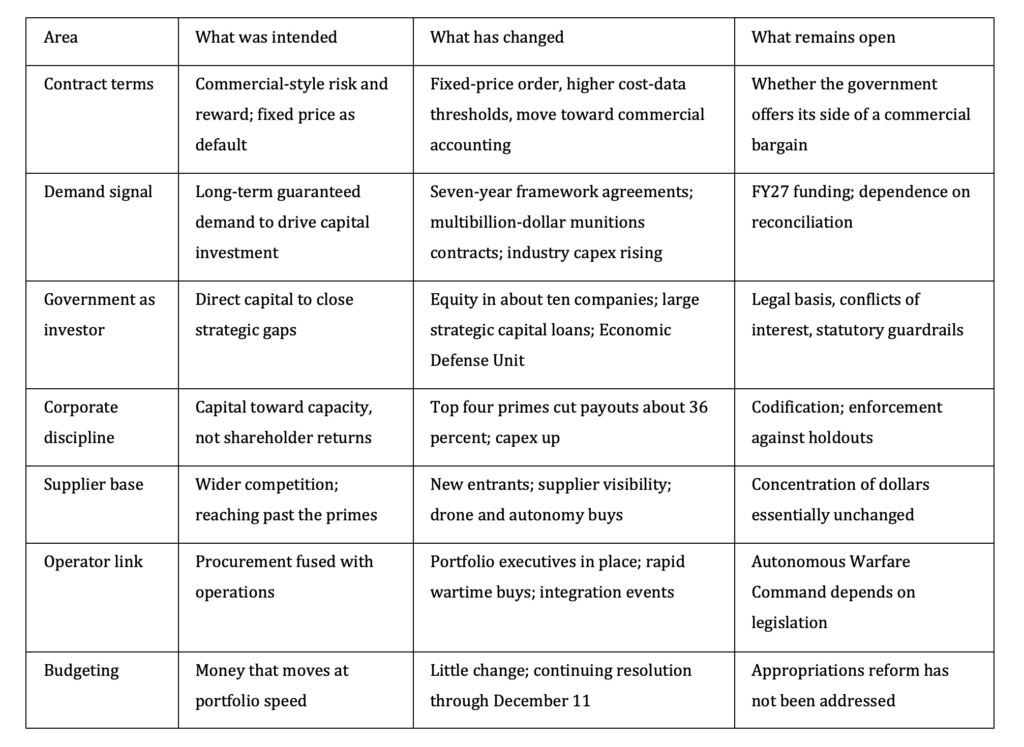
The last row matters most. AEI’s judgment is that the new portfolio structures need real budget flexibility and that without the authority to redirect funds, “acquisition management will not change as intended” (AEI). The relationship with industry has been renegotiated in its terms. The flow of money that underpins it has not.
What the New Congress Inherits
The midterms have given Democrats new leverage over the FY27 bill. The House passed its FY27 NDAA in July by 216 to 212, while the Senate bill has not passed and the issue has been pushed into the lame-duck session (ndaa.ai). The department is operating under a continuing resolution through December 11 (CSIS).
That puts several questions in front of the new committees:
- Funding the demand signal. Will Congress fund the framework agreements through base appropriations if reconciliation falls short, and if not, which lines are protected first?
- Equity authority. Should the department hold equity at all, and if so, under what statute, with what caps, and with what separation between the officials who invest and those who negotiate contracts?
- Codifying contractor discipline. Should the buyback restrictions become law, and how can they be calibrated so they do not discourage the private investment the department is also courting?
- Measuring results. Where are the portfolio scorecards and the quarterly industrial base metrics the department has promised, and will Congress require them to be published?
- Budget flexibility. Will Congress give portfolio executives the authority to move money among programs, or will portfolio management remain organizational rather than financial?
- Concentration and competition. If the dollars stay concentrated in the largest primes, what evidence would show that the new-entrant tier is becoming a source of production at scale rather than prototypes?
- The operator link. What does Congress need to see before legislating the Autonomous Warfare Command and its “service-like” acquisition authorities?
Conclusion
Two years on, the ambition is clear and much of the architecture is in place. The administration has moved from treating industry mainly as a regulated vendor to treating it as a partner that is expected to invest, is disciplined when it does not, and is in some cases partly owned by the government. That is a real change in the relationship between acquisition and the industrial base, not a rebranding.
But a relationship is defined by what each side can count on over time. Industry is being asked to invest ahead of contracts, carry fixed-price risk, and hold back shareholder returns on the strength of seven-year demand signals. Those signals are only as durable as the appropriations behind them, and the appropriations now depend on a Congress with different priorities. The administration has redrawn the terms of the bargain. Whether those terms last depend on whether the money system, and the new Congress, decide to honor them.