The Monroe Doctrine’s Convenient Amnesia: Historical Reality versus Contemporary Rhetoric

The recent U.S. intervention in Venezuela prompted predictable invocations of the Monroe Doctrine, with policymakers and commentators framing American action as consistent with nearly two centuries of hemispheric policy.
Yet this rhetorical convenience obscures fundamental historical realities that challenge the doctrine’s mythologized status. When President James Monroe announced his famous doctrine in December 1823, he was not describing the Western Hemisphere as it existed, but articulating an aspiration that would take decades arguably a century to approximate reality. The gap between the Monroe Doctrine’s rhetorical claims and the actual distribution of power and influence in 19th-century Latin America reveals much about how historical narratives serve contemporary strategic purposes while obscuring inconvenient truths.
Understanding this gap matters not merely as historical pedantry, but as essential context for evaluating contemporary policy. When decision-makers invoke the Monroe Doctrine to justify intervention, they implicitly claim continuity with a tradition that never quite existed as advertised. The doctrine’s actual history marked by European economic dominance, British naval enforcement, and American incapacity tells a different story than the one typically deployed in policy debates.
The Doctrine’s Aspirational Character
Monroe’s 1823 message to Congress declared that the American continents “are henceforth not to be considered as subjects for future colonization by any European powers” and that any attempt by European powers to extend their political system to the Western Hemisphere would be viewed as “dangerous to our peace and safety.” This bold pronouncement suggested American power sufficient to exclude European influence from an entire hemisphere. The reality was starkly different.
The doctrine had in fact been foreseen by Thomas Jefferson after his retirement to Monticello. He had enjoyed the company of Abbe Correa da Serra, who in 1817 was nominated to be the minister plenipotentiary from what was then the Brazilian based Portuguese empire based in Rio de Janeiro (the Portuguese court had left for Brazil in the face of Napoleonic invasion in 1807). Correa da Serra had arrived in the United States in 1812, the year of the British capture of the new federal capital and the burning of the White House. He had letters of presentation from some of the leading figures of the European enlightenment, including his friend Sir Joseph Banks, the Marquis of Lafayette, Pierre Samuel du Pont, Alexander von Humboldt and Joel Barlow, the American envoy in Paris. He was to spend the summers at Monticello between 1813 and 1818 as Jefferson’s guest.
While he was at Monticello the two men discussed the American diplomatic options after the war of 1812.They foresaw an alliance between Brazil and the United States which would be totally separate from Europe and its “eternal wars” and the American and Brazilian navies would partition the ocean between the hemispheres.and “the lion and the lamb within our regions shall lie down together in peace”
The fact was, however, that the United States in 1823 possessed neither the naval power to enforce Monroe’s principles nor the economic strength to displace European commercial dominance. The U.S. Navy consisted of a handful of frigates and smaller vessels, utterly incapable of contesting European naval power across the vast expanses of the Atlantic and Caribbean. Britain’s Royal Navy, by contrast, dominated global sea lanes with overwhelming superiority. Any European power contemplating intervention in Latin America would face British naval opposition long before encountering American resistance.
In March 1823, in the year of the Monroe Declaration, in fact, Lord Thomas Cochran, had taken command of the new Brazilian Navy as “The First Admiral”. Between 1818 and 1822, Lord Cochran had commanded the new Chilean Navy. In his Chilean command he had helped assure the independence of Chile His naval exploits also aided the independence movement in Peru. In his Brazilian command and he guaranteed the expulsion of the remaining Portuguese forces from the northeast, thereby guaranteeing the territorial unity of the new Brazilian empire. Lord Cochran was the Scottish “Sea Wolf” of the Napoleonic Wars, known for his daring subterfuges and improbable victory in naval combat. He was in South America as a freelancer having been expelled from the Royal Navy as the result of a Stock Market scandal. Yet in 1832 he was reinstated, and in 1847 he was made a knight of the Order of the Bath by Queen Victoria, and between 1848 and 1851, he was the Commander-in-Chief of the North America and West Indies Station of the Royal Navy. A man of both the “formal” and the “informal” British empire. And also the model for C. S. Forester’s, Horatio Hornblower.
This fundamental power asymmetry meant that the Monroe Doctrine worked not because the United States could enforce it, but because British strategic interests aligned with preventing European re-colonization of Latin America. Foreign Secretary George Canning had proposed a joint Anglo-American declaration against European intervention in Latin America, which Monroe’s advisers rejected in favor of a unilateral American statement. Yet Britain’s actual policy, opposing European intervention while maximizing British commercial advantage, provided the real enforcement mechanism for Monroe’s principles.
Britain’s Informal Empire
Nowhere was the gap between Doctrine rhetoric and hemispheric reality more evident than in Brazil. Britain found out the hard way that territorial conquest of South America was a forlorn task. The British had seized the Dutch colony on South Africa’s Cape of Good Hope in 1805 to protect the sea route to India and the Dutch had surrendered in 1806. Admiral Home Popoham had persuaded (on behalf of the East India Company) General Baird to lend him troops for an attack on Buenos Aires.
The invasion failed and Admiral Home Popham was court martialed for exceeding his orders. In 1807 a second invasion of Buenos Aires took place under the command of General John Whitlock. The British lost 70 officers and 1000 other ranks and Whitelock was forced to sign an armistice. He was also court marshaled and cashiered. But the fact the Buenos Aires residents had received little support from Spain encouraged the formation of a powerful movement for independence. In Brazil the situation was different. The Portuguese court was there in 1808 and Rio de Janeiro was the de facto seat of the Portuguese monarchy and of the Portuguese empire.
In November 1822, George Canning told the British cabinet: “To refuse to recognize Brazil [as an Independent nation] would not be, as has hitherto been the case of the Spanish colonies, an act merely negative. For we have with Brazil established relations, regulated commercial intercourse, and agencies if not actually political affording channels of political correspondence. We cannot withdraw our consuls from Brazil. It is obvious we must continue to cultivate relations of that country.”
Following Brazilian independence Britain rapidly established what historians Ronald Robinson and Jack Gallagher termed “informal empire” or economic and financial dominance without formal colonial administration. British merchants financed the coffee trade that drove the Brazilian economy. British banks financed infrastructure development and government operations. British manufactured goods flooded Brazilian markets, while Brazilian raw materials flowed to British factories and ports.
This economic penetration gave Britain influence over Brazilian policy comparable to formal colonial control, yet it violated no principle of the Monroe Doctrine. Monroe had specified that the doctrine did not challenge “existing colonies or dependencies of any European power,” and Britain maintained its Caribbean and South American possessions. More significantly, the Doctrine’s focus on political systems and colonization said nothing about economic dominance. Britain had discovered or rather, was pioneering a model of influence that required no territorial acquisition and thus escaped the Doctrine’s nominal constraints.
The British-Brazilian relationship illustrated broader patterns throughout Latin America. British capital financed mining operations in Mexico and Chile. British steamship lines connected Latin American ports to global markets. British insurance companies underwrote regional commerce. British diplomatic pressure supported friendly governments and opposed unfriendly ones. This web of economic, financial, and diplomatic influence constituted a form of hegemony more subtle but no less effective than formal colonization.
Argentina provides another compelling example. British investment in Argentine railroads, ports, and utilities gave Britain enormous influence over Argentine development. The phrase “the sixth province of Britain” reflected Argentina’s economic integration with British imperial interests. Yet this relationship developed precisely during the period when the Monroe Doctrine supposedly excluded European influence from the Western Hemisphere.
Other European Powers and Persistent Influence
Britain was hardly alone in maintaining a significant Latin American presence throughout the 19th century. Spain retained Cuba and Puerto Rico until 1898, controlling strategic Caribbean positions and maintaining military garrisons within the hemisphere for seventy-five years after Monroe’s declaration. France attempted to install the Austrian arch duke Maximilian as Emperor of Mexico in the 1860s, a direct challenge to Monroe Doctrine principles that the United States lacked power to prevent during the Civil War. Only after the war’s conclusion did American diplomatic pressure, combined with French domestic political changes, lead to French withdrawal.
The Netherlands held Caribbean territories. Denmark controlled the Danish West Indies (later purchased by the United States as the Virgin Islands). Even Portugal, through its continuing sovereignty over Brazil until 1822, demonstrated that European powers could maintain American possessions despite Monroe’s proclamation.
These persistent European positions reflected realistic assessments of American power. European governments understood that Monroe’s rhetoric exceeded American capacity for enforcement. They calculated correctly that the United States could not prevent European actions in Latin America unless those actions threatened immediate American security interests or conflicted with British policy.
The Economic Dimension
Perhaps the most significant gap between Monroe Doctrine rhetoric and reality involved economic influence. The Doctrine addressed political systems and colonization but said nothing explicit about commerce, finance, or economic penetration. This omission was not accidental for American leaders recognized their inability to compete economically with European powers in Latin American markets.
British manufactured goods dominated Latin American commerce throughout the 19th century. European banks financed Latin American governments and infrastructure projects. European merchant houses controlled import-export trade. European technical expertise built railroads, ports, and telegraphs. This economic infrastructure gave European powers influence over Latin American development that political or military intervention might not have achieved.
The United States gradually increased its economic presence in Latin America during the late 19th century, but European economic dominance persisted well into the 20th century. American capital concentrated in particular sectors, mining, petroleum, tropical agriculture, rather than displacing European influence across the economic spectrum. Only after World War I, when European powers exhausted themselves in mutual destruction, did American economic hegemony in Latin America become reality.
Naval Power and Enforcement
The Monroe Doctrine’s dependence on British naval power for enforcement represents perhaps the most profound gap between rhetoric and reality. American naval weakness in the 1820s through 1880s meant that any European power with serious intent could project force into the Western Hemisphere without immediate American opposition.
Britain’s Royal Navy provided the actual deterrent to European intervention. British strategic interests opposed French or Spanish restoration in Latin America, Russian expansion beyond Alaska, or significant European military presence in the Caribbean. These British interests aligned with Monroe Doctrine principles, creating the illusion that American policy excluded European influence. In reality, British power enforced British interests, which happened to correlate with American preferences.
This dependence on British enforcement created an awkward reality that Monroe Doctrine advocates rarely acknowledged. The United States proclaimed hemispheric principles it could not enforce, relying on a European great power to prevent other European powers from actions the Doctrine notionally prohibited. The situation resembled a weak neighbor declaring his street off-limits to outsiders while depending on a powerful friend to actually keep outsiders away.
American naval capacity increased substantially during the late 19th century, particularly after the Spanish-American War demonstrated American ability to project power in the Caribbean. Yet even this expansion reflected technological and industrial development more than conscious implementation of Monroe Doctrine principles. By the time the United States possessed naval power sufficient to enforce hemispheric exclusion, the doctrine’s relevance had evolved considerably.
Contemporary Invocations and Historical Amnesia
Modern invocations of the Monroe Doctrine, including recent Venezuela rhetoric, typically ignore these historical complexities. Contemporary policy statements present the Doctrine as establishing American hemispheric primacy from 1823 onward, creating a tradition of excluding external powers from Western Hemisphere affairs. This narrative serves useful policy purposes for it wraps intervention in historical legitimacy and presents American action as defending established principle rather than exercising raw power.
Yet this narrative fundamentally misrepresents 19th-century realities. The Monroe Doctrine did not create American hemispheric dominance in 1823. It announced an aspiration that required a century of American power development, European relative decline, and British strategic alignment to approximate reality. Invoking the Doctrine to justify contemporary action implies continuity with a past that never quite existed as advertised.
This historical amnesia matters for several reasons. First, it obscures how American hemispheric influence actually developed which was through economic penetration, naval buildup, and exploitation of European conflicts, not through declaration of principle. Second, it misrepresents the relationship between power and policy, suggesting that declaratory statements create strategic reality rather than reflecting underlying power distributions. Third, it ignores how 19th-century Latin American states navigated between competing foreign influences, presenting them as passive objects of American policy rather than active strategic actors.
Lessons for Contemporary Strategy
Understanding the gap between Monroe Doctrine rhetoric and historical reality offers several insights for contemporary strategy. Most fundamentally, it demonstrates that declaratory policy succeeds only when backed by adequate power and when major competitors find compliance compatible with their interests. Monroe’s declaration worked because Britain’s interests aligned with its principles and because European powers lacked sufficient interest in Latin American intervention to challenge British opposition.
Contemporary assertions of hemispheric primacy face different strategic circumstances. Potential competitors, China most notably, possess economic resources exceeding 19th-century European powers, while American relative power has declined from Cold War peaks. Latin American states possess far greater autonomy and agency than newly independent 19th-century republics. The economic integration and institutional frameworks that connect Latin America to global markets reduce American ability to exclude competitors through declaratory policy.
This suggests that Monroe Doctrine invocations may represent rhetorical convenience rather than strategic analysis. If the Doctrine’s historical success depended on British enforcement and European disinterest rather than American power, contemporary invocations should acknowledge how radically different current circumstances are from 19th-century conditions.
Conclusion
The gap between Monroe Doctrine rhetoric and 19th-century hemispheric reality challenges comfortable narratives about American hemispheric primacy. When Monroe announced his doctrine in 1823, Britain dominated Latin American commerce, European powers held Caribbean possessions, and the United States lacked capacity to enforce hemispheric exclusion. The Doctrine worked not through American power but through British strategic interests and European disinclination to challenge British naval supremacy.
This historical reality complicates contemporary invocations of the Monroe Doctrine. Modern policy statements that present the Doctrine as establishing nearly two centuries of American hemispheric dominance engage in convenient amnesia about actual 19th-century power distributions. Britain’s informal empire in Brazil and throughout Latin America, persistent European colonial possessions, and American dependence on British naval enforcement reveal a far more complex picture than heroic narratives suggest.
Understanding this complexity matters for contemporary strategy. It suggests that declaratory policy succeeds only when backed by adequate power and compatible with major competitors’ interests, conditions that may not apply to contemporary hemispheric challenges. It reveals how economic and financial influence can achieve objectives that military power cannot, a lesson particularly relevant given Chinese economic engagement in Latin America. Most fundamentally, it demonstrates that historical mythology serves current policy preferences but may obscure strategic realities that decision-makers ignore at their peril.
The Monroe Doctrine’s enduring appeal lies partly in its simplicity, a clear principle, boldly stated, apparently governing American hemispheric policy for nearly two centuries.
Yet this simplicity misleads. The Doctrine’s actual history involves British enforcement, European economic dominance, and gradual American power accumulation across decades. Contemporary policy benefits from acknowledging this complex history rather than invoking convenient mythology.
As General Patton observed, “if everyone is thinking alike, someone isn’t thinking.” Questioning comfortable narratives about the Monroe Doctrine represents the kind of contrarian analysis essential for understanding strategic realities rather than repeating comforting myths.
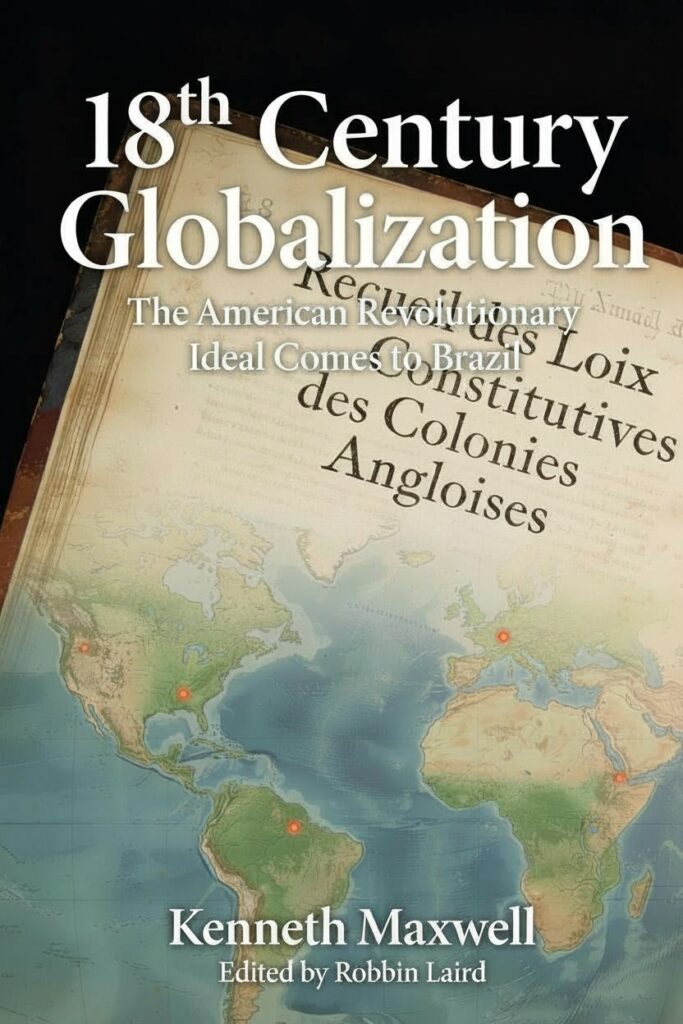
Note; Professor Maxwell’s forthcoming book focuses on 18th century globalization and the spread of revolutionary ideals and will appear next month.