
Assault Support Transformation: A Discussion with MAG-16 Commanders

Marine Aircraft Group 16 commanders, gathered during exercise Steel Knight at Marine Corps Air Station Miramar, offered insights into how assault support aviation is adapting to contested environments and distributed operations. Their collective observations reveal both the remarkable evolution of Marine Corps aviation capabilities and the substantial challenges that lie ahead.
Marine Aircraft Group 16 serves as the Marine Corps’ premier assault support organization, providing the MAGTF commander with the ability to move combat troops and supplies day or night, in all weather conditions, across the full range of military operations. This mission is enabled by four MV-22B squadrons and four CH-53E squadrons, supported by an aviation logistics squadron that maintains and supplies these critical platforms.
Col Nate Storm, the group commander and a veteran CH-53E pilot who previously commanded HMH-462, explained that while MAG-16 headquarters was not directly involved in Steel Knight as a headquarters element, several squadrons were actively providing assault support for the exercise. This participation reflected the ongoing refinement of concepts that have been developing since the Commandant’s planning guidance redirected the Marine Corps toward naval integration and distributed operations.
Evolution Since the Force Design Shift
The transformation of assault support aviation has accelerated dramatically since 2018, when the focus shifted toward major power competition. One commander traced this evolution back to the Commandant’s guidance emphasizing a return to “soldiers from the sea” and renewed naval integration. After twenty years operating in the deserts of Iraq and Afghanistan, Marine aviation is now refocusing on littoral operations.
“The biggest change that we’re seeing right now is what we’re trying to execute during Steel Knight — distributed air operations,” one senior officer explained. “The focus of individual squadrons and bigger exercises like this are specifically focused on that ability to provide the ground combat element its ability to move around the battle space in a distributed function.”
This shift represents more than tactical adjustment. It reflects fundamental rethinking of how assault support platforms operate across extended ranges in contested environments where traditional support structures may not be available or may become targets themselves.
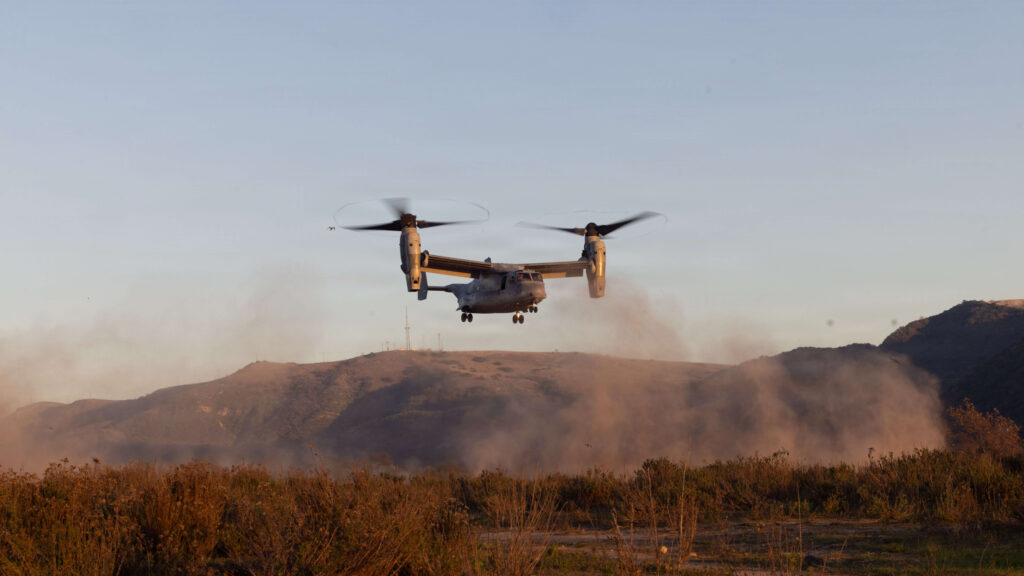
The V-22 Contribution
The Osprey’s integration into Marine aviation provides perhaps the clearest example of how platforms have outpaced conceptual thinking. One commander who attended Weapons and Tactics Instructor course in 2008, part of only the second WTI class where V-22 students participated as actual class members rather than just support, recalled the intense learning process.
“Every time we would get done with an event, the instructors would be back writing notes, because they were still trying to figure out how we were going to employ that aircraft,” he remembered. “It was already pretty apparent that it wasn’t a replacement for the CH-46, like it had been bandied about. It’s not. It has so much different capabilities. If you’re just going to say that it’s going to be a replacement for a CH-46, you’re missing the point.”
Nearly twenty years later, that assessment has proven prophetic. The V-22 performs a vastly expanded mission set, traveling significantly farther and faster than its predecessor. As one commander noted, the aircraft’s capabilities enable operations that simply would not have been possible with the CH-46.
However, this capability expansion brings its own challenges. Demand for V-22 capabilities continues growing across the fleet, with new missions emerging regularly. The recent addition of sonobuoy deployment capability and the potential for deploying torpedoes from V-22s demonstrates how the platform continues finding new roles.
One significant development which I introduced into the conversation was the nacelle improvement program, which has been reported to exceed expectations in terms of readiness improvements and maintenance reduction. Reportedly, the Air Force has seen a dramatic reduction in maintenance burden translates directly to increased readiness and the ability to redirect maintenance hours toward improving other aspects of aircraft capability. Applied to the Marines would mean more birds available to the operational commanders.
Ranges, Refueling and the Reality of Distributed Operations
Multiple commanders emphasized that modern assault support operations increasingly occur at ranges that exceed traditional close air support capabilities. V-22s and CH-53s routinely operate beyond where rotary-wing escorts can follow, pushing into areas where establishing forward arming and refueling points for escort aircraft would compromise operational security.
“We’re continually working at longer ranges than we have in the past,” one officer explained. “Part of that’s driven by distributed aviation operations, part of it’s just the nature of the threat. What we’re seeing is a trend more towards disaggregated units, where the ground force might be part of the stand-in force, but the aviation is going to be separated.”
This separation creates new integration requirements between strike and assault support communities. Rather than sequential operations — strike one day, assault two days later — current planning emphasizes synchronized operations where strike packages set conditions for assault packages in rapid succession, followed by planned retrograde operations.
The tyranny of distance creates another persistent challenge: aerial refueling. One relatively new squadron commander described a mission flying to the Philippines where his aircraft came within 500 pounds of a mandatory plug-in with the tanker.
“It’s a little unnerving launching, knowing that your tanker may or may not show up,” he admitted. “I don’t know if we train to that as much as we would like to.”
The concern extends beyond simply whether tankers will be available. In contested environments, tanker support becomes even more problematic. KC-130s may be tasked with other missions, and Air Force tankers operating from second island chain locations may have their own priorities. For assault support aircraft operating at extreme range, failed tanker rendezvous could prove problematic.
I introduced the notion that one interesting technological development being worked by industry is autonomous air systems to provide for tanking support.
The Distributed Operations Reality Check
The electromagnetic signature problem presents a significant challenge. Current systems used for communication and coordination emit powerful electromagnetic signatures that work well in exercises and permissive environments but would prove disastrous in contested operations.
The challenge of being able to operate in electromagnetic silence (EMCON) is a significant one and the Marines and the joint force are working this challenge very hard.
Every commander emphasized that distributed operations require accompanying maintenance packages. The question isn’t whether to send maintainers forward, that’s essential, but rather determining the right size and structure of maintenance detachments and, critically, which spare parts to pack.
“We’ve cracked the nut on the people, the size and structure of the types of people that go with it,” one officer assessed. “I don’t think we’ve totally cracked the nut yet on the parts pack-up.”
The complexity of modern aircraft makes predicting required spare parts extremely difficult. Even sophisticated platforms like the F-35, which feature advanced diagnostics, still require manual verification of fault indications. The tolerance thresholds in current systems aren’t refined enough to provide absolute confidence that reported faults are genuine.
The challenge becomes more acute when forward deployed. Units essentially gamble on having the right components. If they guessed wrong, aircraft remain grounded until parts arrive – if they can arrive at all in contested environments.
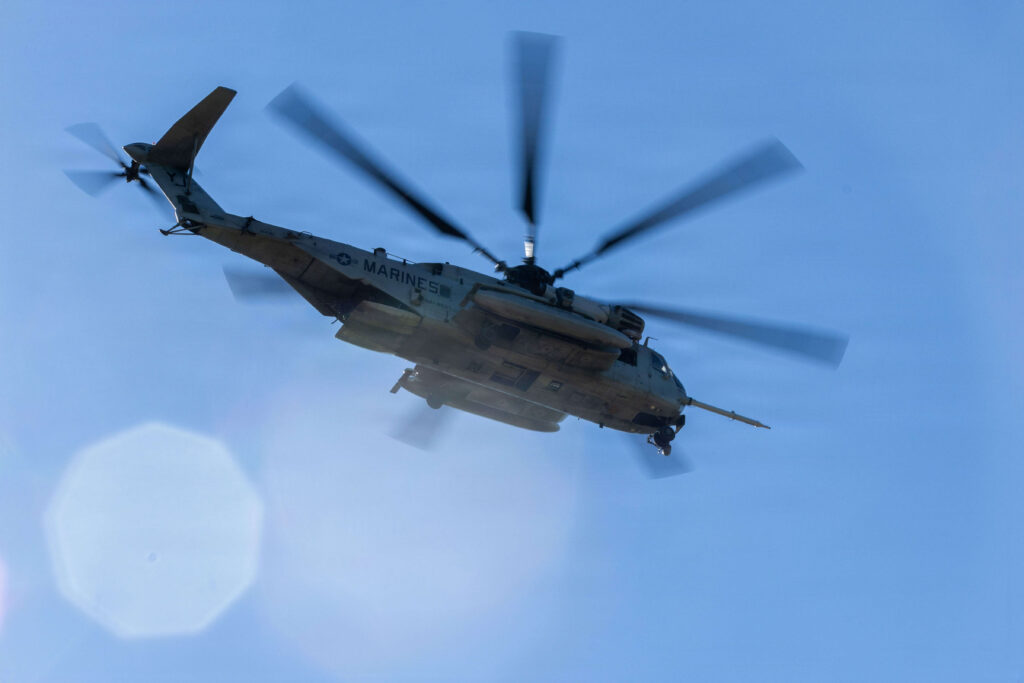
Predictive Maintenance: Promise and Problems
The CH-53K represents a potential solution with its advanced predictive maintenance capabilities. As one commander explained, the ability to know when aircraft will require specific maintenance and plan accordingly could transform distributed operations.
“If you’re in distributed aviation operations with targeting cycles, if you can say ‘I know when this aircraft is going to need to have a certain thing, or how much life I’ve got on a particular component,’ and I can actually schedule when that aircraft can be down, have the parts and the maintainers routed to that location, affect the maintenance, and move on and that’s where the money is going to be made,” he said.
However, even with predictive maintenance, challenges remain. The Navy’s supply system hasn’t matured sufficiently to exploit predictive maintenance capabilities fully. Parts availability remains a persistent problem across the service.
Additive Manufacturing: The Long Road Ahead
One officer with extensive experience in advanced manufacturing offered sobering assessment of 3D printing’s current limitations for aviation maintenance. While additive manufacturing shows promise, significant hurdles remain.Parts produced through additive manufacturing must meet or exceed original equipment manufacturer specifications, but obtaining the proprietary technical data necessary to produce them remains difficult. The timeline from requesting approval to produce a part until it’s ready ranges from eight to eighteen months.
Currently, additive manufacturing works better for ground combat elements with less stringent quality requirements. For aviation, until program offices mandate additive manufacturing for specific parts from the outset, adoption will proceed slowly.
Forward Positioning and the Competitive Operational Space
One operational commander recently returned from a unit deployment program to the First Marine Aircraft Wing described successful long-range operations conducted entirely in EMCON. “I think the blocking and tackling of assault support largely stays the same,” he reflected. “But we’re looking into ways to extend the legs, because back when I was growing up as a pilot, we were not prioritizing aerial refueling or the long-range capabilities of the platform. We were very OEF/OIF-centric.”
The experience highlighted both possibilities and limitations. Forward-leaning operations during competition phase before actual conflict allow positioning of logistics and support. The hub-spoke-node concept embraced by most Marine expeditionary units aims to create common operational pictures for logistics while pre-positioning supplies at multiple Global Prepositioning Network sites.
Multiple commanders stressed the growing importance of integration with strike aviation. Traditional assault support often relied on rotary-wing escorts, but future operations will increasingly require fixed-wing support.
This integration extends beyond simple escort to comprehensive packages where strike and assault support elements work in carefully coordinated sequences. Weapons and Tactics Instructor courses now emphasize these integrated evolutions, with strike packages setting conditions immediately before assault packages execute their missions.
A recurring theme throughout the discussion was the requirement to remain below enemy targeting thresholds while maintaining lethality. This proves particularly critical in the Indo-Pacific theater where peer adversaries possess sophisticated sensor networks and long-range strike capabilities.
The Logistics Pacing Function
While concepts drive headlines, logistics ultimately determines what’s operationally feasible. Multiple commanders emphasized this point with varying degrees of bluntness.The group’s focus on hub-spoke-node operations reflects recognition that pure disaggregation becomes unsustainable. Some consolidation of support proves necessary, but determining the right balance between disaggregation for survivability and consolidation for efficiency remains an ongoing challenge.
The emerging operational concept emphasizes short-duration forward deployments rather than sustained presence. This approach minimizes exposure while maximizing impact.
“I think it’s more lucrative for us to be very short term, short duration,” one squadron commander explained. “Practicing like that – you’re going to get there with whatever flight of four or five or six V-22s on day one and maybe day two. Day three is the CH-53 logistical support. What do you do if it doesn’t get there? I think we need to be doing more of that type of training operation.”
The Path Forward
Throughout the discussion, several themes emerged consistently.
- First, platforms, particularly the V-22, have capabilities that exceed current employment concepts.
- Second, distributed operations remain immature conceptually and especially in execution.
- Third, logistics and maintenance for distributed operations require fundamental rethinking.
- Fourth, integration between strike and assault support must continue deepening.
Yet capability without sustainable support structures and realistic command and control proves of limited utility. As these commanders make clear, assault support transformation requires more than acquiring better platforms. It demands new thinking about how to sustain, command, and employ those platforms in environments fundamentally different from those of the past two decades.
The conversations at MAG-16 during Steel Knight revealed professionals grappling honestly with these challenges. Their insights, grounded in operational experience and focused on practical execution rather than conceptual purity, provide essential perspective on where Marine assault support aviation stands and where it must go to remain relevant in an increasingly contested future.
Participants in the Discussion:
• Col Nate Storm, MAG-16 Commander
• LtCol Brian Spillane, HMH-462
• LtCol Michael Drozd, HMH-465
• LtCol Allen Whitlow, VMM-161
• LtCol Ryan O. Martin MALS-16
• Lt. Col. Justin K. Sing, MAG-16 Executive Officer
Ed Timperlake and I interviewed Lt Col Sing earlier when he was at MAWTS-1 and that interview can be found in our coauthored book on MAWTS-1.