
Guam and the Marianas: Engineering Resilience Through Security Webs, Deterrence Webs, and Kill Webs
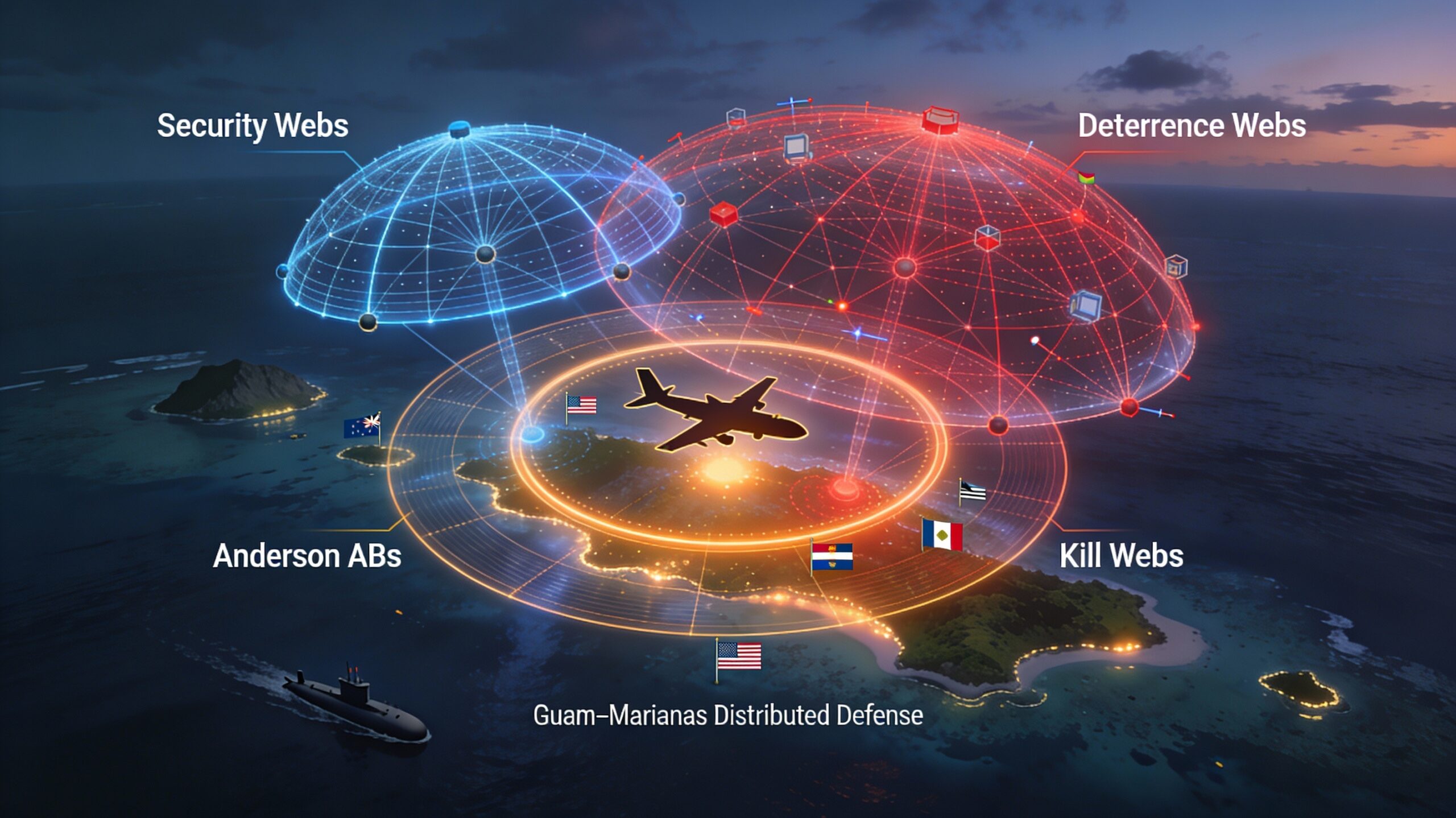
Guam’s transformation from vulnerable forward base to distributed network hub represents a shift in defense thinking and capability.
The Guam story matters because it demonstrates how strategic geography intersects with military transformation when practitioners lead institutional change. For those of us who have tracked Pacific force posture from Cold War triangular relationships through post-9/11 counterinsurgency reorientation to contemporary strategic competition preparation, Guam’s evolution reveals what happens when legacy basing models collide with precision-strike realities and operational necessity forces adaptation.
More importantly, Guam provides a concrete case study for understanding how security webs, deterrence webs, and kill webs function not as abstract strategic frameworks but as integrated operational architectures that shape what forces can actually do under stress. These are not simply conceptual categories. They represent distinct but interconnected layers of military capability that together determine whether distributed operations remain theoretical exercises or become operational reality.
From Strategic Triangle to Distributed Architecture: What Changed and Why
Historically, Guam anchored one vertex of a strategic triangle with Hawaii and Japan, a Cold War construct emphasizing power projection from fixed nodes across the Pacific. This framework expanded to include Australia and South Korea, creating a quadrangle that shaped post-Cold War planning assumptions about forward presence and crisis response.
The model worked adequately when adversary precision-strike capabilities remained limited and when sustained combat operations meant months of buildup time and predictable force flows from CONUS through staging bases to forward theaters.
What broke this model was not simply Chinese military modernization, though the PLA Rocket Force’s intermediate-range precision-strike arsenal certainly concentrated minds, but the recognition that concentrated forces on predictable infrastructure create what military planners politely term “lucrative targets” and what operators more directly call “sitting ducks.”
When your adversary can target your main operating bases with salvos of ballistic and cruise missiles while you’re still spinning up defensive systems, you have moved beyond managing crises through deterrent signaling. You are operating in chaos where first-strike advantages and operational tempo matter more than elegant strategic frameworks.
This reality forced a fundamental rethinking of what Guam represents strategically.
Rather than serving primarily as a single launching point for crisis response, Guam now functions as an anchor node in a distributed network designed around three interlocking operational architectures: security webs that protect forces and infrastructure, deterrence webs that complicate adversary planning and impose costs on aggression, and kill webs that enable rapid, multi-vectored responses across domains. Understanding how these three layers interact on and around Guam illuminates what distributed operations actually require beyond the briefing-slide level.
Security Webs: Engineering Survivability Into Infrastructure and Operations
A security web comprises the layered defensive architecture that enables forces to survive, sustain operations, and regenerate capability under attack. This is not simply “force protection” in traditional terms. It guards at gates and perimeter fencing. Security webs represent integrated systems that span physical hardening, active defense, dispersion, redundancy, and reconstitution capacity.
For Guam, building an effective security web began with acknowledging vulnerability. The island’s 212 square miles offer limited space for dispersal, while its strategic location places it within range of Chinese intermediate-range missiles that some planners grimly labeled “Guam killers.” When your primary operating bases and logistics nodes sit exposed to precision strikes, you face a choice: accept vulnerability and hope deterrence holds, or engineer resilience through layered defenses and distributed infrastructure.
The Guam Defense System (GDS) represents the most visible element of this security web, a 360-degree integrated air and missile defense architecture featuring distributed sensors and interceptors across approximately 16 sites. But reducing GDS to “missile defense” misses its strategic function within the broader security web. The system buys time and creates uncertainty for adversary planners who must now calculate whether saturation attacks will penetrate defenses, what percentage of their strike package will reach targets, and how many follow-on strikes will be required to achieve effects.
Equally important, though less visible, are the hardening and redundancy investments that make infrastructure more resilient. Earth-covered munitions magazines protect ordnance stocks from blast effects. Distributed fuel storage reduces catastrophic loss risks. Backup power systems and redundant communications links ensure that disrupting one node does not cascade into systemic failure. These are not glamorous capabilities, but they determine whether forces can sustain operations after initial strikes or whether the security web collapses under pressure.
The integration of the Northern Mariana Islands, Saipan, Tinian, Rota, into Guam’s security web expanded operational space by more than 80 percent while adding geographic depth and dispersion options. This matters operationally because adversaries must now target multiple locations to achieve decisive effects, spreading strike assets across more aim points and reducing confidence in achieving knockout blows. From a security web perspective, the Marianas function as distributed nodes that increase system resilience through redundancy rather than concentration.
What distinguishes effective security webs from traditional defensive measures is their integration with operational concepts. Hardened infrastructure means little if forces lack the logistics depth to sustain operations or the mobility to exploit dispersion. The recent investments in port modernization, energy infrastructure upgrades, and logistics automation all serve security web functions by ensuring that protective measures enable rather than constrain operations. This reflects a maturation in thinking. Security becomes an operational enabler rather than a constraint on tactical flexibility.
Deterrence Webs: Imposing Costs and Complicating Adversary Planning
Where security webs focus on survivability, deterrence webs operate through imposing costs on aggression and creating uncertainty about outcomes. A deterrence web is not simply “having forces forward” or “showing resolve.” It is an integrated architecture of capabilities, partnerships, and operational concepts that force adversaries to confront escalation risks, alliance cohesion, and operational complexity when considering hostile action.
Guam’s deterrence web functions operate at multiple levels simultaneously. At the most direct level, the presence of strategic bombers at Andersen Air Force Base, B-52s, B-1s, and increasingly B-2s rotating through, provides visible strike capability that potential adversaries must account for in their planning. These are not simply “deterrent symbols.”
They represent actual strike capacity that can reach deep into contested theaters within hours, forcing adversary planners to address air defense, base vulnerability, and escalation dynamics.
But Guam’s deterrence web extends well beyond bomber rotations. The expansion of submarine support facilities at Naval Base Guam increases the capacity to sustain undersea operations across the Pacific, complicating adversary anti-submarine warfare and creating persistent uncertainty about where U.S. and allied submarines operate. This matters strategically because submarine operations impose continuous costs on adversary maritime operations, merchant shipping, naval movements, and logistics flows all operate under the shadow of potential interdiction.
Perhaps most significantly, Guam has become a hub for multinational exercises and allied integration, transforming from a U.S. outpost into a regional cooperation center. Cope North, Agile Reaper, and other exercises bring Japanese, Australian, and increasingly other allied forces to train in distributed operations, multi-domain integration, and coalition warfare.
This is deterrence web construction through building interoperable capabilities and demonstrating alliance cohesion. When potential adversaries observe five-nation fighter detachments operating from Guam, or allied maritime forces conducting complex integration exercises, they confront a different planning problem than simply calculating strike packages against U.S.-only forces.
The Marine Corps relocation from Okinawa to Guam adds another deterrence web dimension, ground combat capability that can deploy rapidly across the Pacific for crisis response or warfighting. While Marines on Guam cannot prevent aggression through their mere presence, their availability for expeditionary operations, particularly in support of distributed maritime operations and expeditionary advanced base operations, creates operational flexibility that complicates adversary planning. The uncertainty about where and how these forces might deploy, combined with their integration into broader joint and coalition operations, imposes planning costs that fixed defenses alone cannot generate.
What makes deterrence webs effective is not any single capability but the integrated uncertainty they create for adversary planners. When considering aggression, potential adversaries must now calculate not just whether they can strike Guam successfully but what escalatory responses might follow, how allied forces will react, where distributed U.S. capabilities might strike from, and whether achieving initial tactical success will translate into strategic advantage or strategic disaster. This operational and strategic complexity is what deterrence webs generate when properly constructed.
Kill Webs: From Platform-Centric Operations to Distributed Lethality
The kill web concept represents the most operationally significant transformation in how military forces generate combat effects. Where traditional warfare emphasized platform capabilities, how many fighters, bombers, ships, or artillery systems you fielded, kill webs focus on the network’s capacity to sense, decide, and strike across domains faster than adversaries can respond.
This is not simply “network-centric warfare” rebranded. It is a fundamental reconceptualization of how distributed nodes cooperate to overwhelm adversary decision cycles and generate effects beyond what individual platforms achieve.
For Guam and the broader Marianas, kill web architecture manifests through several interconnected capabilities.
First, sensor integration or the capacity to fuse data from space-based systems, airborne platforms, maritime sensors, and ground-based radars into coherent operational pictures that enable rapid targeting. This matters because modern operations require near-real-time understanding of where adversary forces operate, not intelligence estimates that arrive hours after events unfold. When commanders can see targets as they emerge and direct fires immediately, you have moved from sequential operations, find, fix, track, target, engage, to simultaneous operations where decision advantage matters more than platform numbers.
Second, Guam’s kill web depends on having diverse shooters distributed across domains. Bombers provide long-range strike. Submarines offer covert precision fires. Surface combatants deliver magazine depth. Ground-based systems add defensive and offensive capacity. The operational logic is redundancy and flexibility, no single shooter type becomes a single point of failure, and adversaries cannot defeat the entire system by neutralizing one capability. This distribution also creates targeting dilemmas. When adversary planners must decide which nodes to strike first, bombers, submarines, missile batteries, command centers, they confront the reality that whatever they target, other capabilities remain operational and will exact costs.
Third, and perhaps most critically, kill webs require command-and-control architectures that enable distributed decision-making rather than centralized direction. This is where artificial intelligence and machine learning become operationally relevant rather than simply technological buzzwords. When combat operations span thousands of miles and unfold in minutes, waiting for centralized approval to engage time-sensitive targets means losing decision advantage. Kill webs function through distributed authorities where shooters can engage targets within commander’s intent and rules of engagement without requesting permission for every action. This requires trust in systems, training in operational concepts, and acceptance that perfection in execution matters less than speed in decision-making.
Guam’s evolution supports kill web operations through several specific investments. The expansion of communications infrastructure and data links enables information flow across platforms and domains. The development of joint all-domain command and control (JADC2) capabilities allows different service systems to share targeting data and coordinate fires. The focus on autonomous systems, from unmanned maritime vessels to autonomous logistics delivery, adds capacity without proportionally increasing personnel requirements, allowing small numbers to generate effects previously requiring much larger forces.
What distinguishes kill webs from traditional fires coordination is the emphasis on resilience through distribution. In conventional operations, losing your command post or communications node could paralyze an entire force. Kill webs are designed so that degrading nodes reduces capability but does not create cascading failure. When individual platforms or sensors can continue operating even when higher-level networks are disrupted, you have built true operational resilience rather than fragile complexity.
How the Three Webs Integrate: Operational Reality Versus Conceptual Frameworks
Understanding security webs, deterrence webs, and kill webs as distinct concepts helps analytical clarity, but operational reality requires recognizing how they integrate and reinforce each other. Effective security webs enable forces to survive long enough to execute deterrence and strike missions. Robust deterrence webs reduce the likelihood of facing attacks that would test security measures. Capable kill webs enhance deterrence by demonstrating operational capacity and impose costs on adversaries who penetrate security measures.
Consider a specific operational scenario: an adversary contemplates striking Guam to degrade U.S. power projection capacity. The security web forces them to allocate substantial strike assets to achieve desired effects, missile defenses must be saturated, hardened facilities must be repeatedly struck, distributed capabilities across the Marianas must be targeted simultaneously. This increases operational complexity and resource requirements, imposing costs before hostilities even begin.
The deterrence web further complicates planning by introducing escalation risks and alliance dynamics. Striking Guam means attacking U.S. territory, not simply forces deployed abroad, with all the escalatory implications that carries. It means confronting allied responses from Japan, Australia, and potentially others who have forces integrated into Guam operations or whose security depends on U.S. capabilities operating from the Marianas. The uncertainty about how conflicts will escalate once initial strikes occur creates hesitation that deterrence seeks to generate.
Finally, the kill web ensures that even if security measures are penetrated and deterrence fails, adversaries will face immediate and distributed responses. Surviving bombers will strike. Submarines will engage. Distributed sensors will continue feeding targeting data. The operational consequence is that successfully striking Guam does not achieve strategic objectives. It initiates a conflict where distributed U.S. and allied capabilities continue imposing costs while the adversary must defend against counterstrikes they cannot fully predict or prevent.
This integration is what transforms Guam from a vulnerable fixed base into a resilient network node. The three web architectures collectively create chaos management capability or the capacity to continue operations under stress rather than seeking to prevent disruption through perfect defense. This represents strategic maturation. We no longer assume conflicts begin cleanly or proceed predictably. We build resilience through engineering redundancy, distributing capabilities, and accepting that operations will be messy, communications will be degraded, and initial plans will not survive contact with reality.
Allied Integration and the Regional Security Architecture
Guam’s transformation cannot be understood purely through U.S. force posture decisions. The island has become a hub for regional security cooperation, reflecting the reality that contemporary Pacific security depends on alliance networks rather than unilateral American dominance. This shift from hub-and-spoke bilateralism to networked multilateralism marks a fundamental change in how deterrence and defense operate across the Indo-Pacific.
Japan’s participation in Guam-based operations reflects its strategic recognition that defending Japan requires capabilities extending well beyond the home islands. Japanese fighters rotating through Andersen, Japanese forces participating in exercises across the Marianas, and Japanese investments in interoperability all serve mutual defense objectives while complicating adversary planning. When Japanese capabilities integrate with U.S. operations from Guam, China confronts a different strategic calculus than simply striking American forces. They must consider whether attacking Guam triggers Japanese defensive responses and whether alliance cohesion strengthens or fractures under pressure.
Australia’s increasing engagement with Guam operations similarly reflects strategic realism about Indo-Pacific security challenges. Australian forces training in distributed maritime operations from Guam and the Marianas are not simply participating in exercises. They are building operational concepts and demonstrable capabilities for how allied forces will operate together under stress. This matters for deterrence because it signals integration depth that transcends declaratory statements. When adversaries observe actual coalition operations demonstrating interoperability and operational sophistication, deterrence gains credibility that policy documents alone cannot provide.
Even Singapore’s quiet but consistent participation in Guam-area operations adds deterrence web strength. Singapore’s strategic location and advanced military capabilities make it a critical partner for distributed maritime operations, and its willingness to operate from Guam demonstrates regional consensus about security challenges and appropriate responses. For China, this regional cooperation transforms Taiwan contingency planning from a bilateral U.S.-China problem into a multilateral challenge where regional powers will shape outcomes.
The allied integration dimension also addresses a fundamental security web challenge. personnel and capability limits. The United States cannot unilaterally garrison the Pacific with sufficient forces to execute distributed operations at necessary scale. Allied contributions expand capability without proportionally increasing U.S. force structure requirements. This is not burden-sharing in traditional terms but genuine operational integration where different nations provide complementary capabilities that collectively exceed what any single nation fields.
Logistics and Sustainment: The Unglamorous Foundation of Everything That Matters
In defense transformation discussions, logistics typically appears as an afterthought, something to address after capabilities and operational concepts are defined. This reflects a fundamental misunderstanding of how modern military operations actually function. Guam’s experience demonstrates that logistics and sustainment architecture determine what forces can do more than platform capabilities or operational concepts determine operational reality.
For distributed operations to work, forces require reliable access to fuel, munitions, spare parts, maintenance capacity, and personnel support across dispersed locations. When operations span the Marianas and beyond, traditional logistics models built around large forward bases and predictable supply chains break down. You cannot rely on scheduled cargo flights when adversaries can strike airfields. You cannot depend on centralized maintenance depots when forces operate from austere locations. This forces rethinking how logistics supports operations rather than constrains them.
Guam’s logistics transformation emphasizes several key capabilities that enable distributed operations.
First, pre-positioned stocks dispersed across multiple locations ensure that disrupting one logistics node does not create catastrophic shortages.
Second, investments in port infrastructure and maritime logistics capacity recognize that distributed operations will depend heavily on sea-based sustainment when air operations face disruption.
Third, development of autonomous logistics delivery systems, unmanned maritime vessels, autonomous ground vehicles, adds capacity without proportionally increasing personnel requirements in contested environments.
The mundane details of fuel storage, munitions handling, and spare parts management determine operational tempo more than combat platform capabilities. When maintainers report that distributed operations require spare parts positioned at multiple locations rather than centralized at main bases, logistics planning must adapt. When operators recognize that fuel consumption rates in high-tempo operations exceed peacetime planning assumptions, fuel distribution architecture must expand. These are not theoretical exercises but operational necessities that emerge from practitioner experience rather than requirements documents.
What Guam’s logistics evolution demonstrates is that sustainment becomes a competitive advantage when properly architected. Forces that can sustain high operational tempo while dispersed across the Marianas gain decision advantage over adversaries who must concentrate to maintain logistics efficiency. This reflects the operational logic of kill webs and security webs, distribution imposes costs on adversaries while enabling friendly forces if logistics architecture supports dispersion rather than requiring concentration.
Civilian Dimensions and the Guam Defense Equation
Guam is home to over 170,000 American citizens whose lives intersect with defense installations, military operations, and strategic planning in ways unique among U.S. territories. This civilian presence creates both obligations and complications that military planning must address. When planners discuss distributed operations and crisis response, they are simultaneously planning for potential civilian evacuations, infrastructure protection, and continuity of civilian governance under stress. This is not an ancillary consideration but a central challenge for security web design.
The military buildup brings economic benefits, construction jobs, service economy expansion, infrastructure investments that benefit civilian and military communities. But it also brings risks that Guam’s civilian population cannot avoid. Unlike communities near CONUS military bases who face minimal direct threat from distant adversaries, Guam’s residents live within range of precision-strike systems that make the island a potential combat zone in ways that fundamentally shape daily life and long-term planning.
Environmental challenges add complexity to both military operations and civilian well-being. Construction projects necessary for distributed basing and infrastructure hardening intersect with preservation of ravine forests, watershed management, and coastal ecosystem protection.
These are not simply regulatory compliance issues but reflect genuine tensions between operational requirements and sustainable development. Finding balance requires treating environmental considerations as operational constraints that shape how capabilities develop rather than as obstacles to overcome through waivers and exceptions.
Civilian resilience planning increasingly integrates with military operations in ways that blur traditional civil-military boundaries. Evacuation planning, emergency response systems, and continuity of governance all require military support in crisis scenarios while simultaneously creating obligations that might constrain operational flexibility. This tension is unavoidable when military operations and civilian life occupy the same limited geographic space under threat from the same adversary capabilities.
What the Guam Transformation Teaches About Pacific Strategy
Guam’s evolution from vulnerable forward base to distributed network hub demonstrates several principles with relevance beyond the Marianas.
First, accepting vulnerability as a starting point rather than denying it enables realistic defense planning. When planners acknowledge that concentrated forces on predictable infrastructure cannot be perfectly defended, they can focus on building resilience through distribution and redundancy rather than pursuing perfect protection that operational reality will not support.
Second, the integration of security webs, deterrence webs, and kill webs shows that effective defense requires multiple reinforcing layers rather than single solutions. Missile defense alone does not provide security. Deterrent signaling without operational capability rings hollow. Strike capacity without survivability creates brittle force structures. The three web architectures work because they address different aspects of the operational problem while reinforcing each other’s effectiveness.
Third, allied integration proves essential rather than optional for distributed operations at necessary scale. The United States cannot unilaterally generate sufficient capability to execute the operational concepts that contemporary strategic competition demands. Allied forces operating from Guam and the Marianas are not simply political symbols of partnership. They provide actual combat capability and operational depth that expand what joint forces achieve while complicating adversary planning through multinational complexity.
Fourth, logistics architecture determines operational reality more than platform capabilities or operational concepts. Distributed operations require distributed logistics. Resilient operations require redundant sustainment. When logistics cannot support operational concepts, concepts remain theoretical regardless of how elegant their strategic logic appears. Guam’s logistics transformation demonstrates what must be built to enable distributed operations rather than simply hoped for through better efficiency or streamlined processes.
Finally, the civilian dimension of Guam’s defense transformation reminds us that military operations occur in political and social contexts that shape what is operationally feasible and strategically sustainable. Planning that ignores civilian well-being, environmental impacts, and governance continuity will generate opposition that constrains operational effectiveness regardless of military necessity arguments. Treating civilian considerations as design constraints rather than obstacles produces better outcomes for both defense missions and island communities.
From Crisis Management to Chaos Management: The Strategic Logic of Resilience
Guam’s transformation reflects a broader shift in strategic thinking that we have examined across multiple theaters and operational domains over the past decade. We are moving from crisis management approaches that seek to prevent disruption through deterrence and perfect defense toward chaos management concepts that accept disruption as inevitable and focus on building resilience that enables continued operations under stress.
This is not defeatism or acceptance of operational failure. It is strategic realism about what contemporary combat operations will actually look like when precision-strike weapons are ubiquitous, when cyber attacks disrupt communications routinely, when adversaries will strike first if they believe tactical advantage justifies strategic risk. In this environment, forces that can continue operating despite disruption gain decisive advantages over forces that require stable conditions to function effectively.
The security web, deterrence web, and kill web framework provides analytical clarity for understanding how chaos management works operationally. Security webs create survivability that enables persistence. Deterrence webs reduce the likelihood of facing maximum adversary effort while shaping how conflicts begin. Kill webs ensure that forces can impose costs on adversaries even when operating under degraded conditions. Together, these three architectures define what resilience means operationally rather than as an aspirational concept.
For practitioners and planners across the Pacific, Guam offers an existence proof that distributed operations, allied integration, and resilient logistics are achievable rather than purely theoretical. The challenges are real, funding constraints, coordination complexity, environmental impacts, civilian considerations.
But the operational imperative is equally real. Concentrated forces on predictable infrastructure will not survive initial strikes in great power conflict. Distributed, resilient, and integrated forces operating from multiple nodes across the Marianas and beyond offer a pathway to operational effectiveness that accepts chaos as the operational environment rather than an anomaly to overcome.
From Strategy to Diplomacy: Colby’s Seoul Speech and the Operationalization of Flexible Realism