Autonomy or Alignment? Canada’s Canberra Vision Tested Against Australia and Brazil
On March 5, 2026, Canada’s Prime Minister chose Canberra to deliver a confident defence of “middle powers” in a dangerous world. The speech was eloquent.
But measured against the argument we have developed in our book on Australia, Brazil, and Global China, it rests on a flawed middle-power theory and an underdeveloped understanding of the architecture of dependence that now shapes the real choices of states like Australia and Brazil. It reads as if the hard lessons of the past two decades have been absorbed only halfway.
Carney’s address offers a reassuring narrative. Australia and Canada, he insists, are “separated by an ocean and a hemisphere, but united by common values, common institutions and a common belief” in open democracies that deliver security and prosperity. He frames the post-war order as something “we helped to build”, an arrangement that kept major power war at bay, expanded trade, and lifted hundreds of millions from poverty. The problem, in his account, is not the model itself but recent shocks, financial crises, populism, authoritarian revisionism, pandemics, that have strained institutions and weakened rules.
In response, he calls on “middle powers like Australia and Canada” to act, and to act together. The tools he emphasizes are familiar: deeper defence cooperation, support for Ukraine, stronger roles in the Indo-Pacific, “friendshored” supply chains, critical minerals partnerships, and the mobilization of pension and superannuation systems as patient capital for infrastructure, green energy, and advanced manufacturing. The message is that if like-minded democracies integrate more tightly, militarily, economically, technologically, they can both defend the order and make it fairer, more resilient, and more just.
It is an attractive story. It is also exactly the kind of generic middle-power theory our book set out to test against the lived experience of Australia and Brazil.
Carney assumes that “middle powers” form a category whose members share interests simply by virtue of being squeezed between larger states. In this view, middle powers are natural coalition partners: they want rules, they want predictability, they want operating room between Washington and Beijing. Coordination is merely a matter of political will and diplomatic effort.
Our work says otherwise.
Kenneth Maxwell and I deliberately skip past the tired definitional debates in the middle-power literature to ask what Australia and Brazil actually do when confronted with Global China and a fragmenting order. What emerges is not a class of states with common interests, but two resource-rich democracies exposed in different ways to Chinese demand whose choices have diverged sharply.
Both countries rode the China boom. Both were told by Western economists and policymakers that deepening integration with the global economy would produce mutual prosperity and peace. Both opened their markets, sold their commodities, and watched Chinese demand transform their export sectors. Yet over twenty years, Australia reinforced its alliance ties and experimented however imperfectly with pushback against Chinese coercion. Brazil drifted into a pattern of structured accommodation with Beijing and Moscow.
The lesson is straightforward: “middle power” is not a reliable analytical category if it obscures the specific architectures of dependence that bind particular sectors, firms, and political coalitions far more tightly to China or to any other dominant partner than others.
Australia is the country Carney highlights, and with good reason. It is the democratic middle power that most clearly illustrates his preferred story: a state that learned from its exposure to Chinese economic leverage and decided to buttress its sovereignty by deepening ties to trusted partners.
When Beijing imposed sweeping trade restrictions on Australian barley, wine, coal, beef, copper, cotton, and lobster, Canberra did not capitulate. It sought alternative markets, relied on market flexibility, and quietly accepted some economic pain in order to maintain political autonomy. Over the same period, Australia tightened foreign investment screening, restricted sensitive technology access, and made hard choices on 5G and infrastructure. It doubled down on alliance commitments, invested in defence, and positioned itself as a key node in an emerging Indo-Pacific security architecture.
Carney’s Canberra speech fits neatly into this trajectory. He proposes more interoperable capabilities, more joint exercises, closer cooperation on intelligence and cyber, and a strong Canadian presence in the Indo-Pacific. He calls for integrated critical minerals supply chains between Canada and Australia, harmonized standards, and cross-investment by pension and superannuation funds in each other’s infrastructure, data centers, and advanced manufacturing. It is an ambitious programme to turn Australian and Canadian vulnerabilities into shared strengths.
From our standpoint, this is the more hopeful side of the story, a middle power discovering that it retains agency even inside an asymmetric relationship with a global economic power. But we have to ask whether the solution on offer is genuine strategic autonomy or simply a re-routing of dependence.
The speech’s most telling absence is Brazil. In The Wall Street Journal narrative that helped spark our book, Brazil appears as part of an imagined club of “squeezed” states that might band together with Canada, Australia, Japan, and others to escape becoming “roadkill in the new world order.”
Our research demonstrates that this club is more notional than real.
Brazil’s experience with Global China is sobering. Over two decades, it built a commodity-based dependence in which soybeans, iron ore, and crude oil destined for China became central not only to its balance of trade but to the power of politically influential sectors in Brasília. China’s role as lender, investor, and technology supplier deepened. Under President Lula, Brazil has co-authored a Ukraine “peace plan” that tracks closely with Chinese preferences, challenged the dollar’s reserve status in Beijing, reversed its initial exclusion of Huawei from critical infrastructure, and moved into alignment with Chinese and Russian positions across a range of major international questions.
These choices are often dressed in the language of “active non-alignment” or South–South solidarity. But the pattern we document is less one of equidistance between great powers and more one of structural accommodation to the interests of the principal trade and investment partner. When more than a quarter of your exports go to China, and when the domestic political winners from that relationship dominate your political economy, strategic non-alignment curdles into something else entirely.
Carney’s speech, by contrast, treats the middle-power category as if Brazil could simply choose to behave like Australia and Canada if only its leaders embraced the right narrative and the right partners. That is wishful thinking. Brazil is a reminder that middle powers can move in exactly the opposite direction toward a China-centric architecture of dependence that narrows, rather than expands, their range of strategic choices.
The central concept in our book is precisely what Carney does not fully confront: the architecture of dependence. This is not simply a matter of individual supply chains or isolated investment decisions. It is a web of commodity flows, infrastructure ownership, technology platforms, financing structures, and institutional rules that make it costly for any state to diverge from the preferences of the dominant actor.
China has pursued this architecture deliberately. Its commodity trade with Brazil and Australia, its infrastructure investments, its financing terms, and its technology exports have all been structured to increase switching costs. For Brazil, the result has been a steadily tightening weave of agricultural, energy, and infrastructure dependence. For Australia, the same architecture was partially built but then challenged when coercive tools were brought to bear.
Carney talks about economic coercion and the vulnerabilities exposed by Covid and war. He proposes “friendshored” or “de-risked” supply chains among democracies. But he never acknowledges that friendshoring can replicate the same structural asymmetries under a different flag. If Canadian pension funds and Australian superannuation funds own critical infrastructure and digital assets across an integrated bloc of democracies, we may have shifted the locus of dependence without changing its nature. Smaller states inside that bloc will still find their options constrained by the preferences of dominant capital and technology providers.
The question our book poses is not whether dependence on a democracy is morally preferable to dependence on an authoritarian state. It is whether middle powers can build real strategic autonomy, capabilities to feed themselves, fuel themselves, secure their data, and defend themselves, rather than simply accepting a new, more comfortable hierarchy.
To his credit, Carney gestured in Canberra toward a thicker notion of sovereignty. He argued that a country that cannot feed, fuel, or defend itself has few meaningful options, and he extended that list to data, digital infrastructure, critical minerals, and advanced manufacturing. This is very close to our argument that sovereignty now requires control over key nodes of value creation and information, not just territory and traditional military power.
The problem is that his proposed mechanisms for achieving that sovereignty are almost entirely financial and alliance-based: mobilize trillions in pension and superannuation assets; modernize bilateral investment and tax agreements; integrate critical minerals and clean-energy supply chains; deepen defence collaboration. It is a vision of “sovereign” autonomy built out of very large, very mobile pools of capital operating within a club of rich democracies.
From our perspective, this risks creating what might be called a “comfortable empire of dependence.” Within that club, some states Canada and Australia among them will gain insulation and leverage. But many others, including Brazil, will find themselves caught between a China-centered architecture that still dominates their trade and infrastructure and a democratic bloc whose standards and capital flows they cannot easily meet or influence.
If the test of middle-power strategy is whether it expands the range of meaningful choices available to countries like Australia and Brazil, then the Carney vision is at best incomplete. It may secure a subset of middle powers already wired into the transatlantic and Indo-Pacific alliance systems. It does little to address the structural incentives pulling Brazil and many others toward Global China.
What would a middle-power project look like if it took seriously the lessons of Australia and Brazil?
First, it would abandon the comforting assumption that middle powers naturally align. It would start from empirical realities: trade patterns, sectoral interests, domestic coalitions, and existing architectures of dependence. It would recognize that a Brazilian farmer, an Australian miner, and a Canadian pension-fund manager have very different relationships to Global China, even if their governments share democratic credentials.
Second, it would treat “friendshoring” as a means, not an end. The metric would not be the volume of cross-border capital within a democratic club, but the degree to which critical capabilities, food, energy, data, defence, and key industrial inputs, are diversified and controllable from the standpoint of the middle power itself.
Third, it would focus on building credible paths out of dependence for countries currently locked into China-centric architectures. That means designing trade, investment, and technology arrangements that help Brazil and others like it reduce single-partner exposure without demanding an immediate geopolitical realignment. It means accepting that the route to genuine autonomy will be uneven, contested, and slow.
Finally, it would speak more honestly about the trade-offs. Strategic autonomy is not free. Australia has paid a real price for resisting coercion. Brazil pays a different price for accommodation. The hardest questions for middle-power leaders are not about values which are easily invoked but about which sectors of their own economies they are prepared to restructure, and whose short-term gains they are willing to challenge, in order to escape long-term dependence.
There is, however, a more fundamental problem with Carney’s Canberra address that our framework exposes: the speaker himself is not exempt from the analysis. The critical lens we apply to Australia and Brazil, tracing architectures of dependence, measuring the gap between declared sovereignty and operational reality, asking whose domestic interests are served by accommodation, applies with equal force to Canada. The speech is delivered as if Canada stands outside the problem it diagnoses. It does not.
Canada’s relationship with China is not the arm’s-length partnership of a confident sovereign state. It is a relationship shaped by deep commodity exposure, contested investment decisions, and a domestic political economy in which agricultural, energy, and real-estate sectors have had strong structural incentives to maintain access to Chinese markets and capital. Canadian canola, pork, and seafood exports have all been subject to Chinese trade pressure used as political leverage. The Meng Wanzhou affair in which Canada enforced a U.S. extradition request while its own citizens were held hostage in Beijing revealed not Canadian strength but the acute vulnerability of a middle power caught between a dominant ally and a dominant trading partner, unable to resolve the tension on its own terms. Chinese investment in Canadian critical minerals and real estate raised national-security concerns that Ottawa was slow to address and inconsistent in enforcing. These are not peripheral episodes. They are data points in an architecture of dependence that Carney’s speech never acknowledges.
The Arctic makes the gap between rhetoric and reality starker still. Canada claims sovereignty over one of the world’s most strategically consequential territorial expanses. The Northwest Passage, the seabed beneath it, and the resource wealth of Canada’s north represent both an enormous asset and an acute vulnerability. Yet Canada’s ability to enforce that sovereignty to surveil its northern approaches, respond to intrusions, sustain a military presence, or project power across Arctic distances has been chronically underfunded and structurally neglected across successive governments of both parties. Russia operates nuclear-powered icebreakers and maintains hardened Arctic basing. China has declared itself a “near-Arctic state” and is building a polar-capable fleet while investing in Arctic shipping infrastructure across the Russian north. The United States presses Canada on sovereignty disputes along the Passage itself. Canada’s response has been a combination of assertion and delay: sovereign claims loudly declared, defence capabilities quietly deferred.
This is precisely the pattern our book identifies as the operational signature of a middle power that has not yet made the hard choices sovereignty requires. Carney told his Canberra audience that a country which cannot feed, fuel, or defend itself has few meaningful options. He is right. But Canada cannot meaningfully defend its Arctic, and has not invested to change that. NORAD modernization commitments have been repeatedly announced and repeatedly delayed. Canada’s surface fleet is aging and Arctic-capable vessels are thin on the ground. Its northern bases are sparse, its surveillance architecture inadequate for the pace of Russian and Chinese activity now underway. If Australia represents a middle power that absorbed the cost of resistance to coercive dependence, Canada has not yet decided what it is willing to pay.
Canada’s NATO defence spending record reinforces the point. For decades, Canada has been among the alliance’s most persistent underperformers against the two-percent-of-GDP benchmark, falling back on the assumption that American strategic guarantees are available without Canadian investment in the capabilities that would make those guarantees credible. That assumption is now under serious strain. The Trump administration’s explicit pressure on NATO allies to carry more of their own defence burden, combined with Washington’s posture toward Canada on trade, sovereignty, and even territorial integrity, has exposed how thin the guarantee actually is when political conditions shift. A middle power that has structured its defence around a patron’s permanent willingness to provide security has not escaped dependence. It has simply chosen a more comfortable patron.
None of this is an argument against Carney’s larger aspirations. Deeper Canada-Australia cooperation on critical minerals, defence technology, and supply-chain resilience is genuinely worth pursuing. The instinct to pool middle-power agency in a fragmenting order is sensible. But the credibility of that project depends on Canada subjecting itself to the same analytical rigor it applies to others. A middle power that arrives in Canberra to preach strategic autonomy while carrying its own unexamined architectures of dependence in commodity trade, in Arctic defence, in alliance free-riding is offering a vision, not yet a strategy.
From that standpoint, Carney’s Canberra speech is a revealing document. It shows how a leading middle-power politician wants the story told: as a tale of like-minded democracies pooling capital and capabilities to rebuild a frayed order.
Our book insists on a different frame, a world of divergent middle-power paths, shaped by architectures of dependence that cannot be wished away by rhetoric, however polished, delivered on the floor of a friendly parliament.
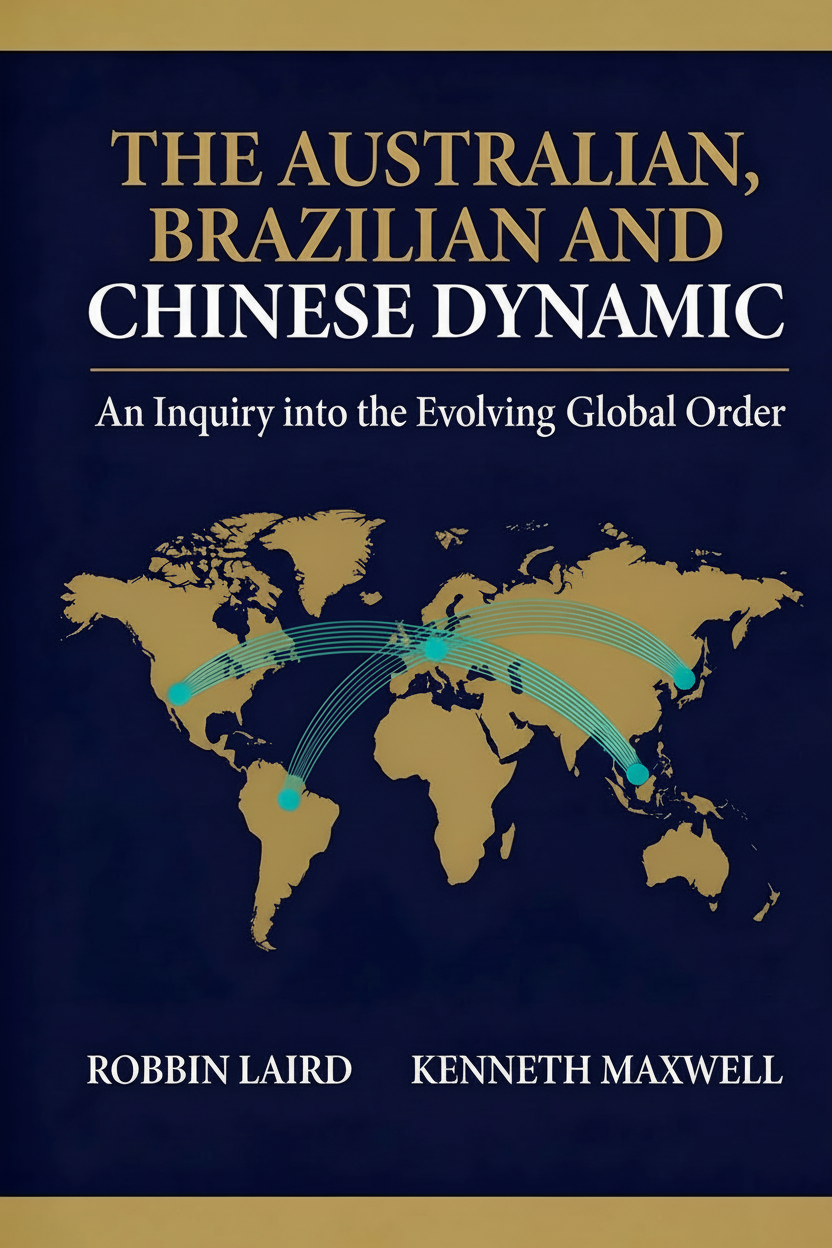
Note: We are publishing our book on Global China and middle powers later this year.