
Lessons from the Drone Wars: Maritime Autonomous Systems and Maritime Operations
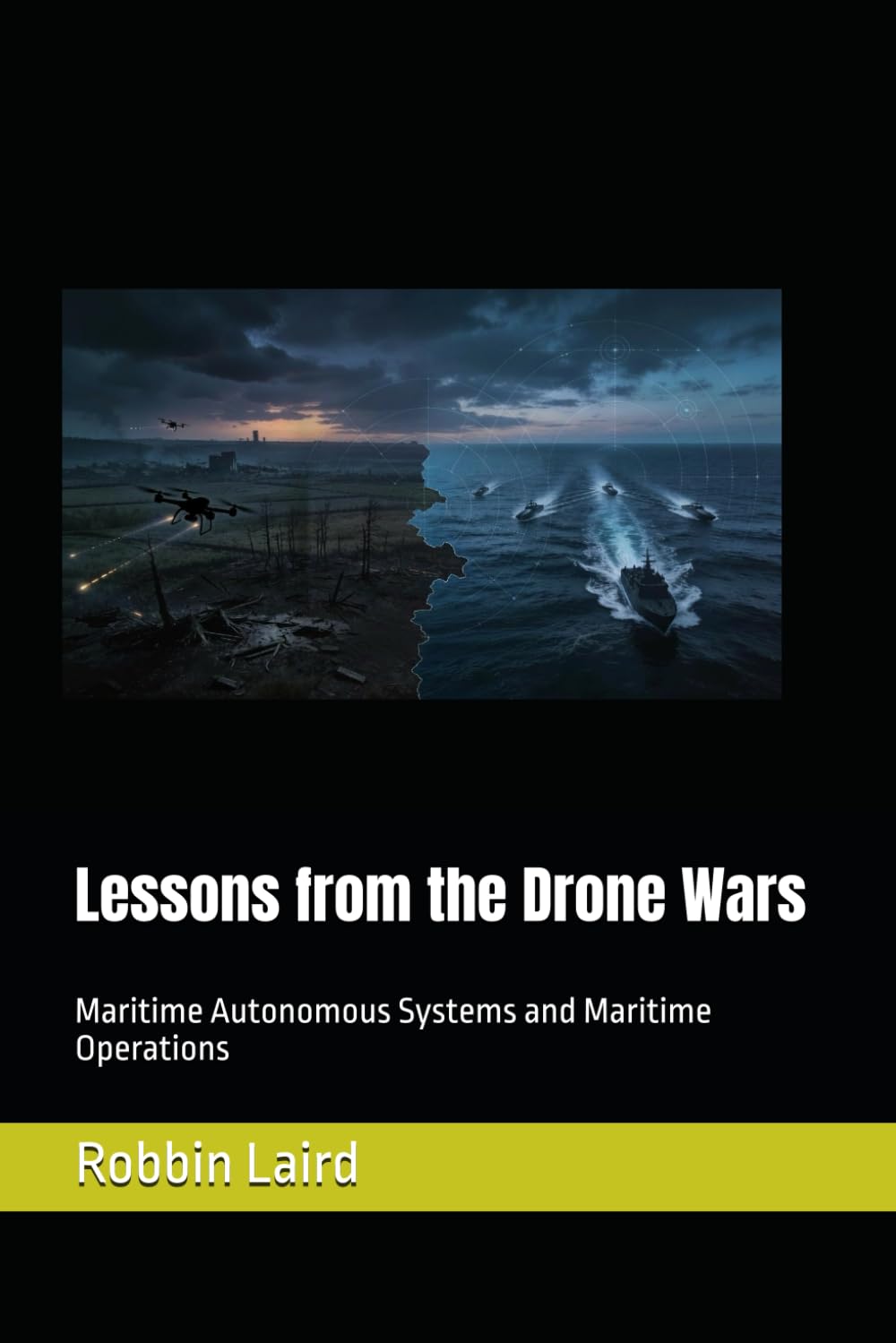
The battlefield has been transformed. Not gradually, not theoretically, but demonstrably, operationally, and at a pace that has outrun the institutional frameworks most Western defense establishments rely upon.
My new book, Lessons from the Drone Wars: Maritime Autonomous Systems and Maritime Operations, is an effort to capture what this transformation means in practice, for naval strategy, for allied force design, and for those responsible for making consequential decisions in an era of persistent disorder.
For four decades I have studied how majro powers build, deploy, and adapt military force. I have interviewed operators, commanders, engineers, and strategists from Washington to Canberra, from Helsinki to Tokyo. What I am witnessing now is qualitatively different from any previous inflection point in my career. The conflicts in Ukraine, the Red Sea, and the broader Indo-Pacific littorals are not simply testing new weapons. They are stress-testing the entire logic of modern maritime power.
The central argument of this book is straightforward, even if its implications are not: the era of “exquisite scarcity”, the doctrine built around small fleets of extraordinarily expensive, sophisticated platforms, is being fundamentally challenged by the rise of “intelligent mass.” Cheap, networked, attritable systems deployed in large numbers are reshaping the cost calculus of every major naval power.
Consider the December 2025 “Sub Sea Baby” operation in Novorossiysk harbor. A Ukrainian underwater unmanned vehicle engaged and neutralized a Russian Kilo-class submarine, a Kalibr-capable strategic asset, at its pier. The operation was preceded by the destruction of Russia’s sole Black Sea maritime patrol aircraft, eliminating the sensor layer that might have detected the threat. What had been considered a protected sanctuary proved to be nothing of the kind. The Black Sea Fleet was forced to reposition. The consequences rippled through Russian operational planning for months.
Or consider Operation Spider Web in June 2025, when 117 drones launched from concealed positions inside commercial trucks struck five Russian airbases across 4,300 kilometers. Forty-one aircraft valued at approximately seven billion dollars were destroyed or damaged using equipment that cost $120,000. These are not curiosities. They are data points in a pattern that every serious maritime strategist must confront.
One of the consistent errors in popular coverage of drone warfare is treating unmanned systems as self-contained “magic weapons.” My work, developed over years of research with Ed Timperlake and informed by extensive field visits to operational commands, has long emphasized a different framework: the kill web. Drones are nodes, not solutions. Their value is inseparable from the sensor architecture, communication networks, decision-making authorities, and firing platforms they are embedded within.
In the maritime domain, this has profound implications. The combination of surface, subsurface, and aerial unmanned systems, integrated through resilient mesh networks and enabled by AI-assisted targeting, is creating what I describe as a “mesh fleet” concept. Naval warfare is transitioning from platform-centric thinking, where individual ships carry inherent combat value, to a network-centric logic, where value is generated through the integration and coordination of heterogeneous systems across domains.
This is not a distant vision. The Houthi maritime campaign in the Red Sea has demonstrated that small, non-state actors can leverage precisely this logic to threaten global shipping lanes, challenge the world’s most capable naval forces, and impose sustained operational costs on adversaries with far greater resources. The lessons are not comfortable, but they are clear.
Throughout my research and writing over the past several years, I have developed what I call the “chaos management” framework or the recognition that modern military forces must be structured not to restore stability in a crisis, but to operate effectively within persistent complexity.
The drone wars have accelerated this necessity. The innovation cycles that once measured in years now compress into weeks. Ukrainian forces demonstrated 70–80% casualty rates against Russian armor using FPV drones costing hundreds of dollars against targets worth millions. Ukraine built over 500 drone manufacturers, shifting from near-total import dependency to 96% domestic sourcing in under two years. These are not metrics from an experimental program. They are outcomes from a shooting war.
For allied navies and defense establishments, including AUKUS partners, NATO maritime forces, and Pacific allies, the question is not whether this transformation is occurring. The question is whether institutional procurement cycles, legacy doctrines, and bureaucratic risk aversion will allow them to adapt before the next conflict, rather than during it.
The book addresses the autonomy question directly, cautioning against the “autonomy illusion” or the conflation of automated, collaborative, and truly autonomous systems in ways that distort procurement decisions. It examines the “high-low mix” challenge: how allied navies can integrate exquisite platforms like the F-35 and nuclear submarines with affordable, attritable unmanned systems in ways that generate genuine combat power rather than paper capability.
It also addresses the strategic dimension that too often goes unexamined: the psychological effect of persistent unmanned presence. Loitering drones do not merely threaten physical assets. They impose a sustained cognitive and organizational burden on adversary forces that erodes operational patterns and decision-making confidence over time. Understanding this dimension is essential to understanding what deterrence means in the drone age.
That is why I compared drone warfare in terms of an analogy to Hitchcock’s film, The Birds. We live increasingly in Hitchcock’s world, where distributed threats operating with collective intelligence can strike without warning at individual targets.
The question is no longer whether such capabilities will proliferate for they already have but whether societies can adapt to perpetual exposure, developing defensive systems, legal frameworks, and psychological resilience adequate to the challenge.
Like the survivors slowly driving away from Bodega Bay, we must learn to navigate a fundamentally altered landscape where the sky itself has become hostile and the distinction between peace and war has collapsed into persistent, chaotic threat.
For a podcast which discusses the book, see the following: