
Transforming Marine Aviation Sustainment: The AI/ML Revolution in the 2026 Marine Aviation Plan
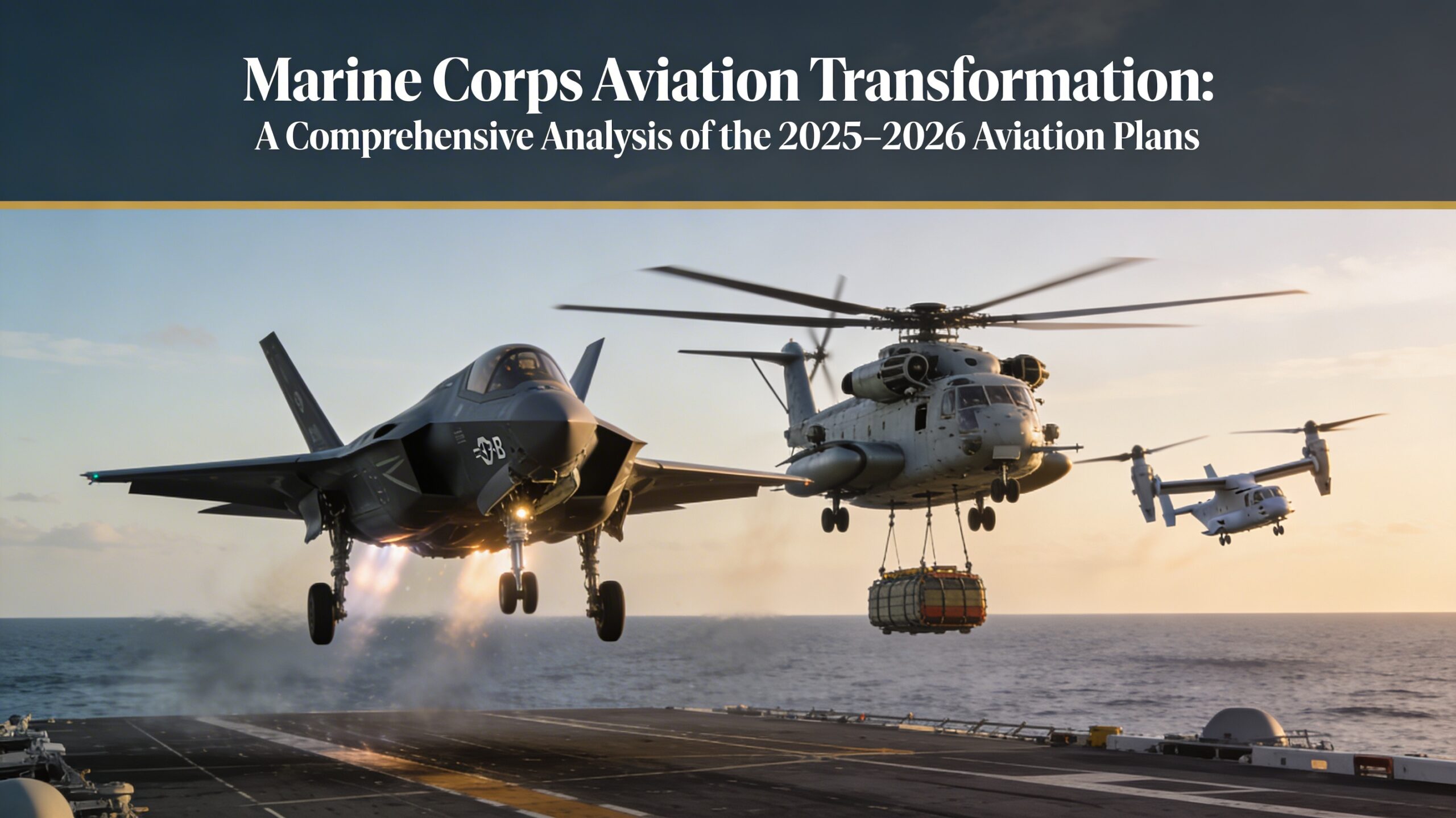
The 2026 Marine Aviation Plan represents a watershed moment in how the Marine Corps approaches aviation readiness.
At its core lies a fundamental reconceptualization of sustainment, moving from decades of reactive maintenance practices toward a predictive, data-driven model that leverages artificial intelligence and machine learning to transform how Marine Aviation maintains, supplies, and operates its aircraft.
This transformation directly addresses one of the most persistent challenges facing naval aviation: maintaining high readiness rates while conducting distributed operations across vast geographic areas with limited logistics infrastructure.
The plan articulates the problem with striking clarity: “Marine Corps Aviation remains reactive in maintenance, supply, and operations planning, limiting readiness and reducing the ability to sustain distributed aviation operations and crisis response.”
This assessment acknowledges that traditional sustainment approaches built around centralized maintenance facilities, predictable supply chains, and established operational tempos—cannot support the demands of Distributed Aviation Operations (DAO) in contested environments.
When Marine Aviation squadrons must operate from austere, disaggregated sites across the Indo-Pacific or other theaters, the conventional model of flying aircraft back to main operating bases for scheduled maintenance or waiting days for parts to arrive through traditional supply channels becomes operationally prohibitive.
The AI/ML sustainment initiative organizes this transformation into three complementary Lines of Operation: Dynamic Aviation Supply, Predictive Maintenance, and Optimized Operations. Together, these efforts aim to create an integrated sustainment ecosystem where data flows seamlessly between maintenance, supply, and operations systems, where artificial intelligence identifies patterns invisible to human analysts, and where predictive algorithms enable Marines to anticipate and prevent failures before they impact combat readiness.
This represents not merely an incremental improvement in existing processes but a fundamental reimagining of how the Marine Corps sustains its aviation combat power.
Line of Effort 1: Dynamic Aviation Supply
The first line of effort tackles one of the most vexing challenges in expeditionary aviation: ensuring the right parts are available at the right place and time when operating from distributed, austere locations. Traditional aviation supply packages built around historical consumption data and standardized configurations assume relatively stable operating environments with predictable failure rates and established resupply chains.
These assumptions collapse when squadrons disperse across multiple Forward Arming and Refueling Points (FARPs), expeditionary airfields, and austere sites in contested environments where resupply may be sporadic or impossible for extended periods.
Dynamic Aviation Supply fundamentally rethinks how the Marine Corps structures and employs Supplemental Aviation Spares Support (SASS) packages. Rather than static supply sets based on historical averages, the initiative envisions adaptive packages that respond to actual operational conditions, evolving aircraft configurations, and real-time failure data.
The AI/ML component becomes critical here, machine learning algorithms can analyze vast datasets encompassing aircraft configuration management, operational tempo, environmental conditions, mission profiles, and component failure rates to identify patterns that would be impossible for human logisticians to discern manually.
For example, AI systems can recognize that F-35B aircraft conducting operations in high-temperature, high-humidity maritime environments while carrying external fuel tanks and specific weapons loads experience different component wear patterns than aircraft operating from temperate bases with standard training profiles. The system can then recommend adjusting supply packages for specific deployments to include higher quantities of components statistically more likely to fail under those specific operational conditions, while reducing quantities of parts less likely to be needed.
This precision reduces both the logistics footprint, critical when every pound of supplies must be moved by airlift or ship, and the risk of critical parts shortages that ground aircraft.
The plan’s emphasis on capturing “latest configurations and failure rates” addresses another persistent challenge: aviation supply packages often lag behind rapid capability upgrades and configuration changes.
When an aircraft receives new sensors, weapons systems, or defensive countermeasures, the associated supply packages may not immediately reflect the different maintenance requirements and failure modes of the new equipment.
AI/ML systems can continuously analyze maintenance data streams to identify emerging failure trends associated with new configurations and automatically recommend adjustments to supply packages before widespread parts shortages develop.
Beyond individual platform optimization, Dynamic Aviation Supply supports the concept of “highly dynamic, nodal webs of aircraft and support sites” that characterizes Distributed Aviation Operations. In this operating model, aircraft don’t return to a single main operating base but may rotate through multiple forward sites, each with varying levels of maintenance capability and parts availability.
AI systems can optimize the distribution of supply packages across this network, ensuring that high-demand items are positioned at nodes with the highest probability of need based on planned operations, aircraft rotations, and historical maintenance trends. This network optimization, balancing readiness requirements against airlift capacity and operational security considerations, represents precisely the type of complex, multi-variable problem where AI/ML excels beyond human cognitive capacity.
The plan explicitly notes goals of “improving deployed aircraft readiness rates while reducing costs and material footprint.” These dual objectives often seen as contradictory in traditional logistics become achievable through AI-driven precision. By ensuring the right parts are available where and when needed, the Marine Corps can reduce aircraft downtime (improving readiness) while simultaneously reducing the total quantity of parts that must be procured, stored, and transported (reducing costs and footprint).
Early implementations of similar predictive supply systems in commercial aviation have demonstrated readiness improvements of 15-25% while reducing inventory carrying costs by 20-30%. Achieving comparable results across Marine Aviation would represent a transformational improvement in operational capability.
Line of Effort 2: Predictive Maintenance
The second line of effort addresses what may be the most significant cultural and operational shift in the entire AI/ML sustainment initiative: conducting aviation maintenance synchronized with operational tempo and aviation logistics (AVLOG) availability based on data driven probabilities.
Currently, aviation maintenance is categorized as either scheduled or unscheduled. Scheduled maintenance encompasses specific part replacements or inspections based on parameters such as flight hours, calendar days, or events such as the number of takeoffs or landings. These known parameters allow maintenance and sustainment planners to foresee and plan for impending manpower demands, maintenance time, and supply requirements based on a certain operational tempo. Unscheduled maintenance, >65%-75% of all maintenance actions, are reactionary measures that respond to unanticipated component failures or malfunctions and can severely degrade flight operations and sortie generation.
Employing predictive maintenance concepts, enabled by AI/ML analysis of sensor data, performance parameters, and historical failure patterns, identify impending failures before they occur. This capability facilitates planning for and performing maintenance synchronized with operational aircraft demand, AVLOG availability and location, and manpower available.
Essentially this use of technology turns unscheduled maintenance degraders into foreseen scheduled maintenance actions and supply requirements that can be planned for. This shift profoundly increases aircraft readiness and maintenance efficiency. Further, predictive maintenance bolsters the operational flexibility of a constantly moving force by preemptively locating manpower and supply requirements where they will be needed.
The 2026 plan details several concrete initiatives that establish the foundation for this transformation. The Advanced Maintenance Training Academies for H-1 and V-22 aircraft represent a crucial investment in the human element of predictive maintenance. These programs partner with manufacturers, Bell for the H-1 series and AH-1Z/UH-1Y, and Boeing/Bell for the V-22, to leverage Original Equipment Manufacturer (OEM) instructors and engineering specialists who possess the deepest technical knowledge of these complex platforms.
This partnership approach acknowledges that effectively implementing predictive maintenance requires maintenance personnel to understand not just how to follow technical manual procedures, but why certain failure modes occur, what data signatures indicate developing problems, and how to interpret the outputs of AI-driven diagnostic systems.
The emphasis on “hands-on experience and 3D courseware for critical maintenance tasks” reflects recognition that predictive maintenance demands higher levels of technical expertise than traditional reactive maintenance. When an AI system flags an anomalous vibration signature in an MV-22B proprotor gearbox or identifies unusual temperature trends in an AH-1Z transmission, maintenance personnel must be able to interpret these alerts, conduct focused inspections to verify or rule out specific failure modes, and make informed decisions about whether to remove components for detailed inspection or continue monitoring. This requires a deeper understanding of system engineering, failure modes and effects, and diagnostic techniques than traditional “remove and replace” maintenance.
The mention of establishing “a strong baseline for Maintenance Chiefs while fostering a culture of maintenance excellence” points to the leadership dimension of this transformation. Shifting from reactive to predictive maintenance requires organizational culture change, not just new technology. Maintenance Chiefs must champion the use of data-driven decision-making, encourage their Marines to trust AI-generated alerts even when conventional indicators appear normal, and balance the confidence to defer scheduled maintenance when data shows components are healthy against the judgment to act preemptively when predictive indicators suggest developing problems.
Several specific technologies and programs support this predictive maintenance transformation. The ODSSHI (Osprey Drive System Safety/Health Instrumentation) system exemplifies sensor-based condition monitoring, adding vibration sensors and instrumentation to the MV-22B drive system to enable real-time monitoring of component health.
Rather than replacing proprotor gearboxes on a fixed schedule, maintenance personnel can monitor actual bearing condition, lubrication system health, and structural integrity, replacing components when data indicates degradation rather than at arbitrary hour limits. This approach both improves safety (by identifying developing problems before catastrophic failure) and reduces maintenance burden (by extending component life when condition remains good).
The broader implications extend beyond individual platforms. As predictive maintenance systems mature across the Marine Aviation enterprise, the accumulated data and refined algorithms become increasingly valuable. Machine learning models trained on years of sensor data, maintenance actions, and component failures can identify subtle patterns that predict specific failure modes with high accuracy.
An AI system that has analyzed data from thousands of CH-53K engines across various operating conditions can recognize early indicators of impending turbine blade erosion or bearing wear with far greater reliability than even the most experienced maintenance chief examining a single aircraft.
The plan’s emphasis on “fostering a culture of maintenance excellence” acknowledges that predictive maintenance success depends on maintainers trusting and effectively utilizing AI-driven insights.
This requires transparent systems where Marines understand why the AI recommends specific actions, training that builds confidence in data-driven decision-making, and leadership that consistently reinforces the value of predictive approaches. When a predictive system recommends replacing a component that appears to be functioning normally, and that replacement prevents an in-flight failure two weeks later, the resulting success story reinforces cultural adoption across the maintenance community.
Line of Effort 3: Optimized Operations
The third line of effort represents perhaps the most ambitious element of the AI/ML sustainment initiative: fusing data from previously siloed systems to enable comprehensive optimization of flight operations and maintenance.
The plan specifically identifies NALCOMIS (Naval Aviation Logistics Command Management Information System), M-SHARP (Marine Corps Safety and Health Automated Recordkeeping and Reporting Program), and GCSS-MC (Global Combat Support System-Marine Corps) as systems whose data integration will drive optimization. Each of these systems historically operated independently, managed by different communities, and served distinct functions, NALCOMIS for maintenance tracking, M-SHARP for safety and mishap data, and GCSS-MC for supply chain management.
This data fragmentation has long hampered holistic optimization efforts. A squadron operations officer planning the flight schedule sees one picture based on aircraft status codes in NALCOMIS. The maintenance control chief sees overlapping but distinct information about component time remaining and scheduled maintenance requirements. The supply officer monitors parts availability through GCSS-MC. The safety officer analyzes mishap trends in M-SHARP. Each domain optimizes within its silo, but true enterprise optimization requires synthesizing information across all these domains simultaneously.
The AI/ML initiative aims to break down these barriers by creating integrated data platforms where information flows seamlessly between systems and AI algorithms can identify optimization opportunities invisible to humans working within individual functional areas.
Consider a practical example: an AI system analyzing the integrated dataset might recognize that a particular maintenance task on the AH-1Z, when performed by specific maintenance personnel during certain times of day, correlates with slightly elevated mishap risk indicators in subsequent flights. This pattern, involving data from maintenance records (NALCOMIS), personnel qualifications, work schedules, and safety reports (M-SHARP), would be virtually impossible for human analysts to identify across separate databases. The AI can flag this correlation, prompting investigation that might reveal, for instance, that the task involves critical torque specifications more difficult to achieve accurately under high-temperature conditions, leading to procedural adjustments that improve both safety and maintenance quality.
The plan describes developing “a suite of AI-enabled tools to automate and optimize complex, data-intensive tasks of scheduling and managing flight operations and maintenance.” Flight scheduling in a Marine Aviation squadron represents an extraordinarily complex optimization problem. Schedulers must balance pilot currency requirements, aircraft maintenance status, training objectives, operational commitments, fuel availability, range time, weather conditions, crew rest requirements, and numerous other variables. Human schedulers rely on experience and judgment to create workable schedules, but AI systems can evaluate millions of potential schedule permutations, identifying options that maximize training value while minimizing maintenance disruption and operational risk.
Maintenance scheduling presents equally complex optimization challenges. When multiple aircraft require different maintenance actions with varying duration, priority, and parts availability, determining the optimal sequence, which aircraft to maintain in which order, which maintenance tasks to perform concurrently versus sequentially, and how to allocate limited maintenance personnel across competing demands, taxes human cognitive capacity.
AI optimization algorithms can simultaneously consider aircraft operational priority, parts availability, maintenance task dependencies, personnel qualifications and availability, facility constraints, and projected operational requirements to generate maintenance schedules that maximize squadron readiness.
The integration of safety data through M-SHARP adds another critical dimension. By analyzing correlations between maintenance actions, operational patterns, and safety incidents, AI systems can identify risk factors that inform both scheduling decisions and procedural improvements. If data reveals that certain mission profiles following specific maintenance actions correlate with elevated precautionary landing rates, the system can recommend additional quality assurance checks or suggest scheduling these mission types with time buffers that allow thorough post-maintenance operational checks.
The plan’s vision of “generating safer, more efficient operations that reduce unscheduled downtime and increase aircraft availability” reflects the ultimate objective: using data integration and AI optimization to fundamentally improve how Marine Aviation operates. Safer operations result from AI systems identifying and flagging risk correlations across multiple data sources.
More efficient operations emerge from optimal scheduling that reduces conflicts, minimizes aircraft idle time, and coordinates maintenance with operational tempo. Reduced unscheduled downtime follows from predictive maintenance that addresses developing problems before they cause failures. Increased aircraft availability comes from the cumulative effect of all these improvements, better parts availability, more efficient maintenance, optimized scheduling, and proactive problem prevention.
The challenge of implementing this integrated optimization capability should not be underestimated. It requires not just technology development but also policy changes, procedural updates, and organizational adaptation. Data sharing agreements must be established. System interfaces must be developed. Data quality and standardization issues must be resolved. AI algorithms are only as good as the data they analyze, and years of inconsistent data entry practices across multiple systems present significant challenges. Personnel must be trained to use new tools and trust AI-generated recommendations. Leaders must be willing to make decisions based on algorithmic optimization rather than purely intuitive judgment.
Strategic Implications and Operational Impact
The AI/ML sustainment initiative’s strategic significance extends well beyond improving maintenance efficiency or reducing parts shortages. This transformation directly enables the distributed operations concept that underlies Marine Aviation’s contribution to Expeditionary Advanced Base Operations and stand-in forces operations in contested environments.
When aircraft operate from disaggregated sites with limited maintenance infrastructure and constrained supply chains, the ability to predict failures, optimize limited parts inventories, and efficiently manage maintenance with reduced personnel becomes operationally decisive.
Consider operations across the Indo-Pacific, where Marine Aviation detachments may operate from remote islands or austere expeditionary airfields hundreds of miles from main operating bases. In this environment, an unscheduled maintenance issue that grounds an aircraft might take days or weeks to resolve through traditional supply and maintenance processes, time during which that aircraft’s combat power is unavailable and the detachment’s operational capability is degraded.
AI-driven predictive maintenance that identifies developing problems before deployment, dynamic supply packages that ensure critical parts are forward-positioned, and optimized scheduling that maximizes available aircraft utilization transform this equation. Aircraft remain mission-capable longer, maintenance issues are resolved faster with forward-positioned parts, and limited maintenance personnel focus efforts where they generate the greatest readiness return.
The initiative also addresses the perennial tension between maintenance and operations tempo. Historically, high operational tempos strain maintenance organizations, leading to deferred maintenance, reduced quality assurance, and eventual readiness degradation. By optimizing maintenance scheduling, improving parts availability, and enabling predictive interventions that prevent major failures, the AI/ML approach allows Marine Aviation to sustain higher operational tempos without degrading readiness. This capability becomes critical during crisis response operations where sustained, high-tempo operations may be required for weeks or months.
The data infrastructure and AI capabilities developed through this initiative also position Marine Aviation rapidly to integrate insights from the broader Joint Force and industry partners. As other services and commercial aviation operators implement similar AI-driven sustainment approaches, the Marine Corps can leverage shared learning, incorporate proven algorithms, and contribute its unique distributed operations insights to the broader community. This collaborative approach accelerates capability development while reducing costs and technical risk.
Conclusion: The Path Forward
The AI/ML sustainment initiative in the 2026 Marine Aviation Plan represents transformational ambition matched with practical implementation focus. By organizing the effort into three clear lines of operation, Dynamic Aviation Supply, Predictive Maintenance, and Optimized Operations, the plan provides a coherent framework for what could otherwise become an unwieldy technology implementation program. Each line of operation addresses specific capability gaps while contributing to the overarching goal of transitioning from reactive to predictive sustainment.
Success will require sustained commitment, significant investment in both technology and training, and willingness to change established processes and organizational cultures. The plan’s emphasis on Advanced Maintenance Training Academies, industry partnerships, and cultural transformation alongside technological development reflects realistic understanding that effective AI/ML implementation depends as much on people and processes as on algorithms and data systems.
The ultimate measure of success will be operational impact:
• Can Marine Aviation squadrons sustain distributed operations across contested environments with higher readiness rates and reduced logistics footprint?
• Can predictive maintenance prevent in-flight failures that endanger aircrew and degrade combat capability?
• Can optimized operations and maintenance scheduling generate more available aircraft with existing personnel and resources?
If the AI/ML sustainment initiative achieves these outcomes, it will represent one of the most significant advances in Marine Aviation readiness and operational capability in decades. This would be a transformation as consequential as the technological improvements in the aircraft themselves.
Marine Corps Aviation Transformation: A Comprehensive Analysis of the 2025-2026 Aviation Plans