
From Missile Defense to Systems Warfare: The MEADS Case and the Future of Security
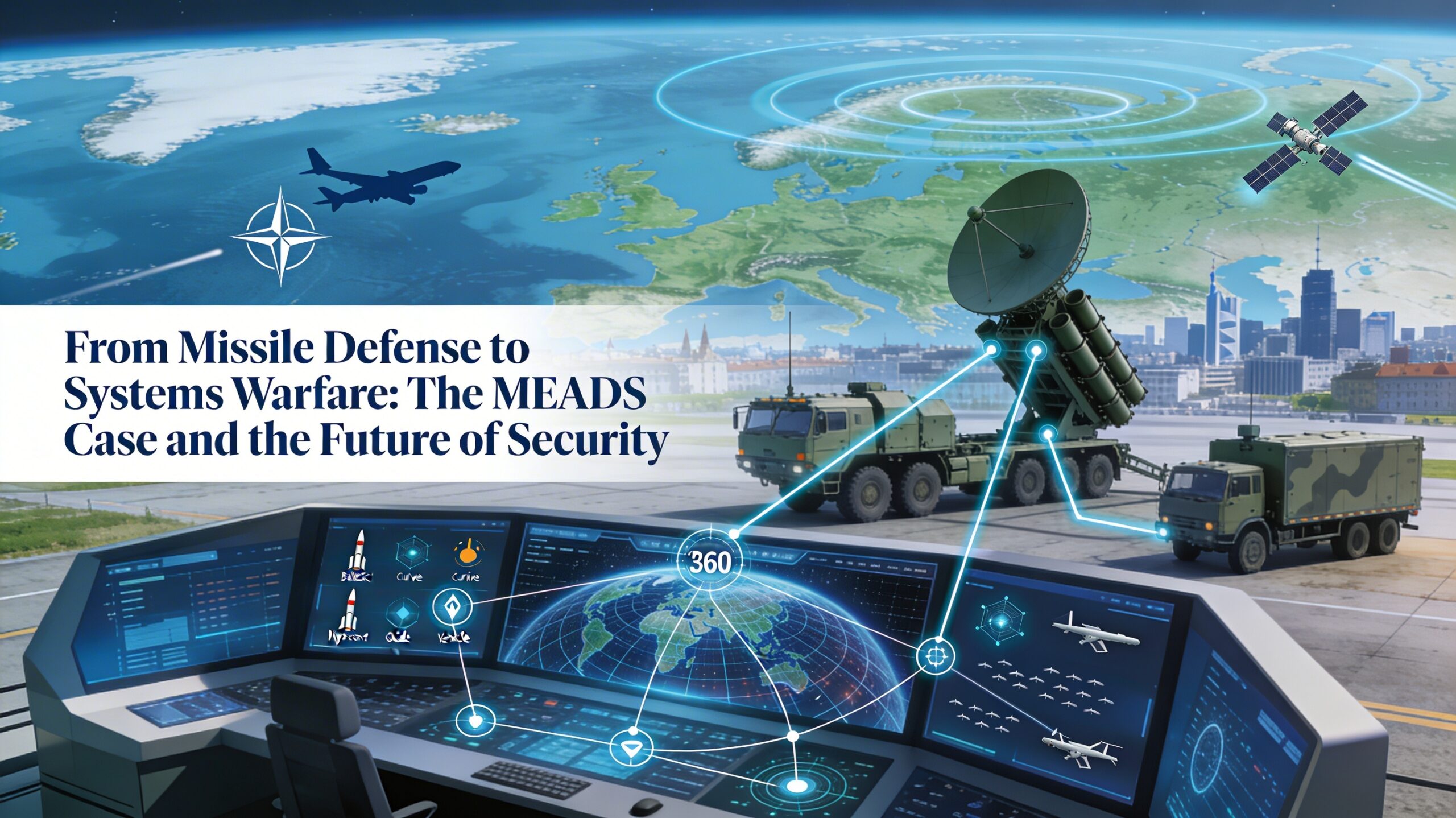
For a long time, we viewed missile defense as an essentially technical problem. A problem of trajectories, sensors, and interceptors. After all, the issue seemed relatively simple: identify a hostile missile and destroy it before it reached its target.
This vision guided the development of major Western systems for decades, from the MIM-104 Patriot to the SAMP/T. Sophisticated systems, certainly, but built around an implicit assumption: that the threat was limited, identifiable, and manageable within a linear sequence: sensor, decision, interceptor.
Today we know that model is no longer sufficient.
The transformation of the battlefield in recent years has introduced a discontinuity that is not merely technological, but structural. Hypersonic missiles have compressed the decision-making window to the point of near-elimination. Low-cost drones have made large-scale saturation possible. Multi-domain operations have integrated kinetic attacks, electronic warfare, and cyber actions into a single coordinated sequence.
The result is that defense is no longer circumvented. It is put under pressure as a system. It is no longer a matter of intercepting a missile.
It is a matter of determining whether the overall defense architecture is capable of withstanding a persistent, distributed, adaptive attack.
Even the most advanced systems available today demonstrate this. The Israeli multi-tiered architecture likely represents the pinnacle of contemporary air defense.
Yet even it reveals limitations when subjected to continuous saturation and heterogeneous threats.
Technological superiority, on its own, is no longer sufficient.
It is in this context that the case of MEADS (Medium Extended Air Defense System) takes on a significance that goes far beyond its industrial history. MEADS was not simply a system intended to replace the Patriot.
It was something different. It was an attempt to redefine the very concept of missile defense. Its architecture was based on principles that today seem almost inevitable: 360-degree coverage, distributed sensors, integration between platforms, “plug and fight” logic, and native interoperability.
But the most significant point was not in individual performance. It was in the fact that the system’s value no longer lay in the individual interceptor, but in the ability to integrate sensors, decision-makers, and effectors into an adaptive network. The 2013 test at White Sands represents, from this perspective, a key milestone. The simultaneous interception of two targets (missile-aircraft) coming from opposite directions, with a minimal configuration, demonstrated more than just technical capability. It demonstrated that the architecture worked and that the operational principle was already valid. It was not, therefore, an immature project. It was a system that had already proven its logic.
Yet that path was interrupted. The reasons are well known: financial constraints, industrial decisions, and a preference for the evolution of systems already in service. Europe, and Italy in particular, chose to continue along an evolutionary path, represented today by the SAMP/T NG. A coherent, rational choice, sustainable in the short term. But evolution and transformation are not the same thing. MEADS represented a break with the past; the SAMP/T NG represents only an improvement.
The difference is not technical: it is strategic.
Because in the meantime, the nature of conflict has changed. Contemporary warfare is no longer a sum of platforms, but a competition between complex systems. Systems that must be scalable, resilient, and adaptive. Systems that must be capable not only of intercepting, but of continuing to function under pressure. And this is where another, often underestimated element emerges: that of technological sovereignty.
The MEADS program had allowed Italy to access central segments of the system’s architecture: integration, radar, command and control, and software. These were not marginal contributions, but structural capabilities.
In other words, a foundation of real autonomy was being built. Interrupting that path likely meant relinquishing a portion of that sovereignty.
Today, the issue of European strategic autonomy is at the center of political debate.
But autonomy is not a declaration. It is a capability.
And this capability is measured by the ability to design, integrate, and produce complex systems while maintaining control over the architecture and software. In our century, the true value lies not in the missile. It lies in the system that decides how and when to deploy it.
The most recent developments, including those related to artificial intelligence developed by Leonardo, certainly point toward greater predictive capability and more advanced threat management. But even these innovations risk remaining incomplete if they are not integrated into an appropriate architecture.
The question, therefore, is not whether MEADS was the perfect choice. No system is.
The question is whether it represented a necessary step toward a new concept of defense.
And, above all, whether Europe has fully grasped that step.
Today, observing the conflicts in Ukraine and the Middle East, we see clearly that war has become a competition between adaptive, interconnected, and persistent systems. In this context, superiority is no longer measured by the ability to destroy more, but by the ability to withstand better.
Withstanding means maintaining the system’s functionality under stress.
It means adapting more quickly than the adversary.
It means integrating, in real time, information, decisions, and operational capabilities.
It, after all, anticipated precisely this.
And so the question that remains is not about the past, but the future: not whether we should have adopted it, but how much it will cost us not to have fully realized that vision.
Note: This article was published in Italian in Formiche on April 11, 2026 and is republished with permission of the authors.