
Australia and Indonesia: Co-Inventing Amphibious Power in the Archipelago
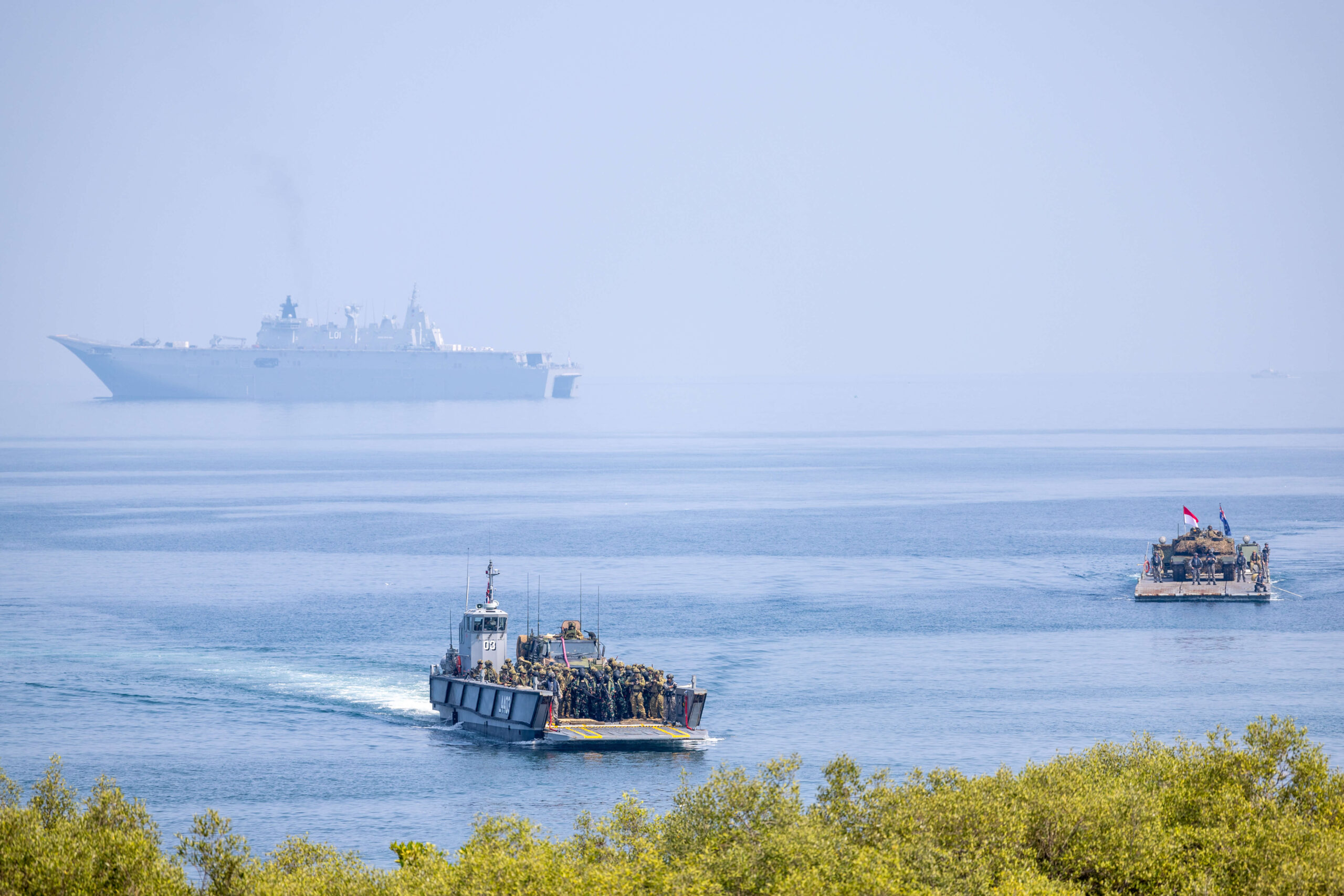
The November 2024 amphibious landing at Banongan Beach in East Java marked more than the largest and most complex joint drill Australia and Indonesia have ever conducted. It signalled the emergence of a qualitatively new defence relationship, one in which two middle powers are beginning to co-invent how they operate in contested littoral spaces stretching from northern Australia through the Indonesian archipelago.
This is not a story about symbolic reassurance or modest interoperability gains. It is about two neighbours with historically complicated ties choosing to place complex amphibious operations at the centre of a reordered bilateral partnership.
From Strategic Suspicion to Shared Amphibious Enterprise
For decades, the Australia–Indonesia defence relationship oscillated between periods of pragmatic cooperation and episodes of mutual suspicion rooted in asymmetries of size, political culture, and strategic orientation. The August 2024 Defence Cooperation Agreement (DCA) codified a genuine step change. Both governments describe it as the most significant defence agreement in the history of the bilateral relationship—building on but going well beyond the 2006 Lombok Treaty.
The DCA does three things that matter operationally. It establishes a clear legal framework for forces operating on each other’s territory and in each other’s airspace and waters. It explicitly envisages more complex, combined operations across land, air, maritime, and amphibious domains. And it grounds that cooperation in a shared understanding of regional security challenges, from grey-zone coercion to natural disasters. That last dimension is important: it means the legal and operational architecture is designed for the full spectrum of likely contingencies, not just the most extreme.
Exercise Keris Woomera 2024 (KW24) is the first major operational test of that framework. Around 2,000 ADF and TNI personnel conducted air, maritime, amphibious, and follow-on land operations across both countries, culminating in a live-fire amphibious landing in East Java with tanks, artillery, infantry, attack helicopters, and fighter aircraft.
This is not engagement at the margins. It is the core of how both sides now intend to think about power projection and crisis response in the northern approaches.
Keris Woomera as an Amphibious Systems Laboratory
In official language, KW24 is about testing combined capabilities across sea, land, and air in the most complex scenarios yet attempted. In practice, it functions as a systems laboratory, a proving ground for a maturing Australian Amphibious Force and an Indonesian military modernising under constrained budgets and a crowded regional agenda.
The exercise begins not on the objective beach but in Darwin and at sea. HMAS Adelaide sails from northern Australia with a small but significant Indonesian contingent embarked, around thirty to thirty-five personnel, who integrate into shipboard routines, planning teams, and the Australian Amphibious Force itself. The task group conducts preliminary landings in Australian waters before pushing north and west for the culminating assault at Banongan Beach. Under cover of Australian Army Tiger attack helicopters and Indonesian Air Force F-16s, a combined force of infantry, tanks, and vehicles moves ashore by landing craft from Adelaide, with HMAS Stuart providing escort and live-fire serials at sea. Once the lodgement is secured, the training audience pivots rapidly into humanitarian assistance and disaster-relief and evacuation vignettes before concluding with a joint live-fire demonstration.
This is precisely the kind of multi-phase, multi-domain problem set that Australian strategy now emphasises for the joint force in the littorals. The critical difference is that it is being rehearsed not only with the United States but with the nearest large neighbour whose geography sits at the centre of any realistic Indo-Pacific crisis scenario.
Helping the Australian Army Become a Littoral Force
For Australia, the DCA and Keris Woomera arrive at a moment when the Army is being directed to reinvent itself as a littoral manoeuvre force rather than a continental heavy army. A new Littoral Manoeuvre Group in Brisbane, the consolidation of watercraft and riverine units, and sustained doctrinal work on land power in the littoral all point toward an Army designed to move and fight along coasts and archipelagic chokepoints with long-range fires, integrated ISR, and amphibious mobility.
KW24 advances that transformation in three concrete ways.
- First, it validates emerging doctrine in realistic terrain. Conducting ship-to-shore movement, combined arms integration, and follow-on HADR and NEO missions on actual Indonesian beaches and training areas, rather than abstract Australian coastlines, tests Australian concepts against the geography they are actually meant to serve.
- Second, it stresses command and logistics across national lines. Integrating even a modest TNI contingent into the Australian Amphibious Force compels Australian commanders to manage language differences, legal permissions, cultural friction, and varying readiness levels inside a single amphibious architecture, precisely the challenges that would arise in any coalition operation across Southeast Asia.
- Third, it builds regional legitimacy for a forward-leaning Army. Australian officials are explicit that KW24 is part of military diplomacy, intended to signal that Australian forces are prepared to operate alongside Indonesian partners in responding to shared security challenges. That political dimension matters at least as much as the tactical training value.
The bilateral amphibious construct thus gives Australia a proving ground in which it can turn its conceptual pivot to littoral operations into a credible, regionally accepted capability rather than a purely national project prosecuted in a diplomatic vacuum.
Helping Indonesia Modernise a Joint Amphibious Force
For Indonesia, the value proposition looks different but is genuinely complementary. The TNI is under sustained pressure to professionalise, become more joint, and maximise the impact of limited resources while signalling both strategic autonomy and seriousness as a regional security actor. Amphibious and coastal operations are central to that agenda: Indonesia’s geography demands a credible ability to move forces and deliver relief across an archipelago of more than seventeen thousand islands.
Keris Woomera and the broader DCA help Jakarta in several reinforcing ways. They offer an affordable pathway to modern amphibious standards. By embedding personnel on Adelaide and operating alongside a full-spectrum amphibious task force, LHD, frigate, attack helicopters, fighter cover, TNI units gain hands-on exposure to capabilities and operational standards they cannot yet field independently at scale. They accelerate doctrinal development without requiring immediate capital outlays. Practising complex ship-to-shore movement, joint live-fire, and HADR scenarios with a capable partner allows Indonesian officers and NCOs to experiment with new tactics, techniques, and procedures—refining their own amphibious doctrine and then carrying that learning back to Jakarta and Surabaya. Over time the DCA’s provisions for expanded training and education in each other’s facilities will produce a cadre of TNI officers genuinely comfortable planning and executing joint and combined amphibious operations.
Importantly, the relationship also bolsters Indonesia’s regional role without tying it to any single patron. Indonesian leaders present the DCA as an instrument of military diplomacy and a means of addressing shared security threats while preserving the country’s independent foreign policy line. Seen alongside Super Garuda Shield with the United States and growing cooperation with Japan and others, the Australian track helps Indonesia diversify its external military relationships on its own terms. From Jakarta’s vantage point, this is less about becoming an adjunct to Australian operations and more about using a capable neighbour as a testbed and multiplier for its own amphibious and joint ambitions.
Strategic Significance: Anchoring a Shared Littoral
The deeper significance of what is unfolding is that Australia and Indonesia are beginning to treat the waters and islands between them as a shared littoral system that must be managed collaboratively rather than as a dividing line between two distinct strategic spheres. Keris Woomera sits within Australia’s broader Indo-Pacific Endeavour deployment, its largest annual military engagement activity in the region; the DCA explicitly frames cooperation in terms of maintaining security and stability in this shared space.
For Australia, that framing means an Army and joint force whose credibility in northern and archipelagic operations depends as much on Indonesian perceptions and partnership as on raw capabilities. Platforms and doctrine matter, but operational legitimacy in Southeast Asia is inseparable from the quality of relationships with neighbours who sit astride the approaches. For Indonesia, it means that the gradual modernisation of the TNI can be levered up by selective access to Australian platforms, training systems, and planning processes—tailored to Indonesian realities and consistent with Indonesian strategic autonomy.
Neither side is abandoning its hedging instincts or domestic political constraints. The Australia–Indonesia relationship has deep structural complexities that no single agreement or exercise resolves. But by placing complex amphibious training and a formal DCA at the centre of the relationship, Canberra and Jakarta are co-inventing a new model of middle-power defence cooperation: one grounded in shared littoral geography, mutual transparency through exercises, and a practical acceptance that credible crisis response in their neighbourhood will often require each other’s ships, aircraft, and soldiers operating from the same beach.
That is a more durable foundation for regional security than declarations alone and it is being built one amphibious landing at a time.
Featured Image:
The Australian Defence Force’s amphibious force and Indonesian National Armed Forces marines prepare to make land with Royal Australian Navy ship HMAS Adelaide at anchor offshore Banongan Beach, East Java, during Exercise Keris Woomera 2024. Credit: Australian Department of Defence.
Bibliography
AP News. “Indonesia and Australia Hold Joint Military Drills after Signing a New Defense Agreement.” November 13, 2024.
https://apnews.com/article/indonesia-australia-joint-military-exercise-a65a21004a1ec821c5b2f61d2bb8154e
Australia Department of Defence. “Ambitious Amphibious Exercise Begins.” News release, November 5, 2024.
https://www.defence.gov.au/news-events/news/2024-11-06/ambitious-amphibious-exercise-begins
Australia Department of Defence. “Explosive End to Combined Activity.” News story, November 18, 2024.
https://www.defence.gov.au/news-events/news/2024-11-19/explosive-end-combined-activity
Embassy of Australia, Jakarta. “Australia and Indonesia Complete Joint Amphibious Exercise.” Media release, 2024.
https://indonesia.embassy.gov.au/jakt/MR24_106.html
Embassy of Australia, Jakarta. “Australia–Indonesia Military Exercise Keris Woomera Wraps Up in East Java.” Media release, 2024.
https://indonesia.embassy.gov.au/jakt/MR24_109.html
Indo-Pacific Defense Forum. “Keris Woomera Showcases Enhanced Australia-Indonesia Military Collaboration.” December 8, 2024.
https://ipdefenseforum.com/2024/12/keris-woomera-showcases-enhanced-australia-indonesia-military-collaboration
Indo-Pacific Defense Forum. “Australia-Indonesia Defense Relationship Expands to Address Complex Security Challenges.” November 17, 2025.
https://ipdefenseforum.com/2025/11/australia-indonesia-defense-relationship-expands-to-address-complex-security-challenges
Lowy Institute. “Indonesia and Australia: Defence Cooperation under Prabowo.” The Interpreter, April 16, 2026.
https://www.lowyinstitute.org/the-interpreter/indonesia-australia-defence-cooperation-under-prabowo
Lowy Institute. “A Step, Not a Leap: Assessing the Indonesia-Australia Defence Cooperation Agreement.” The Interpreter, April 13, 2026.
https://www.lowyinstitute.org/the-interpreter/step-not-leap-assessing-indonesia-australia-defence-cooperation-agreement
Radio Free Asia. “Australia to Hold Largest-Ever Joint Military Exercise with Indonesia in East Java.” August 28, 2024.
https://www.rfa.org/english/news/southchinasea/australia-indonesia-military-exercise-08292024150618.html
UWA Defence and Security Institute. “Mutual Trust and Reciprocity: Strengthening the Australia-Indonesia Defence Relationship.” Policy brief, May 19, 2025.
https://defenceuwa.com.au/publications/policy-briefs/mutual-trust-and-reciprocity-strengthening-the-australia-indonesia-defence-relationship
Australia. Department of Defence; Australian Industry & Defence Network. “Australia-Indonesia Defence Cooperation Agreement Enables Largest Combined Joint Activity in Recent History.” Media material, November 2024.
https://aidn.org.au/australia-indonesia-defence-cooperation-agreement-enables-largest-combined-joint-activity-in-recent-history
Australia. Minister for Defence. “Australia-Indonesia Defence Cooperation Agreement Signed.” Media release, August 28, 2024.
https://www.minister.defence.gov.au/media-releases/2024-08-29/australia-indonesia-defence-cooperation-agreement-signed
Australia. Department of Foreign Affairs and Trade. “Australia–Indonesia Treaty on Common Security.” Treaty text, 2026.
https://www.dfat.gov.au/countries/indonesia/australia-indonesia-treaty-common-security