
Training as Combat Generation: The Case for a Systems Approach

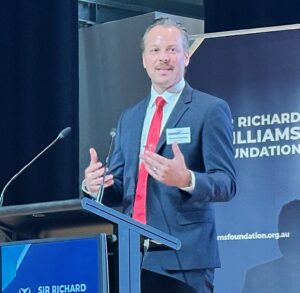
One of the more thought-provoking presentations at the seminar came from Alexander Robinson, Sales and Capability Director at Pilatus Aircraft Australia. Robinson opened with a self-deprecating acknowledgment: he had spent the previous evening sitting next to Air Chief Marshall Binskin, trying to make the turboprop training argument against a career’s worth of carrier landing experience, Mirage time, Hornet time, and F-16 time. He called it “a valuable discourse.” His escape hatch, he said, was to frame the entire discussion as being about providing options, not selling platforms.
That framing was more than rhetorical cover. It was the intellectual spine of the presentation.
The Core Argument: Training as Operational Terrain
Robinson’s central argument cuts against the grain of how training is conventionally discussed in defense circles. He is not making an education argument, and he is deliberately not making a platform argument. He is making what he calls a “combat generation” argument or the claim that Phase 4 training design has direct strategic consequences for mass, depth, and survivability, especially in a high-threat and fiscally constrained environment.
The point is not subtle. Australia fields a genuinely tier-one Air Force, exceptional platforms operated by high-quality people, but at limited scale, across a vast operating area, with finite surge depth relative to task demand. In that context, as Robinson put it, “the training pipeline itself becomes operational terrain.” Every instructor posting, every red air sortie, every jet hour consumed for training is an opportunity cost: it represents combat-ready mass that either exists or does not when the call comes.
The harder question, Robinson argued, is not simply whether Australia is training well. It is whether the training system is designed to generate and sustain combat-ready mass at the tempo the strategic environment demands. That is a different question entirely and it is one that the current architecture may not be optimally positioned to answer.
The Fifth Generation Mismatch
In fifth generation air combat, the center of gravity in the cockpit has shifted. Modern fighters are in many respects easier to fly than their predecessors but considerably harder to employ effectively. As Robinson observed, aircrew today are managing far more sensors, far more data, and far more complex tactical situations. The aircraft has become a decision node, not merely a weapons platform. The pilot is functioning as a conductor rather than a musician.
The competencies that now dominate modern air combat, systems thinking, cognitive prioritization, situational awareness, decision-making under pressure, timeline control, are being developed late in the pipeline, often largely at the OCU level. Meanwhile, expensive jet hours are being consumed earlier for training events that do not require jet-specific performance to achieve the required training effect. The result is the familiar combination: bottlenecks, downstream remediation, and pressure concentrated at the most expensive end of the system.
Robinson was careful to frame this as a system design problem, not a failure of people or effort. That distinction matters. It means the solution is also systemic, not a question of working harder within the existing architecture but of rethinking the architecture itself.
Training Realism Defined by Effect, Not Platform
The core design principle Robinson offered is deceptively simple: training realism should be defined by the effect, not by the platform. Each training task should be delivered by the lowest cost platform that can credibly deliver the required training outcome, whether that is a simulator, a turboprop, an advanced jet trainer, or a frontline aircraft. The goal is to protect what he calls “the jet-only envelope” and to be explicit and disciplined about where that envelope actually begins.
There are tasks that genuinely require jets: high alpha, sustained high-G maneuvering, transonic acceleration, mass fuel flow management, specific excess power. Those effects are envelope-specific, not merely syllabus-specific, and they belong in jets.
But many of the highest-value training tasks are cognitive, procedural, and decision-based rather than kinematic. Radar mechanics, intercept geometry, tactical formation, data link discipline, attack decision-making, the closure rates change on a turboprop, but the decision points do not. If the trainee is making the same calls, in the same sequence, under the same cognitive pressure, the training effect is being generated.
This logic points toward what Robinson describes as a hybrid Phase 4 construct: cognitive-dense tasks delivered on a high-performance turboprop integrated with embedded mission training suites and potentially live-virtual-constructive capabilities, while jets are reserved for the irreducible envelope that only jets can teach. The objective is not to pretend a turboprop is a fighter. It is to stop using jets for tasks that do not actually require them.
The Allied Precedents: Switzerland and France
Robinson grounded the argument in operational precedents rather than theory.
Switzerland has trained fighter pilots exclusively on turboprops since 2008. It is one of at least four nations operating a direct turboprop-to-fighter pipeline, transitioning directly from the PC-21 to the F/A-18C and shortly to the F-35. The Swiss made this shift incrementally, after operating Hawks and F-5s as advanced jet trainers—and what instructor and student feedback has consistently shown is that the hardest transition was not PC-21 to Hornet but PC-7 to PC-21. The cognitive load explanation accounts for that; the kinematic explanation does not. Importantly, Switzerland has reported no requirement to double training time and no degradation in operational outcomes.
France offers a parallel data point. The French Air and Space Force replaced a mixed fleet of Epsilons and Alpha Jets with a single PC-21 fleet for transition directly to Rafale and Mirage. The results: a fivefold reduction in maintenance and operational costs, fuel savings, improved training flow, and no change in downstream operational performance. What the French have been explicit about is that the primary value of the PC-21 is not kinematic replication. It is systems management exposure, decision discipline, and structured deep debriefing, precisely those fifth-generation skills that Robinson identifies as the current pipeline’s gap.
Both services openly acknowledge their limitations, high alpha, sustained specific excess power, the absence of external stores. Robinson’s point is not that these limitations are irrelevant but that they can be mitigated through syllabus design and a protected jet envelope, rather than by holding onto legacy platforms that were designed for a different training logic.
What These Forces Have Done and What It Means for Australia
Robinson’s summary formulation is worth sitting with: these forces have traded platform purity for training system resilience. They have strengthened their combat generation capability and their scalability as a result—both upward and downward. The argument is not that Australia should copy Switzerland or France. As Robinson put it, there are no perfect solutions, only trade-offs, and the goal is to help Air Force design the training system as a system of systems so that air power can be genuinely scalable across all four training phases.
He closed with something more personal and more revealing about the intellectual posture behind the presentation. He had considered swapping out one of his slides to feature the forthcoming PC-21X, a platform refresh Pilatus is set to announce later in 2026. He thought better of it.
To do so would have been, as he put it, “disingenuous to the first point I made” that this is not about a platform. What Pilatus wants, what industry wants, and what Robinson said he personally wants as an Australian, is a training system that produces aircrew ready for OCU at the standard required: the right knowledge, skills, attitudes, and mission-critical competencies so that when those young men and women get to the frontline, they fight tonight, they win tomorrow, and they come home.
The Broader Context
Robinson’s presentation connects to a broader theme running through the Williams Foundation seminar and through the wider conversation about Australian strategic advantage: the question of how to generate and sustain effective air power at scale in a fiscally constrained environment, against a threat that is evolving and across an operating area that demands both range and presence. The training pipeline is not typically where those conversations begin. Robinson’s argument is that it should be because the pipeline is where the force is made or unmade before the fight begins.
The kill web construct that Ed Timperlake and I have developed over the years places significant weight on the depth and resilience of the force, not merely on the exquisite capability of individual platforms. A training system designed as Robinson describes would contribute directly to the intelligent mass side of the equation: more air crew, progressed further and faster, with the cognitive tools to function as effective decision nodes in a networked, distributed fight. That is not a training abstraction. It is a combat generation problem. And Robinson is right that it has strategic consequences.
The paper Robinson referenced published in The Air and Space Power Journal and forthcoming in condensed form in the ASPI Journal is worth reading for those who want the analytical foundations in full. ∗The presentation itself, delivered to a room that included some of the most experienced airmen in the Indo-Pacific region, was a model of how an industry representative can contribute to a serious strategic conversation: by leading with the operational logic, letting the platform follow if it must, and keeping the focus on the outcome that actually matters.∗
∗ The paper addresses the urgent need for scalable aircrew training in the Indo-Pacific context, where modern aviators must manage information at tempo, make autonomous decisions under pressure, and coordinate effects within joint, complex, and often degraded battlespace conditions. Robinson’s work emphasizes how Australia’s strategic environment, characterized by accelerating military modernization, grey-zone coercion, and potential high-intensity conflict—elevates the premium on adaptable, integrated air power.
See my own book, on the same subject: