
Space as a Fight Tonight Domain: Jeremy King on Australia’s Strategic Imperative

At the Williams Foundation Semnar on the Fight Tonight Force held on 23 April 2026, Jeremy King’s, Chief Executive of Lockheed Martin Australia and New Zealand, central argument was straightforward, even if its implications are not: space is no longer a distant frontier or a strategic luxury. It is essential infrastructure, and it is already under attack. The fight tonight is not coming. It is happening now.
The Infrastructure Dependency In Plain sight
He opened by grounding the audience in a reality that defense planners have long understood intellectually but have been slow to operationalize. Space-based systems now underpin not just military operations but the entire functioning architecture of modern society, position, timing, navigation, communications, banking, weather, insurance, and intelligence, surveillance, and reconnaissance. Australia’s own independent review of critical infrastructure security has catalogued space as a dependency across every sector it examined.
That dependency is deepening precisely as the threat is intensifying. King pointed to the sheer density now accumulating in low Earth orbit — thousands of satellites today, tens of thousands anticipated — and the sobering mathematics of what happens when maneuvering capability is lost. A recently published analysis found that at current orbital density, without active collision avoidance, the time to first collision would be measured in days, not years. That is not a distant risk scenario. It is a physics problem playing out in real time.
But the physical threats — solar weather, collision risk — are only part of the picture. The more operationally relevant threats are the ones being prosecuted by state actors right now. King was direct: jamming, spoofing, and unsolicited rendezvous and proximity operations are not edge cases. They are standing features of the current gray zone contest. When he described the boundary between hard kill and soft kill as “wafer thin” in any operation where space dependencies are paramount, he was describing the operational environment his former colleagues inside the ADF are managing today.
The Fight Tonight Frame Applied to Space
The seminar theme — fight tonight — took on particular weight in King’s remarks. He was explicit that space is already a contested operational domain. The cyber attack on a satellite ground system at the outset of Russia’s full-scale invasion of Ukraine in 2022 was not an anomaly; it was a preview. The ongoing electronic warfare contest in Ukraine, the persistent interference campaigns in the Middle East, these are not future scenarios. They are data points from the current fight.
This framing has direct implications for how Australia structures its space architecture. King drew on the PACE methodology — Primary, Alternative, Contingency, Emergency — as a framework for thinking about resilience across degraded operational conditions. The point is not simply to build better satellites. It is to build architectures that can absorb degradation and continue to deliver effect. Primary systems must be resilient by design and fit for purpose in a contested threat environment. Alternative systems, including commercial capabilities, must be integrated to augment requirements. Contingency and emergency solutions must exist for the genuinely denied environment.
This is not a new concept in resilience thinking, but its application to the space domain has lagged badly behind the threat. King did not shy away from saying so. He noted, pointedly, that the pace of space technology development has outrun procurement timelines, a dynamic that those serving as delivery managers inside Defence are experiencing directly. The systems being bought today must be able to do more than “fight tonight.” They must survive the first night and maintain an assured path to continued access thereafter.
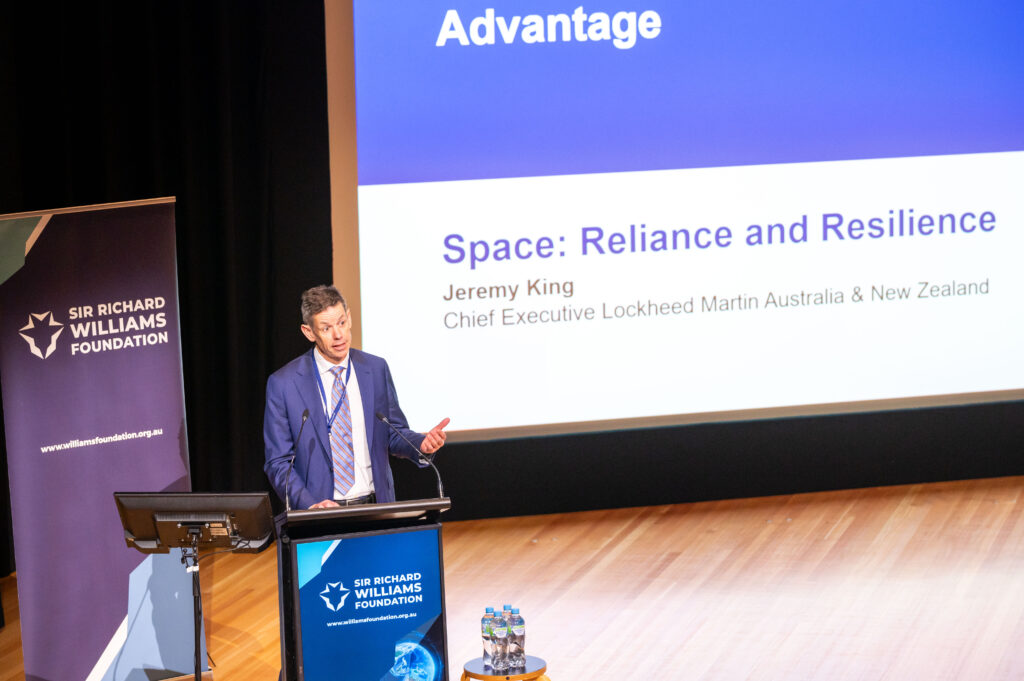
The Collaborative Imperative
King was emphatic that space superiority, for Australia, is not achievable unilaterally. The ADF leadership has said as much consistently, and he reinforced it with substance. Just the previous month, Lieutenant General Coyle hosted a gathering of space chiefs at the Australian War Memorial with the explicit intent of building collaborative relationships and reinforcing shared access to space technologies. The diplomatic architecture of space competition is being assembled through these practitioner-level engagements, not through formal treaty negotiation.
The industrial dimension of this collaboration is where King’s remarks carried the most operational weight. He pointed to Lockheed Martin’s work with Japan on next-generation anti-jamming military communication satellites as a model for what allied co-development can deliver, capabilities designed with regional threat considerations at heart, built to meet the needs of the warfighter today and into the future. The recently launched tenth GPS III satellite, the final in that series, represents a generation of capability offering substantially improved accuracy, coverage, and anti-jamming performance over its predecessors. GPS IIIF, the successor series, is already under construction with even more robust counter-EW features.
Interoperability and resilience, in King’s formulation, are not simply technical requirements. They are the mechanisms through which allied force multiplication in the space domain becomes real. Nations that collaborate on space programs achieve more than the sum of their individual investments. They build shared architectures that are harder to degrade comprehensively and that create redundancy at the alliance level, not just the national level.
The Australian Industry Dimension
King was careful to anchor his remarks in Australian sovereign capability, and the picture he painted was more encouraging than many in the room might have expected. Australia has world-class companies operating in the space domain, exporting globally across civil, commercial, and military sectors.
Nevaeh Technologies out of Adelaide, a graduate of Lockheed Martin’s mentor-protégé program, and Salentium Defence are examples of what Australian industry can deliver when given access to the global supply chain. FCOM Space and Defence, Black Tree Technology, Gilmore Space, and Space Machines Company round out a roster of companies that, in his telling, are genuinely competitive on the international stage.
Lockheed Martin’s Australian industrial participation program has surpassed $225 million in export contracts with Australian companies, a portion of which flows directly into the space sector. King’s point was that the sovereign industry base Australia needs to underwrite its space resilience is not a distant ambition. It exists now. The challenge is to integrate it deliberately into the ADF’s space architecture rather than treating it as an afterthought to large prime-contractor programs.
This is where King positioned the role of the primes. Rather than positioning Lockheed Martin as the solution to Australia’s space challenges — a pitch he deliberately stepped back from — he articulated a prime systems integrator model in which the major defense companies serve as the connective tissue linking Australian small and medium enterprises into global supply chains and allied program structures. That is a different framing than the traditional prime contractor model, and it is one that aligns better with the sovereign industrial capability objectives Australia has been articulating since the Defence Strategic Review.
What Fight Tonight Actually Demands
There was a thread running through King’s remarks that connects directly to the broader seminar theme. Fight tonight is not a readiness standard that applies only to aircraft and submarines and soldiers.
It applies to the domain that makes everything else function. An F-35 without assured communications, navigation, and ISR from space is a diminished platform. A joint force without assured space access is not a joint force in any operationally meaningful sense. It is a collection of platforms attempting to coordinate through degraded and contested channels.
The 2026 Secure World Foundation counter-space capabilities report, which King cited, is now tracking thirteen nations with counter-space programs, up from three in 2018. That trajectory does not suggest a domain that will stabilize. It suggests a domain in which the competitive pressure will intensify, the gray zone contest will continue, and the premium on resilient architecture will grow.∗
King’s contribution at the seminar was to make that case with the credibility that comes from having sat on both sides of the capability acquisition table, as a delivery manager inside the ADF and now as an industry executive. His argument for resilience by design, for collaborative architecture with allies and partners, and for deliberate integration of Australian industry into global space programs is not a marketing pitch. It is a practitioner’s assessment of what fight tonight actually demands in the domain that underpins all others.
The question that follows from his remarks is the one the seminar was designed to address: does Australia’s current approach to space capability — its procurement timelines, its industrial integration, its collaborative architecture with allies — match the fight tonight standard?
King’s implicit answer was that the gap remains, but that the pieces to close it are present. The challenge now is organizational will and procurement speed.
Note: This is the first article covering the second session of speakers at the seminar. The presentations during the second session of the seminar will published throughout this week.
Notes
Lockheed Martin, “Small Business Programs: Mentor Protégé Program,” https://www.lockheedmartin.com/en-us/suppliers/small-business-programs/Programs.html.
“Silentium Defence Becomes Second Australian Company to Graduate from the Lockheed Martin Mentor Protégé Program (MPP),” news release, Lockheed Martin Australia, November 9, 2023, https://lockheedmartinau.mediaroom.com/index.php?s=2429&item=122663.
Andrew McLaughlin, “Silentium Passive Radar Selected for Land 156,” Australian Defence Magazine, January 18, 2026, https://www.australiandefence.com.au/defence/land/silentium-passive-radar-selected-for-land-156.
“Silentium Defence World‑Class Passive Radar Technology Selected for LAND 156,” Silentium Defence, February 9, 2026, https://www.silentiumdefence.com.au/silentium-defence-world-class-passive-radar-technology-selected-for-land-156/.
“Gilmour Space Technologies | Launching Rockets and Satellites to Orbit,” Gilmour Space Technologies, https://www.gspace.com.
“Gilmour Space Secures Major Funding,” Australian Defence Magazine, January 20, 2026, https://www.australiandefence.com.au/defence/cyber-space/gilmour-space-secures-major-funding.
∗ Secure World Foundation, Global Counterspace Capabilities: An Open Source Assessment, 2026 (Broomfield, CO: Secure World Foundation, 2026).