
From Sea Dragon to Kill Web Node: The CH-53K as Airborne Manager of the Mine-Warfare Fight
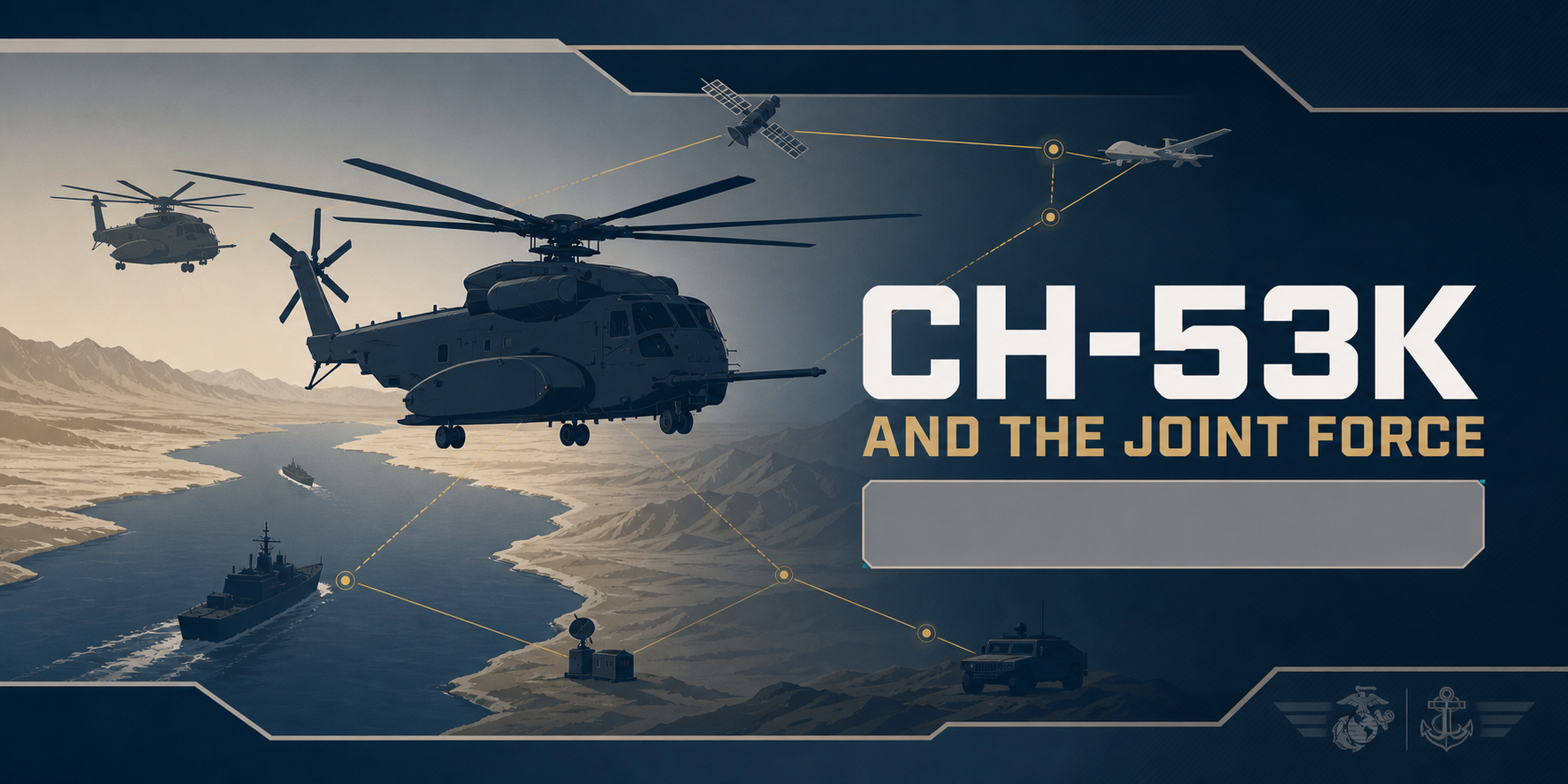
The MH-53E Sea Dragon’s role in mine countermeasures at the Strait of Hormuz has been indispensable but fundamentally limited by its generation. It tows. It sweeps. It clears a corridor. But it does not think, and it does not connect.
That is the essential distinction between the Sea Dragon era and what a CH-53K-centered approach would represent, not a one-for-one platform substitution, but a qualitative leap in how the airborne element of the mine-warfare mission integrates with the broader force operating from a platform like USS Lewis B. Puller.
Understanding why requires looking carefully at what the mine-warfare fight at Hormuz has actually become, and what the airborne element of that fight needs to do that the Sea Dragon was never designed to accomplish.
The Sea Dragon’s Structural Limitation
The Sea Dragon is an analog warrior in a digital fight. Its value lies in physical effect, dragging magnetic sweep sleds and acoustic generators through threat water to trigger or neutralize mines at a safe standoff. That is genuine operational capability, and it was decisive in earlier Hormuz contingencies. The platform proved its worth precisely because helicopters can cover water faster than surface ships, and in the confined, shallow geography of the strait, speed of clearance has always translated directly into strategic effect: open lanes mean oil moves, commerce flows, and coercive pressure on the adversary’s mine-laying calculus increases.
But the current operational environment has moved beyond what that capability profile can fully address. UUVs and USVs are now central to the mine-clearance effort, operating as sensors and neutralization platforms launched from and controlled aboard the ESB. The mine-warfare fight as it now exists around the Puller is not a single-domain sweep. It is a multi-layer, multi-medium prosecution campaign involving autonomous systems working the bottom and the surface, EOD divers prosecuting specific contacts, and helicopter assets providing overwatch and sweep. The Sea Dragon was not designed to manage that kind of distributed, multi-domain clearance operation. It executes its own lane. It does not orchestrate the lanes of others. In a fight that now depends on the coordinated output of a constellation of autonomous systems, that limitation is operationally significant.
There is also the question of sustainability. The Navy dismantled its Mine Warfare Command in 2006, and in the years that followed, both surface and airborne MCM capabilities eroded steadily. The MH-53E is an aging system, the fleet is small, and the maintenance burden is high. The Sea Dragon was already part of a mixed approach before the current Hormuz crisis made the mine-warfare mission urgent again. Its continued relevance depends on a sustainment base that has been shrinking, not growing. Replacing it with a platform that brings not just equivalent capability but expanded mission potential is therefore not simply a modernization argument. It is a force design imperative.
The CH-53K’s Organic Digital Architecture
The CH-53K was designed from the outset as a networked platform, not a brute-lift workhorse with communications bolted on afterward. Its architecture includes an integrated digital cockpit built around a common avionics infrastructure, a fly-by-wire flight control system that generates continuous aircraft state data, an open systems architecture specifically designed to allow rapid integration of new mission systems, and the processing capacity to handle real-time sensor fusion across multiple inputs. Those are not features added for convenience. They are the structural basis for the K’s role in distributed operations, and they represent a fundamentally different relationship between the helicopter and the broader force than the Sea Dragon was ever capable of sustaining.
Where the Sea Dragon is a towing platform with limited situational awareness beyond its own sensors, the K is a node. It can receive, process, fuse, and retransmit tactical data across the force. It can serve simultaneously as an executor of its own mission and as a relay and manager for the missions of others. That dual capacity, doing and orchestrating, is precisely what the Hormuz mine-warfare fight now requires from its airborne component.
The open systems architecture deserves particular emphasis. One of the persistent frustrations of integrating new autonomous systems into existing operational frameworks is the integration timeline, legacy platforms with closed or proprietary avionics architectures require extended developmental cycles to accommodate new interfaces, and by the time the integration is complete, the autonomous system itself has often evolved. The CH-53K’s open architecture breaks that cycle. UUV and USV management interfaces are integrable without the years-long developmental drag that characterized earlier helicopter generations. The same fly-by-wire architecture that gives the Kilo its handling precision at low altitude and in the confined deck environments of a ship like the Puller also feeds the data bus that makes it a capable multi-mission sensor and systems manager.
The CH-53K as Airborne C2 Node
The operational logic here is straightforward but important. UUVs operating in the acoustic clutter and electromagnetic-shadow environment of shallow Gulf water have limited ability to communicate directly with a surface ship. The geometry is unfavorable: water absorbs and scatters the signals on which UUV communication depends, distances across the operational area can exceed reliable surface communication ranges, and the data latency introduced by those constraints makes real-time coordination from a ship-based C2 node alone genuinely difficult. A CH-53K orbiting overhead at operational altitude bridges that gap in a way no surface asset can replicate.
Operating with broad line-of-sight to both the Puller and the UUV/USV constellation working the threat area, the Kilo can serve as the airborne relay and management layer for the entire autonomous system force. It can receive contact reports from UUVs prosecuting bottom objects, relay that data to the ship in near-real time, and simultaneously task USVs on the surface to investigate or mark the contacts. It can deconflict search lanes between multiple autonomous vehicles operating in overlapping areas, a coordination problem that becomes geometrically more complex as the number of systems increases. It can cue EOD assets to specific prosecution points identified by the autonomous systems. And it can do all of this while simultaneously providing the overwatch and, where required, the towed sweep capability that the Sea Dragon currently provides as its primary mission.
This is not a speculative capability extrapolated from aspirational program documents. It flows directly from the Kilo’s existing architecture and from the trajectory of how autonomous system management has been integrated into rotary-wing platforms across multiple domains. The Kilo was designed to grow into precisely this kind of multi-function role. The mine-warfare mission at Hormuz provides the operational context that makes the case for doing so urgently.
Intelligent Mass Applied to Mine Warfare
The contrast between the Sea Dragon and the CH-53K maps onto a broader tension in force design between exquisite scarcity and intelligent mass. The Sea Dragon represents exquisite scarcity in the mine-warfare context: a specialized, aging platform present in small numbers, increasingly difficult to sustain, and incapable of expanding its mission envelope beyond its original design parameters. Its value is real but bounded. It does one thing well, it cannot easily be adapted to do more, and the fleet is too small to provide the persistent, redundant coverage that a contested strait demands over an extended campaign.
The CH-53K operating as an airborne manager of UUVs and USVs is the inverse model. Its value is not locked in a fixed mission profile. It expands with the force around it. One Kilo managing multiple UUVs and USVs while simultaneously providing overwatch and retaining the option to conduct its own sweep represents a qualitatively different force ratio than the Sea Dragon could generate. Add a second Kilo to the rotation and the coverage, coordination capacity, and operational tempo of the entire autonomous system constellation increases proportionally. The platform becomes a multiplier of the force, not simply a component of it.
This is the logic of intelligent mass applied to mine warfare: not more of the same capability, but a capable platform whose organic digital architecture amplifies the output of the entire distributed force around it. In an environment where the adversary can lay mines faster than legacy MCM platforms can clear them, force multiplication is not a quality-of-life improvement. It is the operational answer to the problem.
The Integration Imperative
The strategic case for the Puller rests on the insight that mobile basing is most valuable not as a platform capability in isolation but as a joint integration capability, a node within an operational network that extends sea power and delivers effects across warfighting functions. The ESB is valuable because it brings aviation, unmanned systems, small craft, EOD, and command-and-control together on a single hull and positions that integrated capability persistently in the threat area, transforming mine clearance from a commuting activity into a sustained campaign.
The same logic applies within the aviation element of that campaign. The Sea Dragon was the right tool for a platform-centric era: essentially self-contained, executing its sweep and returning to the ship, contributing its lane to the clearance effort without particular reference to what other assets were doing in adjacent lanes. The CH-53K fits the integration-centric era that the Puller embodies, because its value is not primarily in what it does autonomously but in what it enables others to do in coordination with it. It is an airborne expression of the same integrating logic that makes the ESB concept strategically powerful.
The Puller is already functioning as the integrating node the current fight requires, combining Navy mine-warfare teams, EOD detachments, special operations forces, and autonomous systems on a single hull positioned just outside the chokepoint. The CH-53K’s potential role is to extend that node into the third dimension, providing the entire operation with a persistent airborne C2 layer capable of managing the autonomous system constellation, relaying data across the force, and conducting direct-effect missions simultaneously.
That is not a replacement for the Sea Dragon. It is a transformation of what the airborne element of the mine-warfare mission can accomplish and the Puller’s operational debut at Hormuz has made that transformation not a future aspiration but a present requirement.
Lewis B. Puller and the Mine Warfare Mission at the Strait of Hormuz