
A Different Aircraft for a Different Fight: The CH-53K vs. CH-53E in Long-Range Raid Operations
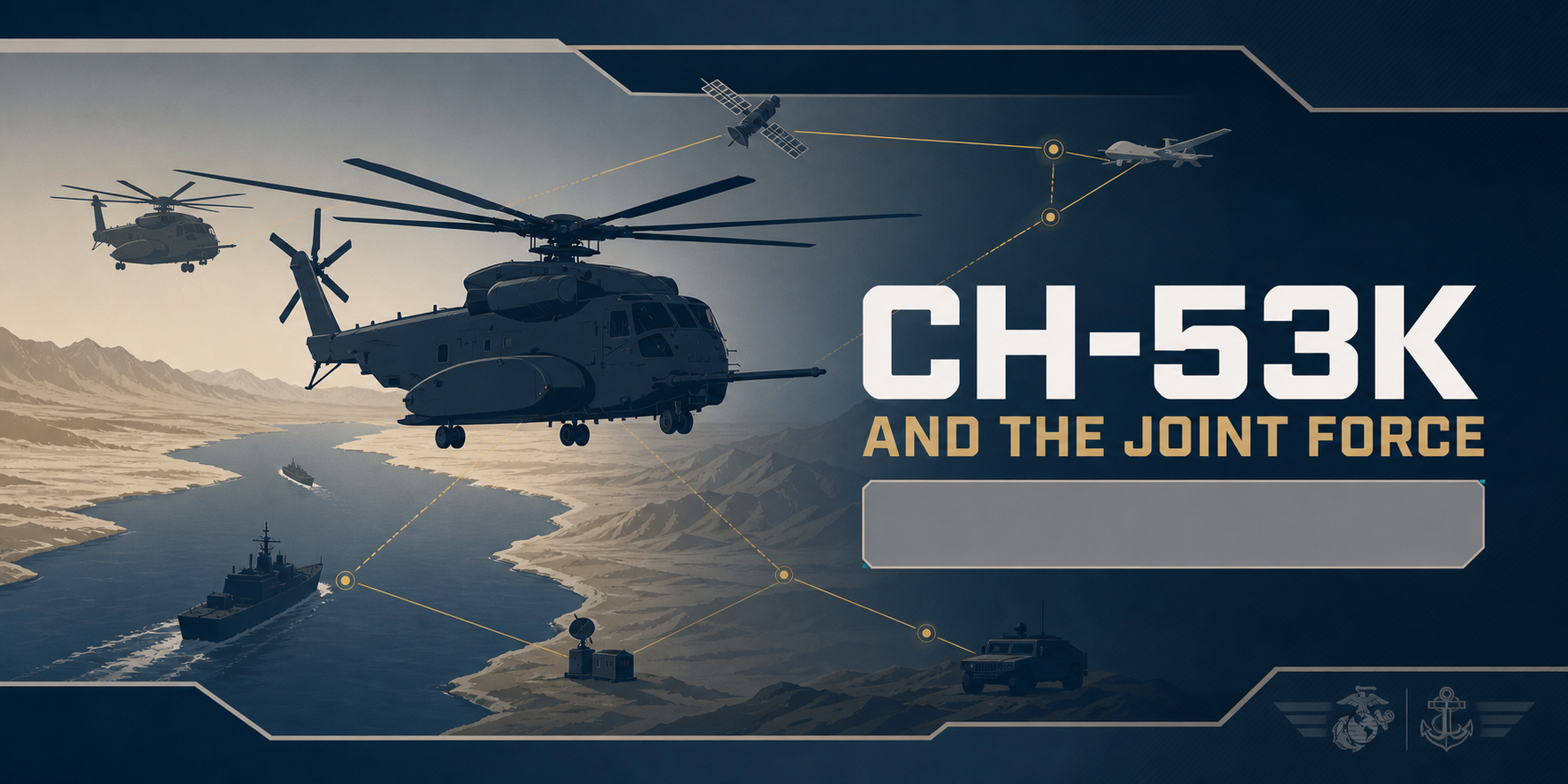
The CH-53K King Stallion is a substantially better enabler of long-range raid operations than its predecessor, the CH-53E Super Stallion.
That claim is not a marketing assertion or a program office talking point.
It follows directly from a comparison of the two aircraft’s performance characteristics against the specific demands of the long-range raid mission profile: extended range, meaningful payload, contested environments, aerial refueling, and the logistical complexity of distributed operations. The Kilo carries far more useful load at range, performs more reliably in the hot-and-high conditions that define the Pacific and Middle Eastern operating environments, and provides crews with handling qualities and systems integration that are qualitatively better suited to the cognitive demands of complex, multi-phase assault support missions.
Understanding why requires working through the comparison systematically. The differences between the two aircraft are not marginal improvements in a single dimension. They compound across payload, range, environmental performance, crew workload, cargo integration, external lift, and reliability and the compounding matters because a long-range raid stresses all of those dimensions simultaneously. An aircraft that is somewhat better in each category is not merely somewhat better at the raid mission; it is categorically more capable of executing it under the conditions that actually obtain in the operational environments the Marine Corps expects to face.
What follows is a systematic examination of those differences and their operational implications, grounded in the mission context that the Weapons and Tactics Instructor course at MAWTS-1 has been using to validate the King Stallion’s role in the emerging distributed operations architecture.
Payload and Range Where It Matters
For a long-range raid, the foundational question is straightforward: how much combat power can you move, how far, under the realistic environmental conditions of the operating area? The CH-53K’s answer to that question is substantially more favorable than the CH-53E’s across the full range of scenarios the Marine Corps plans for.
The Kilo is designed to carry 27,000 pounds at a 110-nautical-mile mission radius under Navy high/hot conditions. the standardized hot-and-high performance benchmark that reflects the challenging density altitudes encountered in Pacific island chains, the Persian Gulf, and the arid interior operating environments of the Middle East and Central Asia. That figure represents nearly three times the external lift capacity the CH-53E can deliver in the same environmental conditions. The Kilo’s maximum external lift capacity reaches 36,000 pounds, driven by three 7,500-shaft-horsepower engines that together produce roughly triple the load-carrying margin of the E in the regimes most likely to constrain a real-world raid mission.
The operational translation of those numbers is concrete and consequential. In a raid context, greater payload at range means fewer aircraft and fewer sorties to move the same ground combat element to the objective. Fewer sorties means fewer windows of exposure for aircraft operating in a contested environment. It means more flexibility in what can be included in the first wave—vehicles, bulk fuel, heavy weapons systems, and the sustainment that turns a raid from a hit-and-run into something the force can consolidate and exploit. It means more margin when density altitude is punishing and the E would already be operating at or near its limits.
Perhaps most importantly in the context of distributed operations, it means planners can consolidate loads that would otherwise require multiple sorties or multiple aircraft into fewer, larger movements. That consolidation is not merely an efficiency gain. It changes the signature and predictability of the logistics chain in ways that have direct implications for survivability in a contested environment where adversary sensors and long-range fires are looking for patterns to target.
Hot-and-High and Degraded Visual Environment Performance
WTI mission profiles are designed to stress aircraft and crews in the conditions most likely to produce failures in real-world operations: hot weather, high altitude, degraded visual environments, night operations, and combinations thereof. This is not coincidental. MAWTS-1’s institutional experience has repeatedly confirmed that the scenarios most likely to produce mission failure, crew error, and aircraft mishaps are not the benign ones—they are the ones where environmental degradation compounds tactical complexity.
The CH-53K’s engines, drivetrain, and rotor system are optimized specifically for high/hot performance. The aircraft maintains significant power margin in density altitude conditions where the CH-53E is already power-limited, conditions in which the Echo’s crews must reduce payload, extend time on the ground during approaches and departures, or accept reduced mission flexibility in order to stay within the aircraft’s limits. The Kilo does not eliminate environmental constraints, but it pushes them significantly further out, giving planners and crews working room that the E simply does not provide in the same conditions.
The practical difference shows up most clearly at the extremes of the mission profile: approaches and departures from austere landing zones at high altitude or in high temperatures, and the ability to maintain heavy external loads when conditions deteriorate during the transit. With the Echo, planners working a raid into mountainous or desert terrain must plan to the edge of the performance envelope, accepting that margin is thin and that any degradation of conditions during execution may force a reduction in payload or an abort. With the Kilo, the same planners can work with a genuine buffer. That buffer is not a luxury; it is the operational difference between a plan that is fragile and one that is robust.
Degraded visual environment performance deserves particular attention. Brownout conditions during landing, dust or sand kicked up by rotor wash obscuring the landing zone, are among the most dangerous phases of helicopter operations in desert environments, and they are effectively unavoidable in many of the operating areas the Marine Corps plans for. The Kilo’s fly-by-wire flight controls and enhanced power margins reduce the risk during brownout approaches in ways that matter to both mission success and crew safety. An aircraft that can execute a brownout landing more reliably, with lower workload and greater stability, is an aircraft that the force can depend on in the conditions that actually obtain rather than the conditions that briefings assume.
Fly-by-Wire and the Cognitive Demands of a Long-Range Raid
A long-range raid is not a single demanding phase of flight. It is a sequence of demanding phases stacked in succession: departure from the ship or forward operating base, low-level transit through potentially contested airspace, an aerial refueling join with a tanker, continued transit, approaches to austere or unprepared landing zones, the raid execution itself, extraction under time pressure, and the return transit which may include another refueling event. At each phase, the crew faces simultaneous demands from the aircraft, from the tactical environment, from the communications architecture, and from the coordination requirements of a composite package that may include multiple aircraft and joint assets.
The CH-53K’s full-authority digital fly-by-wire flight control system is directly relevant to managing that cognitive burden. Fly-by-wire gives the aircraft the ability to hold a precision hover in high winds, stabilize itself in turbulence and degraded visual environments, and compensate automatically for the handling changes that accompany heavy external loads at varying fuel states. The crew does not have to actively manage those compensations. The flight control system handles them, freeing cognitive bandwidth for the tasks that automation cannot perform: threat assessment, tactical decision-making, coordination with other aircraft and ground elements, and the judgment calls that determine whether the mission succeeds or fails.
This distinction—between tasks the automation handles and tasks the crew must handle is not a minor quality-of-life improvement. In the most demanding phases of a long-range raid, every increment of workload reduction is cognitive bandwidth available for the tactical problem. The aerial refueling join is the clearest example. Flying formation behind a tanker, in darkness or marginal visibility, at range, with a heavy load, while managing communications and monitoring the threat picture is among the highest-workload evolutions in rotary-wing aviation. The CH-53K’s fly-by-wire system reduces the purely mechanical demands of that evolution, holding position, managing power, compensating for tanker wake, in ways that meaningfully reduce the probability of a refueling failure or an aircraft handling incident during the join.
Compared to the CH-53E’s mechanical flight controls, the Kilo’s fly-by-wire represents a qualitative improvement in crew capability across exactly the phases that define the long-range raid: night formation flying, aerial refueling joins, brownout landings, and heavy-lift approaches to austere sites. Those phases are not the exception in a raid profile; they are the rule. An aircraft that handles them with lower workload and greater stability is an aircraft that can execute them more reliably, with lower risk, and with more margin remaining for the unexpected contingencies that real-world operations reliably produce.
Cargo Configuration and Joint Integration
Long-range raids in a distributed operations context are as much logistical problems as they are assault support problems. The force arriving at the objective needs not just troops and firepower but sustainment: fuel, ammunition, critical spare parts, and the heavier equipment that gives dispersed stand-in forces the capability to operate persistently rather than merely to arrive and withdraw. How efficiently a heavy-lift helicopter can move that sustainment, in what form, in what quantities, with what compatibility to the broader logistics chain, shapes how effective the raid can be at building something durable rather than merely achieving a transient effect.
The CH-53K’s cabin is approximately twelve inches wider than the CH-53E’s. That dimension, which reads as a modest engineering detail, has significant operational implications. The K can carry 463L pallets, the standard military airlift pallet used throughout the joint logistics system, and it can transport up-armored HMMWVs internally, which the CH-53E cannot do to the same standard. These two capabilities together tie the King Stallion directly into the joint airlift chain. Loads that arrive by C-17 or C-130 can transfer directly into the CH-53K with minimal reconfiguration, moving from strategic airlift to tactical delivery without the time-consuming and labor-intensive process of breaking down and rebuilding loads to fit an incompatible cargo system.
In a raid context, this compatibility is practically significant. It means that serious sustainment, fuel in standard containers, ammunition on standard pallets, critical equipment on standard configurations, can move from theater-level logistics all the way to a forward austere site in fewer handling steps and fewer sorties. It means the Kilo can re-role rapidly between troop lift and logistics support as the tactical situation evolves during the raid execution, without requiring extensive reconfiguration that consumes time the raid timeline may not have. And it means that the planning assumptions connecting strategic and operational logistics to the tactical tip of the distributed operations concept are more reliable when the bridging asset is a CH-53K rather than a CH-53E.
This joint logistics compatibility is not incidental to the Marine Corps’ distributed operations concept. Expeditionary Advanced Base Operations (EABO) and stand-in force concepts depend fundamentally on the ability to sustain dispersed units from a logistics chain that does not require those units to be collocated with fixed infrastructure. The CH-53K’s cargo architecture, wider cabin, 463L compatibility, internal HMMWV carriage, is one of the mechanisms by which that sustainability becomes operationally real rather than conceptually aspirational.
External Lift and the Triple-Hook Advantage
When pushing a raid deep into contested or austere territory, what the aircraft can carry externally is as important as what it can carry internally. External loads, bulk fuel blivets, vehicles, outsized equipment, and the heavy systems that ground forces need to be combat-effective rather than merely present, determine what kind of capability arrives at the forward edge and in what quantity. The difference between arriving with the equipment to hold and operate and arriving without it is frequently the difference between a raid that achieves durable effect and one that achieves only transient disruption.
The CH-53K’s external lift system is built to handle very heavy loads with a triple-hook configuration that enables the carriage of multiple separate loads simultaneously or very large single loads with better center-of-gravity management than a single-hook system allows. The triple-hook architecture gives planners and load crews more flexibility in how they package external loads: two medium loads on the forward and aft hooks, one large load on the center hook, or configurations that match the specific equipment being moved to the hook points best suited to managing the resulting handling characteristics. Combined with the fly-by-wire flight control system’s ability to compensate for the changes in aircraft handling that accompany heavy external loads, the Kilo’s external lift capability is more operationally flexible than the Echo’s.
The CH-53E can lift heavy external loads. It is a capable aircraft in that role and it has done the mission reliably for decades. But it operates with lower margins and less sophisticated load management and flight control integration than the K provides. In hot-and-high conditions, those margins compress further. The practical consequence, in a raid context, is that the Kilo can routinely carry loads in a single evolution, bulk fuel blivets, vehicles, and outsized equipment together, that would require the Echo to either make multiple sorties, accept significantly less range and margin, or leave equipment behind.
For distributed operations specifically, the external lift advantage intersects directly with the logistics architecture the Marine Corps is building. Delivering bulk fuel to an expeditionary F-35B operating site, positioning air defense components at a forward node, recovering a downed rotorcraft from a remote location—all of these missions fall within the CH-53K’s external lift design space in ways they do not for the Echo. Each of them represents a capability the distributed network requires to function, and each of them becomes more reliable and more routinely executable when the heavy-lift asset available is a King Stallion.
Reliability, Maintenance, and Sortie Generation
WTI-style long-range raids depend on aircraft actually making launch times and then turning around on the far side of the mission. A complex, multi-phase raid built around precise timing—in which the assault force, the logistics package, the aerial refueling rendezvous, and the extraction all depend on each element executing on schedule—is acutely sensitive to aircraft availability. An aircraft that goes down for maintenance in the final hours before launch, or that cannot generate the sorties required to support the package, does not just reduce capability; it can compromise the entire evolution.
The CH-53K is a new-build design, not a modernized legacy airframe. Its systems were designed with reliability and maintainability as explicit engineering requirements, reflecting decades of operational experience with the limitations of the CH-53E’s maintenance burden. The Kilo’s projected maintenance man-hours per flight hour are substantially lower than those of the aging Echo fleet, and its diagnostic and prognostic systems give maintenance crews better visibility into aircraft health and better ability to address issues before they result in an unscheduled grounding.
The operational implication is higher sortie generation rates and greater confidence that a planned package will launch with the aircraft it was planned around. For distributed operations, where the logistics chain depends on heavy-lift sorties that are both timely and reliable, that improvement in availability is not merely an administrative convenience. It feeds directly into doctrine. Planners can write execution plans that assume a higher fraction of the available heavy-lift force will be on-spec for demanding missions, plans that are less dependent on the kind of availability hedging that the CH-53E’s maintenance demands have historically required.
Over time, as the Kilo fleet matures and the maintenance community develops deeper experience with the aircraft’s systems, those availability advantages will compound. The institutional knowledge of how to turn the Kilo quickly, how to manage its maintenance schedule to maximize availability during high-tempo periods, and how to use its diagnostics to stay ahead of failures rather than react to them is still being built. The trajectory is clearly in the right direction, and it starts from a materially better baseline than the aging Echo fleet provides.
The Compounding Advantage and Its Doctrinal Significance
The analysis above covers six dimensions in which the CH-53K outperforms the CH-53E in long-range raid operations.
But the most important insight is not the per-category comparison. It is the compounding effect when all six dimensions interact simultaneously, which is exactly what a long-range raid demands.
Consider what the Echo requires of its planners versus what the Kiloallows. A long-range raid with the Echo requires planning to thin performance margins in hot-and-high conditions, accepting that payload will be constrained and that any deterioration of conditions during execution may force an abort or a load reduction. It requires crews to manage higher workload in the most demanding phases, increasing the probability of handling incidents during aerial refueling and brownout operations. It requires more sorties to move the same combat power, which means more exposure, more predictability, and more time in the contested environment. It requires cargo re-handling between joint airlift and helicopter because the Echo’s cargo system does not seamlessly interface with 463L pallets. And it requires planners to hedge against lower availability and higher maintenance uncertainty when building the mission package.
The Kilo removes or significantly reduces each of those constraints simultaneously. Better hot-and-high margins mean plans can be built with genuine buffers rather than against the edge of the envelope. Fly-by-wire means lower crew workload in the most demanding phases and more bandwidth for tactical management. Greater payload at range means fewer sorties and less exposure. 463L compatibility means the joint logistics chain flows end-to-end without the friction of cargo re-handling. Triple-hook external lift means more capability delivered per evolution. Higher reliability means greater confidence that the package will execute as planned.
None of those improvements is individually decisive. But together, they transform what the Marine Corps can ask of its heavy-lift aviation in a demanding, contested environment. The long-range raid that was previously a stress test, executable under favorable conditions, fragile under adverse ones, becomes a more robust and repeatable operational tool. Distributed operations that were previously constrained by what the Echo could deliver at range become more viable because the logistics connector that ties the distributed network together is more capable, more reliable, and more flexibly integrated with the joint force.
That transformation is what the WTI 2-26 long-range raid was, in part, validating. Not the individual capabilities of the King Stallion in isolation, but their combined effect in a demanding, operationally realistic scenario—and the doctrinal implication that the heavy-lift piece of the distributed operations puzzle is, with the CH-53K, substantially closer to solved than it was with the CH-53E.