
The Hybrid Navy Gamble: Why Britain’s Drone-Heavy Fleet Plan Is Drawing Fire
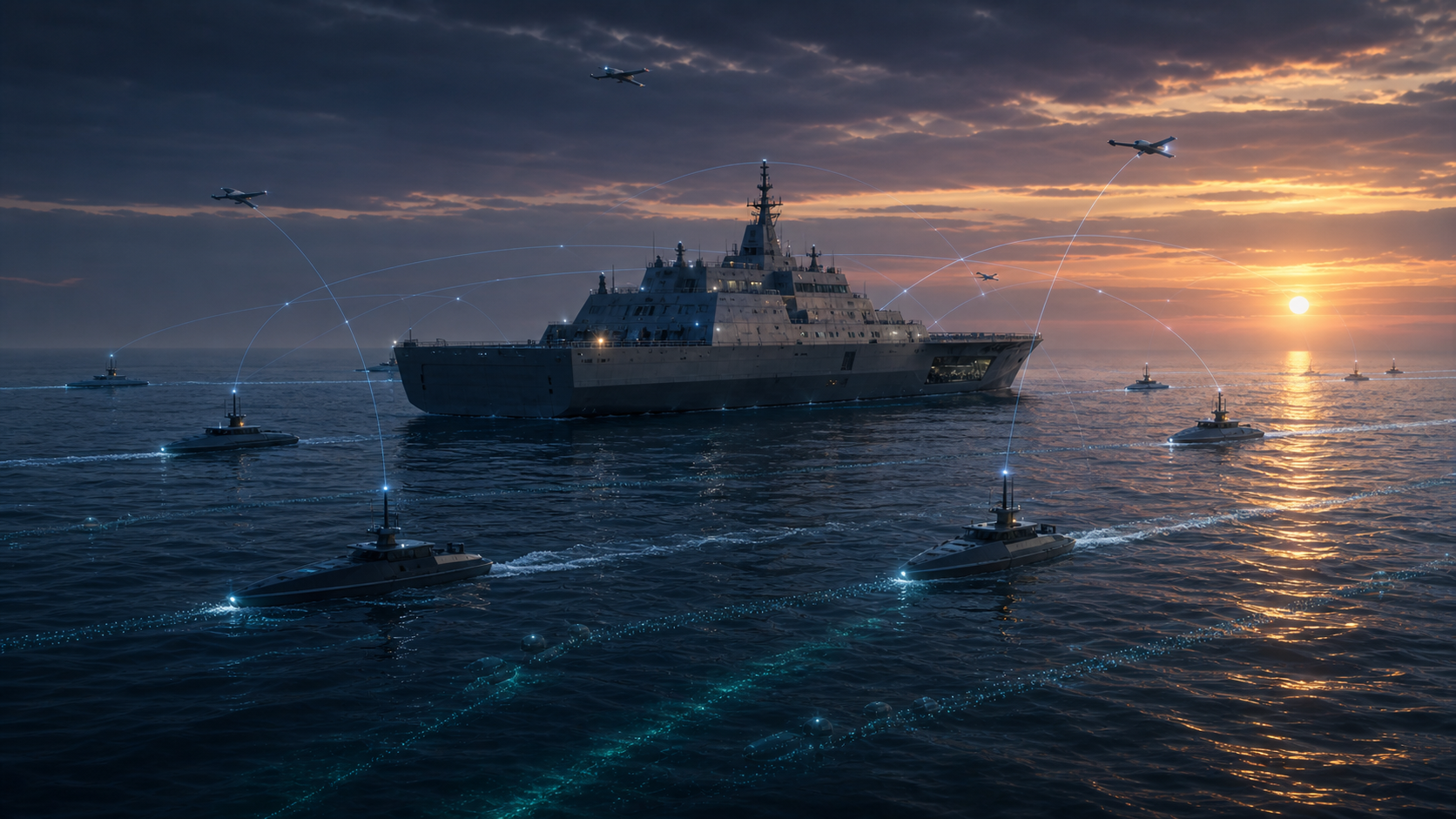
When the United Kingdom’s Ministry of Defence unveiled its Defence Investment Plan (DIP) on 30 June 2026, the government billed it as nothing less than a “generational transformation” of British military power, a £298 billion, four-year commitment designed to translate the 2025 Strategic Defence Review’s ambitions into hard funding lines. Secretary of State Dan Jarvis framed the moment in stark terms: Britain had inherited a defence programme that was “underfunded, overcommitted, and insufficiently attuned to the threats we now face,” with 47 of 49 major projects delayed or over budget. The DIP was meant to be the corrective.
Nowhere is that corrective more visible or more contested than in the plan’s vision for the Royal Navy. The document commits to building what it calls a “Hybrid Navy”: a fleet built around a shrinking core of crewed frigates and destroyers, augmented by a much larger constellation of uncrewed surface and subsurface vessels, all stitched together by artificial intelligence into what the plan terms a “Maritime Fighting Web.” It is, in the government’s own words, a fleet designed to fight the wars of tomorrow rather than refight the wars of yesterday, built on lessons drawn directly from Ukraine’s improvised but devastatingly effective maritime drone campaign against Russia’s Black Sea Fleet.
It is precisely this last claim that the lessons of Ukraine translate cleanly onto a NATO blue-water navy that has drawn the sharpest independent critique. Jennifer Parker, principal and founder of Barrier Strategic Advisory and a widely read voice on naval affairs at the Lowy Institute’s The Interpreter, argues that the UK has taken a real and important lesson from Ukraine and applied it to entirely the wrong problem. Her essay, “Uncrewed and untested: The wrong lessons for a hybrid navy,” published within weeks of the DIP’s release, is worth taking seriously — not because it dismisses the value of uncrewed systems, but because it asks the question British planners appear to have skipped: what, precisely, is this fleet for?
What the Plan Actually Proposes
Strip away the rhetoric and the Hybrid Navy concept rests on a fairly specific set of commitments. The DIP allocates at least £1.3 billion over the next four years to a family of uncrewed platforms: the Type 91 uncrewed missile platform, the Type 92 uncrewed underwater sensing platform, the Type 93 extra-large uncrewed underwater vessel (XLUUV), and the Type 94 uncrewed radar picket. These will operate alongside a new class of crewed “Common Combat Vessels” (CCV), which the plan describes as the “central brain” of the system, the node that connects and directs the uncrewed elements around it.
This is not conceived as a supplementary capability bolted onto an otherwise conventional fleet. It is conceived as a replacement architecture. The plan states explicitly that the Hybrid Navy Maritime Air Defence system, built around Type 91 and Type 94 platforms, will “eventually replace our Type 45 Destroyers, which are due to retire from 2035.” The crewed fleet, meanwhile, is set at roughly 19 major surface combatants: 13 Type 26 and Type 31 frigates (including a much-touted combined fleet arrangement with Norway under the Lunna House agreement) and at least six Common Combat Vessels. Beyond that, the plan envisages Queen Elizabeth-class carriers exploiting uncrewed systems including Collaborative Combat Aircraft and increasingly autonomous rotorcraft to build a “Hybrid Carrier Air Wing,” and an autonomous mine-hunting capability developed jointly with France.
The government’s justification leans heavily, and repeatedly, on Ukraine. The DIP’s foreword invokes “the lessons of Ukraine’s fight to resist Russian invasion,” and the body of the document credits Ukrainian innovation with proving that “cheap, massed, precise systems now dominate” and that “speed is decisive.” Atlantic Bastion — the Royal Navy’s broader anti-submarine warfare initiative, launched in December 2025 and backed by an additional £1.5 billion — is presented as the vehicle through which this drone-enabled, AI-fused hybrid fleet will secure the North Atlantic against a modernising Russian submarine threat, including hybrid activity such as undersea cable sabotage. It is a coherent story, and not an unreasonable one on its face. The problem, according to Parker, is that it mistakes a superficial resemblance — “drones worked in Ukraine, so drones should work for us too” — for a genuine like-for-like transfer of lessons between two navies solving fundamentally different problems.
Sea Denial Is Not Sea Control
Parker’s central analytical move is to draw a sharp distinction between two classical naval missions that are often conflated in public discourse: sea denial and sea control. Ukraine, she notes, faced and largely solved a sea denial problem. Its navy, effectively destroyed or blockaded early in the war, could not hope to contest control of the Black Sea outright. Instead, Ukraine used small, cheap, remotely piloted surface vessels, craft in the 5-to-8-metre range, packed with explosives, in combination with cruise missiles, to make the Black Sea too dangerous for the Russian fleet to operate freely. This was spectacularly successful. It confined much of the Russian Black Sea Fleet to port and reopened a maritime corridor for Ukrainian grain exports, hugging the Turkish coastline. Ukraine also had the advantage of land borders through which weapons and resupply could flow continuously, and it was fighting, in effect, defensively and asymmetrically against a materially superior adversary.
Britain’s problem is not this. As the DIP itself acknowledges, nearly 90 percent of UK freight trade moves by sea. The Royal Navy’s task is not to deny an adversary the use of contested coastal waters near home. It is to project and sustain power across the breadth of the Atlantic, to keep sea lines of communication open against a peer or near-peer adversary, and crucially, to maintain the United Kingdom’s own freedom of manoeuvre rather than merely deny it to someone else. That is the mission of sea control, and it is a fundamentally more demanding one. Sea control requires persistence: the ability to remain on station, in hostile or contested waters, for extended periods, ready to fight at the end of long supply lines rather than a few dozen miles from a friendly port.
Parker’s point is not that uncrewed systems are irrelevant to this mission. Iit is that the specific vessels and doctrine that succeeded in the Black Sea say almost nothing about whether large, long-endurance autonomous warships can deliver sea control in the North Atlantic. These are, in her words, “not the platforms used in Ukraine.” And the scale difference matters enormously: industry concepts for the UK’s planned Type 91/92/93/94 vessels suggest hulls between 80 and 100 metres long, displacing 2,000 to 3,000 tonnes, larger, she points out, than Australia’s Arafura-class offshore patrol vessels, which are themselves crewed. These are not expendable exploding jet-skis. They are warships, expected without a crew.
Three Unresolved Problems: Maintenance, Survivability, Control
Having established that the analogy to Ukraine is weaker than the DIP suggests, Parker turns to the practical engineering and operational questions that she argues the plan glosses over. She identifies three in particular.
The first is maintenance. The sea, she notes flatly, is a harsh environment, and keeping any vessel operational at sea requires constant upkeep, hull fouling, corrosion, mechanical wear, and in this case, the added complication of onboard missile systems that require strict environmental controls and regular attention. A crewed frigate can address emergent problems in real time, with sailors making adjustments, repairs, and judgment calls as conditions change over a deployment lasting weeks or months. An uncrewed vessel deployed for the same duration, by definition, cannot. The Type 91–94 designs do not yet exist in finished form, Parker observes, which means the maintenance burden they will impose is still essentially unknown, a significant gap in a plan asking Parliament to commit tens of billions of pounds against a 2030–2035 delivery horizon.
The second problem is survivability, and it presents planners with an uncomfortable dilemma. If these uncrewed vessels are not equipped to defend themselves, they become obvious priority targets for an adversary, sitting ducks in a contested environment, however capable their sensors or missiles might be. But if they are given self-defence systems, surface-to-air missiles, counter-drone capability, electronic warfare suites, then much of the cost and complexity advantage that makes uncrewed platforms attractive in the first place begins to erode. Every additional system is another point of failure requiring maintenance, another driver of cost, another reason the vessel starts to resemble, in expense if not in crew complement, the very frigates it was meant to replace.
The third problem and arguably the most fundamental is control. Even assuming these vessels can operate with a degree of autonomy for periods, someone still has to coordinate them: pass targeting information, deconflict engagements, and ultimately authorise the use of lethal force. All of that depends on reliable, persistent communications across a contested electromagnetic spectrum. Parker’s point here lands with particular force precisely because it draws on the same conflict the DIP cites as its inspiration: “Fighting in Ukraine has shown how heavily contested the electromagnetic spectrum will be.” In other words, the very war the UK is citing as proof of concept for drone warfare is also the clearest available evidence of how badly things can go for uncrewed systems when jamming, spoofing, and signal denial come into play. An uncrewed missile barge that loses its communications link mid-ocean is not a resilient asset; it is, at best, an expensive and possibly dangerous piece of drifting hardware.
A Fleet Already Thinning
Underlying all three of these technical objections is a broader structural worry about timing and risk. Parker notes that the Royal Navy’s crewed escort fleet has already contracted dramatically from its Cold War peak — from 13 destroyers and 35 frigates in 1990 to just six Type 45 destroyers and seven Type 23 frigates today, with announced decommissioning set to reduce the frigate force to five. The Hybrid Navy concept proposes to address this shortfall not by rebuilding crewed numbers to something approaching historical levels, but by betting that an as-yet-undesigned uncrewed fleet, entering service between 2030 and 2035, will make up the difference. That is a five-to-nine-year window in which the Royal Navy’s actual, provable capability will be thinner than at almost any point in its modern history, resting on a promise rather than a delivered system.
Fleet Design Should Follow the Mission, Not the Fashion
Parker’s closing argument is deliberately simple, and all the more persuasive for its restraint: “Fleet design should begin with the strategic task, not enthusiasm for a particular technology.” She is careful not to dismiss uncrewed systems altogether. She explicitly credits Ukraine with demonstrating “the value of small, expendable systems in achieving sea denial.” Her objection is to extrapolation: the leap from a proven, narrow success (denying an adversary use of coastal waters with cheap, disposable craft) to an unproven, sweeping claim (that large, exquisite, uncrewed warships can deliver sustained sea control across an ocean). Those are different problems, solved historically by different means, and no amount of enthusiasm for artificial intelligence or “wartime pace” procurement changes the underlying physics of maintaining a warship at sea or the underlying difficulty of commanding it through a jammed electromagnetic environment.
Her final warning is aimed beyond Britain’s shores. Naval planners in Australia, the United States, and elsewhere have adopted “hybrid fleet” language of their own, and for navies facing genuine capability gaps, the UK’s approach may look like an attractive, lower-cost shortcut. Parker’s message to those navies is essentially: look closer before you follow. The UK’s Defence Investment Plan commits real money and real strategic risk to platforms that do not yet exist, justified by an analogy that, on close inspection, does not hold. Whether that gamble pays off will not be known until the early 2030s by which point, if Parker is right, the Royal Navy may have already traded a “proven fleet concept of today” for “an untested fleet tomorrow.”
I would add that in my view the problem with ‘hybrid fleet’ is that it sounds like a bolt‑on, the old fleet with a few unmanned accessories. The real design question is how to build a mesh fleet or intelligent‑mass fleet, where the web itself is the capital asset. What the Navy currently calls a ‘hybrid fleet’ is, at best, an early step toward a capital mesh fleet in which combat power, logistics, and cognition are all distributed across a manned–unmanned mesh rather than concentrated in a few exquisite hull
What Parker criticizes in the UK case, I take to the next level in a book to be published next year entitled: Re Imagining Capital Ships in the Autonomous Era: An Early Agenda of Questions for Naval Power. This book argues that the age of the singular, exquisite capital ship is ending and that navies that cling to it will lose the next serious fight. In an autonomous era, the true “capital asset” is no longer a single hull but the kill web itself: the network of sensors, shooters, decision‑makers, industrial capacity, and unmanned mass that can sense, understand, decide, and adapt faster than an adversary can strike.
Re‑Imagining Capital Ships in the Autonomous Era takes the reader from concept to design choice, showing how carriers, surface combatants, amphibious ships, auxiliaries, and even commercial hulls must be built and retrofitted as node hosts and motherships for a distributed mesh of manned and unmanned systems. It lays out concrete design imperatives, power and volume for future C2, built‑in unmanned launch and recovery, web‑level survivability, contested‑EM operations, and industrial surge capacity, and then follows them through force structure, logistics, and coalition planning. Rather than offering yet another platform shopping list, it presents a research and design agenda for navies and industries that must choose, explicitly and soon, between doubling down on exquisite scarcity or generating resilient, regenerable intelligent mass at scale
See the following:
https://www.gov.uk/government/publications/the-defence-investment-plan