
The Coast Guard’s Offshore Patrol Cutter Program: The Challenge of Overcoming Persistent Structural Challenges
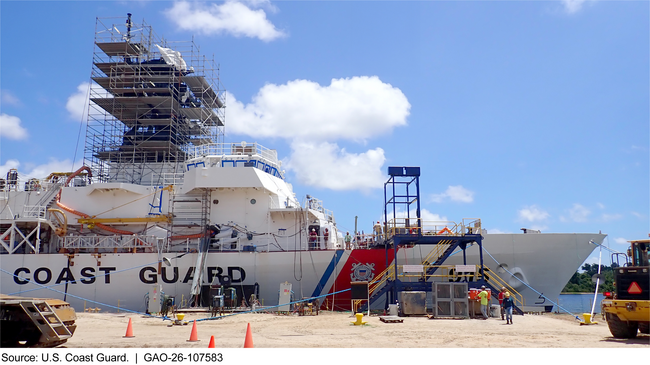
The Government Accountability Office’s latest report on the Coast Guard’s Offshore Patrol Cutter program reads like a script we’ve seen before—and that’s precisely the problem. When GAO warns of “costly rework” and “schedule delays” stemming from the decision to begin construction before achieving design stability, those familiar with Coast Guard acquisition history experience an unsettling sense of recognition. This isn’t just another troubled program; it’s a pattern that speaks to deeper institutional challenges in how the service approaches major capital investments.
The OPC is not a marginal program; it is a generational recapitalization effort intended to replace aging Medium Endurance Cutters that have long exceeded their design service lives. The Coast Guard plans to spend more than $17 billion to acquire 25 cutters in three stages, with stage 1 awarded to Eastern Shipbuilding Group in Florida, stage 2 to Austal USA in Alabama, and stage 3 to be competed later once operational testing validates performance. On paper, this phased approach promised disciplined risk management: learn from the first tranche, refine with the second, then commit fully in the third.
In practice, the OPC story has unfolded as a case study in acquisition déjà vu. The Deepwater program’s failures, the troubled path of the National Security Cutter, and recurring issues with the Fast Response Cutter all reflected the same underlying pattern: optimistic schedules, insufficient design maturity, and a willingness to start building before the technical foundation is ready. The GAO’s latest findings show that the Coast Guard has again crossed this threshold, accepting high levels of concurrency between design and construction and reaping predictable consequences.
GAO’s central critique is straightforward: both stages of OPC production have advanced into construction without stable designs. For stage 1, Eastern Shipbuilding began work on the first four ships before functional and production designs were fully mature; as of May 2025, 2D design drawings had crept from 91 to only 93 percent complete, with the remaining packages concentrated in complex distributive systems and the novel davit arrangement. Those seemingly small gaps translated into extensive out‑of‑sequence work, cable re‑routing, structural re‑cuts, and other rework that cascaded through the shipyard.
Stage 2 was billed as the course correction, yet Austal USA began construction of OPC 5 in August 2024 without achieving design stability, even as it adopted some leading practices such as collaborative design reviews. In complex shipbuilding, that is the equivalent of breaking ground on a skyscraper while the engineering drawings are still in flux: every late change propagates through electrical, mechanical, and structural systems, turning what should be engineering work at the drawing board into expensive, schedule‑killing rework on the production floor. The GAO explicitly links this concurrency to increased risk of “costly rework” and further delays for stage 2 if additional hulls are authorized before the design is locked down.
The consequences are already visible in both program metrics and fleet readiness. Delivery of the stage‑1 lead ship, OPC 1, has slipped repeatedly and is now projected no earlier than December 2026—over five years later than originally planned. Construction on OPCs 3 and 4 under Eastern Shipbuilding has been terminated for default, with the Coast Guard still determining how and where those hulls will ultimately be completed. Meanwhile, the Medium Endurance Cutters that OPCs are meant to replace must stay in service longer, driving up maintenance costs, reducing availability, and extending operational risk for crews.
On the cost side, GAO reports that the total acquisition estimate has climbed significantly, with stage 1 ship production costs rising by hundreds of millions of dollars between the 2022 and 2023 estimates and later stages similarly adjusted upward as more realistic assumptions replaced earlier optimism. DHS’s independent cost analysis judged the updated estimate technically sound but flagged major affordability concerns, including skepticism that four OPCs could be procured within earlier funding envelopes without substantial changes. Delays and rework do not just strain the OPC budget; they crowd out other Coast Guard priorities and erode confidence on Capitol Hill that the service can manage complex capital investments effectively.
The GAO report and your analysis converge on a deeper point: these are not isolated miscalculations but manifestations of structural pressures within Coast Guard acquisition. The service operates as an “acquisition‑constrained” organization, expected to field multi‑mission, ocean‑going platforms on a fraction of the resources available to the Navy.
To get programs approved and funded, leaders are incentivized to adopt aggressive schedules and lean cost assumptions, banking on future fixes rather than insisting on conservative, technically grounded baselines.
At the same time, day‑to‑day operational demands are relentless.
Aging cutters must interdict drugs, interdict migrants, enforce fisheries laws, support Arctic and polar operations, and respond to maritime emergencies every year that new ships slip to the right. That operational urgency feeds the temptation to push into construction before designs are fully mature, rationalized as an acceptable risk in the face of “real‑world” mission needs.
The result is a recurring collision between operational tempo and engineering reality, where the short‑term drive to start building undercuts the long‑term goal of predictable, affordable delivery.
Another revealing strand in the GAO narrative is the reliance on Navy institutions for technical oversight and earned value management. The Coast Guard does not possess its own organic shipbuilding supervision infrastructure; instead, it depends on the Supervisor of Shipbuilding, Conversion and Repair (SUPSHIP) and the Defense Contract Management Agency (DCMA) to monitor cost and schedule performance, particularly at Austal.
GAO notes that DCMA identified significant deficiencies in Austal’s earned value management system and that SUPSHIP has disapproved that system and initiated payment withholds on a Navy contract while working through corrective action plans.
GAO recommended a formal agreement spelling out how the Coast Guard and Navy will coordinate EVM oversight and supervision of Austal’s OPC work, including how withholds and approvals will be applied.
DHS, through its financial management leadership, rejected this recommendation, arguing that existing informal coordination is adequate and presents a united front to the contractor.
That resistance underscores a tension between the desire to retain Coast Guard program autonomy and the practical need for clear, documented governance when problems emerge. When personal relationships and handshake understandings substitute for formal roles and responsibilities, oversight can become brittle just when pressures are greatest.
The program’s staged structure was supposed to ensure that by the time stage 3 was on the table, the Coast Guard would have hard data from testing to validate that OPC designs meet key performance parameters such as endurance, seakeeping, and the demanding davit performance in sea state 5. GAO concludes that this sequence is unlikely to occur: critical operational test results probably will not be available before the Coast Guard must begin work on stage‑3 procurement activities, including drafting the request for proposals.
This raises the specter of yet another round of commitments made ahead of knowledge.
If stage 3 moves forward without incorporating lessons from stage 1 and 2 trials, any latent design deficiencies, whether in mission systems integration, survivability, or the complex small‑boat launch and recovery architecture—risk being propagated into ten additional hulls.
Conversely, if contracts include wide‑open modification clauses to hedge against unknowns, cost control and schedule predictability suffer. GAO therefore urges DHS and the Coast Guard to explicitly map out how test data and other leading practices will be used to shape stage‑3 decisions rather than allowing budget cycles and industrial‑base concerns to dictate the timeline.
GAO’s recommendations amount to a call for discipline at three key decision points.
- First, stabilize the stage‑2 design before authorizing construction of additional cutters, to avoid repeating stage‑1’s pattern of rework and delay.
- Second, disaggregate the single, program‑wide cost goal into stage‑specific cost goals so decision‑makers can see how each shipbuilder and phase is performing and hold them accountable.
- Third, codify how test results and shipbuilding best practices will inform stage‑3 acquisition planning and create a formal framework for Coast Guard–Navy coordination on oversight at Austal.
DHS concurred with only two of the four recommendations, most notably resisting formalization of Navy–Coast Guard supervision and defending its threshold‑based view of “minimum design maturity” as adequate justification for starting stage‑2 construction.
That mixed response highlights leadership’s dilemma: acknowledging structural flaws invites external criticism and potential funding vulnerabilities, while downplaying them risks deeper, more costly failures later.
The OPC program’s trajectory illustrates a hard truth about Coast Guard shipbuilding: technical best practices and institutional behavior remain misaligned.
Breaking the cycle will require:
- Accepting slower program starts in exchange for genuine design stability, rather than treating design maturity criteria as thresholds to be minimally cleared.
- Strengthening risk assessment so that decisions like starting construction without stable designs are clearly recognized as high‑probability, high‑consequence gambles rather than routine trade‑offs.
- Formalizing governance with Navy oversight partners to ensure that EVM data, schedule quality, and corrective actions are managed through clear, enduring mechanisms rather than informal understandings.
- Embedding organizational learning across leadership rotations so that the painful lessons of Deepwater, the National Security Cutter, and now the OPC are not rediscovered afresh with each new program generation.
The GAO report provides not just a critique but a roadmap: a staged program that actually waits for knowledge before commitment; cost goals that illuminate where risk is concentrated; oversight arrangements that match the technical complexity of modern cutters; and a timeline that respects engineering realities as much as operational urgencies.
Whether the Coast Guard can align its internal incentives, external pressures, and industrial relationships to follow that roadmap will determine not only the fate of the OPC, but the credibility of its broader modernization agenda for years to come.
The photo is from the GAO’s web page highlighting the report.