
Marine Corps Aviation Transformation: A Comprehensive Analysis of the 2025-2026 Aviation Plans
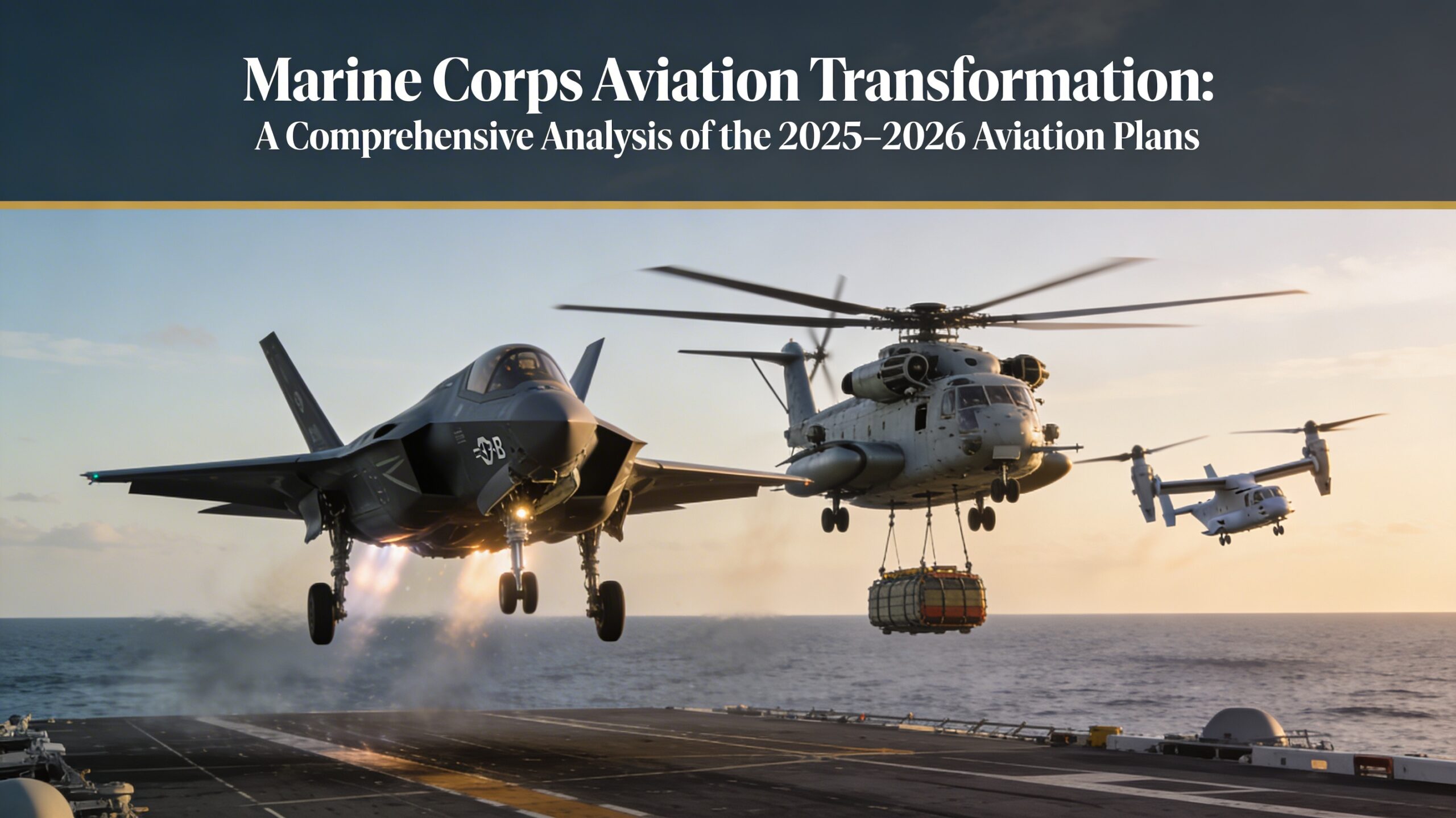
The United States Marine Corps stands at a critical inflection point in its aviation modernization journey. The 2026 Marine Aviation Plan represents not merely an incremental update to the previous year’s strategy, but rather a fundamental acceleration of the service’s transformation toward a distributed, data-enabled, and decisively lethal Aviation Combat Element (ACE).
This article examines the evolution between the 2025 and 2026 plans, revealing how the Marine Corps is balancing immediate readiness requirements with aggressive modernization imperatives designed to outpace peer competitors in contested environments.
The 2025 Aviation Plan operated within the broader Force Design 2030 framework, emphasizing expeditionary operations and distributed lethality. While these concepts remain foundational, the 2026 plan introduces Project Eagle as the strategic blueprint specifically for Marine Aviation. This represents a significant maturation in how the service articulates its aviation transformation.
Project Eagle extends planning horizons across three Future Years Defense Programs (FYDPs), creating a structured approach that translates operational requirements into deliberate, long-term modernization.
This framework addresses a persistent challenge in defense acquisition: the tendency to optimize for near-term budget cycles at the expense of strategic coherence. By extending the planning aperture to encompass FYDP-1 (2026-2030: “Fight Tonight”), FYDP-2 (2031-2035: “Bridge the Gap”), and FYDP-3 (2036-2040: “Future Fight”), Project Eagle ensures that aviation capabilities evolve at the speed of relevance rather than the pace of bureaucratic processes.
Central to the 2026 plan is the T-E-A-M framework, which serves as both an operational philosophy and an organizational culture statement:
- Take care of our Marines, Sailors, and aircrew
- Execute the Basics with Brilliance and precision
- Attain and Maintain our Mission Readiness
- Mitigate Risk in everything we do
This framework represents more than aspirational language. It acknowledges that technological superiority alone cannot guarantee success: the human dimension remains decisive. The emphasis on executing basics with brilliance addresses a sobering reality revealed in mishap analysis: 78.8% of aviation mishaps involve human factors, with nearly 30% attributable to procedural non-compliance. The ambitious “26 in 26” safety initiative, aiming to reduce total Class A-D mishaps by 26 in fiscal year 2026, demonstrates how the T-E-A-M philosophy translates into measurable outcomes.
Operational Concepts: Distributed Aviation Operations and Decision-Centric Warfare
Both plans emphasize distributed operations, but the 2026 plan provides substantially greater clarity on implementation. DAO is explicitly defined as “Marine Aviation’s central contribution to Expeditionary Advanced Base Operations (EABO) and the Corps’ ability to operate inside contested maritime spaces.” This operational concept disperses aviation assets across multiple expeditionary sites to increase survivability, complicate adversary targeting, and provide persistent support to the Stand-In Force.
The 2026 plan goes beyond conceptual descriptions to address the practical enablers of distributed operations. It identifies Aviation Ground Support (AGS) as the “backbone of DAO,” elevating it to the seventh function of Marine Aviation. This organizational change recognizes that as the ACE becomes more distributed and expeditionary, AGS becomes the critical determinant of whether Marine Aviation can sustain combat power in contested environments. The plan directs comprehensive recapitalization of AGS capabilities, ensuring the ACE can generate fuel, power, maintenance, mobility, airfield services, and expeditionary infrastructure from austere and rapidly shifting locations.
Perhaps the most significant conceptual advancement in the 2026 plan is the formal introduction of Decision-Centric Aviation Operations. DCAO enhances DAO by increasing the speed and quality of decision-making through data, digital tools, and emerging AI/ML-enabled decision support. Positioned as the aviation-specific application of the service’s Project Dynamis initiative, DCAO connects Marine Aviation transformation to the broader Department of Defense effort to build an AI-powered, decision-centric warfighting network.
DCAO addresses a fundamental challenge of distributed operations: maintaining decision advantage when forces are dispersed across vast distances and operating under communications constraints. By achieving “data dominance, the ability to sense, process, share, and act on information faster than an adversary”, DCAO ensures distributed sites remain connected, informed, and decision-relevant. As the capability matures, it will enable distributed forces to rapidly re-task, adapt to changing conditions, and close kill webs faster than any competitor.
Platform Modernization: Accelerating Transitions and Expanding Capabilities
Tactical Aircraft: The F-35 Transition Intensifies
Both plans detail the ongoing transition to the F-35, but the 2026 plan reflects a force moving beyond initial operational capability toward full integration. By the end of 2026, the Marine Corps will have received 205 F-35B and 56 F-35C aircraft, supporting 14 fleet squadrons plus developmental/operational test units and Fleet Replacement Squadrons on both coasts.
A significant development detailed in the 2026 plan is the decision to increase all fleet F-35 squadrons from 10 to 12 Primary Aircraft Available (PAA). This expansion, with aircraft increases beginning in FY30 and manpower changes implemented in FY28, reflects operational analysis demonstrating that larger squadrons enhance deployment flexibility and maintenance capacity. The plan projects the total inventory will reach 313 aircraft to support this expanded structure.
The 2026 plan also provides greater specificity on F-35 modernization priorities. Technical Refresh-3 (TR-3) aircraft continue delivery, providing the hardware foundation for future Block 4 capabilities. Critical weapon integrations receive detailed attention, with the fielding of software builds 30P08 and 40P02 bringing Small Diameter Bomb II to the fleet. The plan emphasizes accelerating integration of AGM-88G AARGM-ER, the AGM-158 family (JASSM-ER and LRASM), AIM-9X Block II+, and Six-in-the-bay configurations for the F-35C.
Perhaps most significantly, the 2026 plan positions the Marine Corps as leading the integration of Collaborative Combat Aircraft with the F-35. The MAGTF Unmanned Expeditionary TACAIR (MUX-TACAIR) program will increase F-35 survivability and lethality, enabling successful mission execution across a wide range of developing threat environments.
The F/A-18 Final Chapter
While both plans acknowledge the F/A-18 Hornet’s approaching sunset, the 2026 plan provides precise timelines and demonstrates the service’s commitment to sustaining capability through transition. The Hornet will continue supporting Unit Deployment Program requirements through the end of FY28, with VMFA-323’s dual-mission role as both operational squadron and Fleet Replacement Squadron consolidated into an FRS function in FY26.
The 2026 plan details aggressive final-fit modernization initiatives designed to maximize Hornet relevance and survivability through sundown. The completion of AN/APG-79(v)4 Active Electronically Scanned Array radar fielding by FY26 represents a quantum leap from mechanically scanned radar technology. Combined with a modern electronic warfare suite, the pursuit of net-enabled extended-range weapons, beyond-line-of-sight communications, and Auto Ground Collision Avoidance System integration, these enhancements significantly improve the Hornet’s readiness, lethality, and survivability for its remaining service life.
AV-8B Harrier: Honoring a Legacy
The 2026 plan provides comprehensive details on the AV-8B Harrier’s sunset, including formal commemoration events scheduled for June 2026 at MCAS Cherry Point. VMA-223’s final operational detachment with the 22nd MEU represents the culmination of decades of service. The plan explicitly addresses the transition pathway for Harrier personnel, with highly experienced aircrew and maintenance personnel primarily transitioning to the F-35B, ensuring their expertise continues benefiting Marine Aviation.
Tiltrotor Aviation: MV-22 Sustainment and Modernization
Both plans address MV-22 operations, but the 2026 plan provides significantly greater detail on initiatives to enhance reliability, safety, and operational capability. The Proprotor Gearbox improvements represent the most visible safety-focused initiative, with the introduction of the -119 PRGB (using Triple-Melt steel for critical components) in June 2025, followed by the enhanced -123 PRGB in January 2026. The plan projects an unrestricted operational fleet by December 2027 and complete transition to -123 gearboxes by January 2033.
Beyond safety improvements, the 2026 plan details ambitious modernization initiatives. The Osprey Drive System Safety and Health Instrumentation (ODSSHI) program will incorporate sensors in critical areas of the PRGB and drivetrain, providing vibration signature data that enables proactive maintenance by forecasting component failures. The V-22 Fleet Optimization and Reduction in Configuration Effort (VFORCE) initiative will convert Block B airframes to Block C-Mission Computer Obsolescence Initiative configuration, reducing unique configurations and standardizing aircraft capabilities across the fleet.
The 2026 plan also addresses a critical operational limitation: the pivot from Tailored Nacelle Improvements to full Nacelle Improvements, replacing entire nacelle assemblies rather than focusing solely on wiring bundles. This decision, informed by validated performance data from Air Force Special Operations Command V-22 operations, promises substantial readiness gains that single-system improvements could not achieve.
Heavy Lift: CH-53E to CH-53K Transition
The CH-53K transition continues as a centerpiece of both plans, but the 2026 plan provides enhanced clarity on deployment timelines and operational capability milestones. HMH-461, the first operational squadron, achieved its full complement of 16 aircraft in FY26, transitioning from 0.75 to 1.0 unit status. The plan projects the first CH-53K MEU detachment will CHOP (Change of Operational Control) in FY26, preparing for its first operational deployment in FY27.
The 2026 plan explicitly addresses the complex sequencing required for MARFORPAC Echo-to-Kilo transition, which requires sufficient aircraft inventory to support MARFORCOM requirements and a delivery schedule capable of sustaining consecutive transitions. The planned deployment order, West Coast MEUs (11th, 13th, 15th), then 31st MEU, then UDP, ensures maximum HMH capacity is maintained with minimal impact on deploy-to-dwell ratios.
Significantly, the 2026 plan identifies three “pillars” supporting CH-53K deployment decisions: Aircraft Inventory, Sustainment (Spares and Repairs), and Aircraft Capability. This framework provides transparency into the decision-making process and helps fleet operators understand the interdependencies that govern transition timelines.
Attack and Utility Helicopters: H-1 Mid-Life Modernization
Both plans address H-1 modernization, but the 2026 plan provides substantially greater detail on the Structural and Power Improvement for Next-gen Effects (SPINE) program and its integration with advanced weapons and survivability systems. SPINE provides greater electrical power capacity to expand current warfighting capabilities and enable integration of future weapons including Precision Attack Strike Munition, AIM-9X, and counter-unmanned aerial systems capabilities.
The 2026 plan also details initiatives to grow the two East Coast squadrons from 0.75 to full 1.0 squadrons by the end of FY31, increasing total aircraft inventory to 313 H-1 aircraft and achieving 6.0 squadron equivalents. This expansion addresses a persistent shortfall in East Coast assault support capacity.
Digital Transformation: The Foundation of Decision Advantage
While the 2025 plan acknowledged digital interoperability importance, the 2026 plan positions DI/MAGTF Agile Network Gateway Link (MANGL) as fundamental to achieving decision advantage in distributed operations. The plan articulates a clear vision: providing information to users at the right time to successfully engage adversaries and improve operational efficiency during conflict and competition.
The 2026 plan details the “four pillars of DI”, sensors, processors, interfaces, and radios/apertures, that platforms must integrate to reliably exchange relevant information. It outlines modernization strategy to update architecture and align with Combined Joint All-Domain Command and Control (CJADC2) architecture while maintaining alignment with waveform advancements and other service investments.
Significantly, the 2026 plan details fleet employment initiatives that extend DI/MANGL capabilities beyond aircraft. The Extended Tactical Network enables connections and mission synchronization across multiple theaters, supporting ChatSurfer communications and Tactical Assault Kit server connections. MEU Landing Force Operations Centers “Fly away kits” and tactical vehicles equipped with DI kits enable situational awareness of command operations centers and dismounted forces.
The MV-22 serves as the lead platform for DI/MANGL, with a capability demonstration supported by PMA-275 scheduled for early FY26 and platform fielding decision expected in FY27. The plan details integration efforts for KC-130J and CH-53K, while noting the H-1 program is integrating and fielding DI systems through PMA-276.
Artificial Intelligence and Machine Learning in Aviation Sustainment
The 2026 plan introduces a comprehensive framework for “Transforming Aviation Sustainment for the Future Fight” through AI/ML integration. This initiative directly addresses the problem statement: “Marine Corps Aviation remains reactive in maintenance, supply, and operations planning, limiting readiness and reducing the ability to sustain distributed aviation operations and crisis response.”
The plan organizes AI/ML integration into three Lines of Operation:
- Line of Operation 1: Dynamic Aviation Supply focuses on revising supply package structures to provide sufficient depth for highly dynamic, nodal webs of aircraft and support sites. The initiative evolves Supplemental Aviation Spares Support employment and leverages AI/ML capabilities to review support packages, capturing latest configurations and failure rates to improve deployed aircraft readiness rates while reducing costs and material footprint.
- Line of Operation 2: Predictive Maintenance represents a fundamental transition from reactive to proactive maintenance culture. The plan details partnerships with industry to explore Advanced Maintenance Training Academies that leverage manufacturer instructors and engineering specialists, providing hands-on experience and 3D courseware for critical maintenance tasks on H-1 and V-22 aircraft. These programs establish a strong baseline for Maintenance Chiefs while fostering a culture of maintenance excellence.
- Line of Operation 3: Optimized Operations expands data-centric warfighting across the full spectrum of aviation activities by fusing data from historically separate systems like NALCOMIS, M-SHARP, and GCSS-MC. The plan describes developing a suite of AI-enabled tools to automate and optimize complex, data-intensive tasks of scheduling and managing flight operations and maintenance. The ultimate outcome is a direct increase in combat readiness and lethality by generating safer, more efficient operations that reduce unscheduled downtime and increase aircraft availability.
Weapons and Electronic Warfare: Extending Reach and Enhancing Lethality
Long-Range Precision Fires
Both plans emphasize long-range precision strike, but the 2026 plan provides specific timelines and integration details. The AGM-158C LRASM C-1 variant achieved operational fielding on F/A-18E/F in FY24, with integration continuing on F-35B and F-35C. The production line will cut in the upgraded C-3 variant beginning in FY26, providing even more capability within the FYDP.
The 2026 plan also details continued development and integration of stand-off and net-enabled weapons on the F-35, with weapons acceleration efforts fielding highest-priority capabilities to operational commands quickly while providing maximum envelope and operational flexibility. Net Enabled Weapons University will help meet increased demand for subject matter experts to assist in holistic squadron training for maintainers and operators.
Rotary-Wing Precision Munitions
A significant development detailed in the 2026 plan is the formal initiation of the Precision Attack Strike Munition (PASM) Program of Record, transitioning from the Long-Range Attack Missile Defense Innovation Acceleration. The LRAM DIA completed its Operational Demonstration in September 2025 with successful employment from an HX-21 AH-1Z. Efforts now focus on fielding capability as quickly as possible to deployed squadrons during FY27.
The plan also details continued development of the Advanced Precision Kill Weapon System, with efforts to improve APKWS in conjunction with Navy and Air Force. These enhancements, already demonstrated by Marine H-1s against various air and ground targets, significantly improve ability to provide offensive and defensive air support.
Electronic Warfare Modernization
While both plans address electronic warfare, the 2026 plan provides substantially greater detail on the Intrepid Tiger II EW Family of Systems and future development pathways. Current capabilities include IT-II Versions (V)1 and (V)3 deployed on AV-8B and UH-1Y respectively, with (V)4 in developmental test on MV-22B targeting IOC in FY27. IT-II Block 5 incorporates Counter-Radar capabilities with priority platforms being UH-1Y, AH-1Z, MV-22, and KC-130.
The 2026 plan details ambitious future initiatives including Common Architecture for Persistent EW (CAPE), which allows operationalized capabilities such as Multi-Domain Strike, and development of MUX TACAIR EW capabilities to increase survivability and lethality of manned platforms. A Common Framework Environment will deliver flexible government-owned software architecture for EW, geolocation, waveform, SIGINT, and other electromagnetic spectrum operations capabilities supporting multiple platforms and vendors.
Ground-Based Air Defense: Capability Acceleration
Both plans address Marine Air Defense Integrated System fielding, but the 2026 plan reflects accelerated delivery and expanded force structure. The plan projects 190 total MADIS systems with IOC in FY25 and FOC in FY33, providing foundational capability for Low Altitude Air Defense Battalions and Littoral Anti-Air Battalions.
The 2026 plan details the MADIS C-UAS Engagement System, which enhances lethality by integrating an autonomous effector for Group 1-2 UAS and an economical effector for Group 2-3 UAS and fixed- or rotary-wing threats. Future efforts focus on integrating CES and MADIS subcomponents onto unmanned ground vehicles, along with investing in emerging technologies such as directed energy, low-cost kinetic effectors, and the Army’s Next Generation Short Range Interceptor.
Medium Range Intercept Capability
The 2026 plan provides comprehensive details on Medium Range Intercept Capability fielding, with 3 Batteries comprising 48 launchers achieving IOC in FY26 and FOC in FY30. MRIC complements MADIS and L-MADIS by extending engagement options to advanced threats, integrating with Marine Corps radars and C2 systems to provide mobile and expeditionary medium-range defense.
A significant development detailed in the 2026 plan is the reactivation of 4th LAAD in FY29 with an intended FOC of 12 MADIS systems in FY33. This addresses the longstanding gap of LAAD capability in reserves to augment active component and catch talented LAAD Marines leaving the force.
Aviation Expeditionary Enablers: Restructuring for Distributed Operations
Multifunction Air Operations Center
The 2026 plan provides comprehensive details on the transition to Multifunction Air Operations Center, which enhances MAGTF lethality, operational depth, and flexibility compared to legacy air C2 models. The transition plan includes:
- FY26: All Direct Air Support Center and Tactical Air Operations Center Marines consolidate into unified cadre of MAOC Marines
- FY27-28: Active component MACGs restructure to establish Marine Air Support Squadrons purpose-built for MAOC employment and Marine Air Control Squadrons optimized for air traffic control and Tactical Air Command Center missions
- FY29: Reserve Component reorganization
This organizational transformation represents fundamental reconceptualization of how Marine Aviation conducts command and control in distributed environments.
Air Traffic Control Modernization
The 2026 plan details significant air traffic control modernization initiatives. The Expeditionary Airport Surveillance Radar is expected to achieve IOC in FY28, replacing the surveillance function of ATNAVICS while bringing increased capability. Aligned with EASR fielding, efforts are underway for Expeditionary Precision Approach Landing Capability to support operations in contested environments, critical to distributed aviation operations.
MATC has also begun integration of MANGL/MAGTAB within its formations to enable scalable, interoperable situational awareness at remote air sites and Forward Arming and Refueling Points, ensuring air traffic control functions as an effective node within the broader Marine Air Command and Control System.
Aviation Ground Support Elevation
As previously noted, the 2026 plan elevates AGS as the seventh function of Marine Aviation, acknowledging its criticality to distributed operations. The plan details comprehensive AGS systems modernization including:
- VTOL Surfacing Systems (52 systems, FOC FY26)
- Aircraft Arresting System Replacement (25 systems, IOC FY29, FOC FY33)
- C-130 Transportable ARFF Apparatus (68 systems, currently unfunded, IOC FY28)
- Tactical Aviation Ground Refueling System (78 systems, FOC FY26)
The plan also identifies future AGS capabilities under development: Rapid Intervention System (compact, MV-22 transportable firefighting), Expeditionary Fuel Truck (C-130 transportable refueling asset), Expeditionary Dust Abatement System (water and soil palliative distribution), and Automated Airfield Damage Assessment System (sUAS equipped with multi-spectral imaging and LiDAR powered by AI-driven analysis).
Unmanned Systems: Expanding the Footprint
While both plans address MQ-9A operations, the 2026 plan reflects a force moving beyond initial operating capability toward comprehensive integration. The detailed capabilities schedule projects:
- VMU-1: 6 AV-25, 6 GCS, 3 Sky Tower 1, 6 Sky Tower 2, 6 pLEO, 6 DAAS, 5 ES
- VMUT-2: 4 AV-25, 3 GCS, 4 Sky Tower 2, 4 pLEO, 4 DAAS
- VMU-3: 6 AV-25, 4 GCS, 3 Sky Tower 1, 7 Sky Tower 2, 6 pLEO, 6 DAAS, 5 ES
- VMX-1: 2 AV-25, 1 GCS, 3 Sky Tower 1, 2 Sky Tower 2, 2 pLEO, 2 DAAS, 1 ES
This expansion reflects recognition that VMU squadrons operating from expeditionary sites in the Pacific provide the MAGTF with continuous reach and decision advantage. The 2026 plan positions MQ-9A as delivering Maritime Domain Awareness, extending MAGTF C2, and integrating seamlessly into Naval and Joint campaigns.
MUX TACAIR: Leading Edge Innovation
The 2026 plan details the Marine Corps’ leading role in developing and fielding Collaborative Combat Aircraft integrated with F-35. MUX TACAIR Increment I focuses on providing low-cost, risk-worthy capability that enhances F-35 effectiveness in peer/near-peer fights. The Marine Corps successfully demonstrated Manned-Unmanned Teaming between F-35 and XQ-58 during experimentation flights, with upcoming milestones including taxi testing and first flight of the Conventional Takeoff and Landing variant.
The establishment of the MUX TACAIR Transition Task Force in January 2026 demonstrates organizational commitment to fielding this brand-new capability. This represents a significant departure from traditional acquisition approaches, with the Marine Corps willing to accept operational prototypes and iterative development rather than waiting for fully mature systems.
Training and Readiness: Maintaining the Edge
While both plans acknowledge MAWTS-1’s role, the 2026 plan provides substantially greater detail on how the WTI course has evolved to address future operating environment challenges. The modern course is defined by four key themes: distributed across vast distances (318,000 square miles of airspace), contested by thinking adversaries, conducted across multi-domains, and constantly evolving to meet new threats.
The 2026 plan details how WTI actively incorporates service concepts, ensuring emerging doctrine is tested and refined in realistic settings. It fosters extensive Joint and Coalition partnerships, with regular participation from Navy Third Fleet combatants and Joint Naval Aviation platforms. The capstone event, Strike 4, demonstrates the pinnacle of distributed operations, involving movement of live ordnance via tactical airlift to a FARP where F-35s are hot-refueled and hot-loaded before conducting integrated live-fire night strike against live 4th and 5th Generation adversaries.
Significantly, the 2026 plan positions the WTI course as a critical laboratory for advancing emerging concepts and experimenting with new technologies, in close collaboration with HQMC, MCWL, and industry partners. This commitment to innovation manifests through numerous initiatives: rehearsing complex distributed operations, pioneering tactics for over-the-horizon targeting, advancing sUAS integration for offensive action and integrated counter-UAS development, developing new training to enhance EABO capabilities, honing overwater personnel recovery with MV-22, implementing Aircrew Enroute Casualty Care for distributed forces, and experimenting with MV-22 Anti-Submarine Warfare.
The 2026 plan provides comprehensive details on Aviation Distributed Virtual Training Environment expansion. While enhanced capabilities were fielded at 2d and 3d MAWs, FY26 sees expansion to 1st and 4th MAWs to integrate Marine Aviation platforms and systems into a common training environment.
ADVTE connects to Marine Corps Training Enterprise Network and Navy Common Training Environment to support naval training, while demonstrating interoperability with the Air Force’s Distributed Mission Operation Network through participation in VIRTUAL FLAG training events. This integration enables collaborative unit-level training and large-force exercises within a unified, scalable, all-domain training environment supporting future operating concepts and Force Design objectives.
Reserve Component Integration: Total Force Aviation
4th Marine Aircraft Wing Expansion
While both plans address reserve component roles, the 2026 plan reflects significant force structure growth and capability expansion within 4th MAW. The reactivation of VMFT-402, VMU-4, 4th LAAD, and VMFA-134, along with relocation and transition of VMFA-112 and growth of HMH-772 to 16 CH-53K aircraft, demonstrates commitment to maintaining robust reserve aviation capabilities.
The 2026 plan provides specific timelines for these activations and details the rationale behind each. VMU-4 reactivation in FY28 provides mission crew augmentation to active component, postures to capture transitioning critical UAS talent, and receives future UAS equipment solutions as service priorities dictate. The 4th LAAD reactivation in FY29 with intended FOC of 12 MADIS systems in FY33 addresses the longstanding gap in reserve component ground-based air defense capability.
Adversary Aircraft Modernization
The 2026 plan provides comprehensive details on F-5 modernization through the Avionics Reconfiguration and Tactical Modernization for Inventory Standardization (ARTEMIS) program. Repatriated Swiss F-5s undergo structural and avionics upgrades that improve aircraft safety, sustainability, and flyability. Further advancements in Adversary Mission Systems increase situational awareness and capability through encrypted Tactical Combat Training System I and II.
Significantly, the 2026 plan acknowledges the need to pursue “Adversary Next” with the goal of replacing F-5 over the next 10-15 years as the platform reaches end of service life. This forward-looking approach ensures Marine Aviation maintains professional adversary training capability essential for preparing aircrew for 5th Generation threats.
Future Attack Strike and the Long-Range Vision
The 2026 Aviation Plan explicitly addresses the “next generation” transformation of the Aviation Combat Element through Project Eagle’s extended planning horizon. Within FYDP-3 (2036-2040), designated as the “Future Fight” timeframe, the Marine Corps is developing Future Attack Strike (FASt) as the eventual replacement for the H-1 platform. According to the plan, FASt capability is being developed to provide long-range fires and Close Air Support to the ground force while serving as a Joint Force kill web enabler.
The program continues to evolve through Weapons Integration Risk Reduction trade studies designed to drive innovation and experimentation, with conceptual solutions being analyzed to inform requirements and acquisition pathways. Enhanced capabilities under consideration include kinetic and non-kinetic launched effects, long-range precision fires, advanced survivability, digital interoperability, and electronic warfare—positioning FASt for an Initial Operational Capability around 2040.
The Osprey’s Crossroads: VFORCE and Beyond
The V-22 modernization strategy represents a critical near-term decision point that will fundamentally shape Marine Aviation’s assault support capabilities through mid-century. The plan describes the V-22 Fleet Optimization and Reduction in Configuration Effort (VFORCE) initiative, which will convert Block B airframes to the Block C-Mission Computer Obsolescence Initiative configuration, reducing unique configurations and standardizing capabilities across the fleet. More significantly, the Marine Corps is pursuing additional modernization efforts informed by the Center for Naval Analysis Renewed V-22 Aircraft Modernization Plan (ReVAMP) study to ensure platform relevance and reliability until the end of the V-22 fleet’s service life, while simultaneously developing and informing requirements for Next Generation Assault Support aircraft.
The document makes clear that the decisions being made today on Osprey sustainment, including the full-nacelle-replacement Nacelle Improvements initiative, Flight Control Computer redesign, and cockpit technology upgrades through VeCToR, will directly impact the timeline and requirements for NGAS.
Bridging Current Readiness with Future Capability
This dual-track approach, sustaining and modernizing current platforms while developing their replacements, exemplifies the fundamental tension the Aviation Plan seeks to resolve: maintaining “crisis response readiness” today while delivering “long-term modernization of Marine Aviation for the future fight.”
The plan’s investment priorities reflect this balance, with H-1 modernization focusing on lethality (SPINE/PASM), digital interoperability (LINK-16/pLEO), and survivability (DAIRCM) through the 2040s, even as FASt development accelerates. Similarly, MV-22 priorities center on ODSSHI for drivetrain reliability, VFORCE for configuration standardization, and nacelle improvements for enhanced readiness—all while the NGAS conversation develops in parallel. These aren’t competing priorities but rather complementary elements of a coherent modernization strategy that recognizes the Marine Corps cannot afford capability gaps during platform transitions while operating in an increasingly contested global environment.
Conclusion: A Force in Transformation
The comparison between 2025 and 2026 Marine Aviation Plans reveals a service in the midst of comprehensive, purposeful transformation. While the 2025 plan established foundational concepts and outlined transition pathways, the 2026 plan demonstrates accelerated implementation, organizational maturation, and aggressive pursuit of decision advantage through digital transformation and AI/ML integration.
Several themes emerge consistently across the 2026 plan:
- Distributed Operations as Organizing Principle: Every element of Marine Aviation from platform modernization to sustainment transformation to organizational restructuring is being optimized for distributed operations in contested environments. The elevation of AGS to the seventh function of Marine Aviation, the restructuring of MACGs to establish MAOC, and the aggressive pursuit of digital interoperability all serve the fundamental requirement to operate effectively across vast distances against thinking adversaries.
- Data as the Foundation of Decision Advantage: The 2026 plan positions data-centric warfare not as a future aspiration but as an immediate imperative. The comprehensive framework for transforming aviation sustainment through AI/ML, the detailed roadmap for DI/MANGL implementation, and the integration of Decision-Centric Aviation Operations throughout the force reflect recognition that information superiority enables all other forms of military advantage.
- Balance Between Readiness and Modernization: Throughout the 2026 plan, the tension between maintaining current readiness and accelerating modernization is explicitly acknowledged and deliberately managed. The “Fight Tonight” / “Bridge the Gap” / “Future Fight” framework provides clear guidance for resource allocation, while initiatives like the “26 in 26” safety campaign demonstrate commitment to protecting the force while transforming it.
- Manpower as the Decisive Factor: While the 2026 plan details impressive technological capabilities, it consistently returns to the centrality of Marines, Sailors, and aircrew. The T-E-A-M philosophy, the emphasis on maintenance excellence through Advanced Maintenance Training Academies, and the commitment to strategic talent placement all reflect understanding that technology alone cannot guarantee success.
- Accelerated Timelines and Aggressive Goals: Compared to the 2025 plan, the 2026 version demonstrates increased confidence in execution, reflected in more specific timelines, more ambitious capability targets, and more detailed implementation roadmaps. This reflects organizational learning as transformation progresses from concept to execution.
As Marine Aviation moves forward, the 2026 plan provides a comprehensive blueprint for building the ACE our Nation and Corps requires.
By maintaining crisis-response readiness while driving purposeful modernization, Marine Aviation will remain lethal today and prepared for tomorrow’s distributed fight.
The success of this transformation will determine not just the future of Marine Aviation, but the Marine Corps’ ability to fulfill its role as the Nation’s expeditionary force in readiness.
Go here to read to the 2026 USMC Aviation Plan.
In July 2026, I am publishing a book examining the evolving USMC approach to transformation.
It is entitled: Building the Impact Force: Marine Corps Transformation in an Age of Chaos.
At the heart of the argument is the contrast between “crisis management” and “chaos management.” For decades, the Marine Corps was organized to manage discrete crises with clear beginnings and endings, operating from an assumption of relative stability punctuated by episodic emergencies. Crisis-response Marines were forward-postured, ready to execute well-rehearsed missions such as embassy reinforcement, noncombatant evacuation, and humanitarian assistance.
The emerging environment, by contrast, is characterized by persistent gray-zone competition, blurred boundaries between peace and war, compressed decision timelines, and multiple overlapping threats across domains. In this setting, the book argues, the very logic of a crisis-response force breaks down; what is needed instead is a force that operates continuously inside this “chaos,” generating disproportionate effects through sensing, decision advantage, and integration into joint kill webs.