
Cultivating the Chaos Navigator
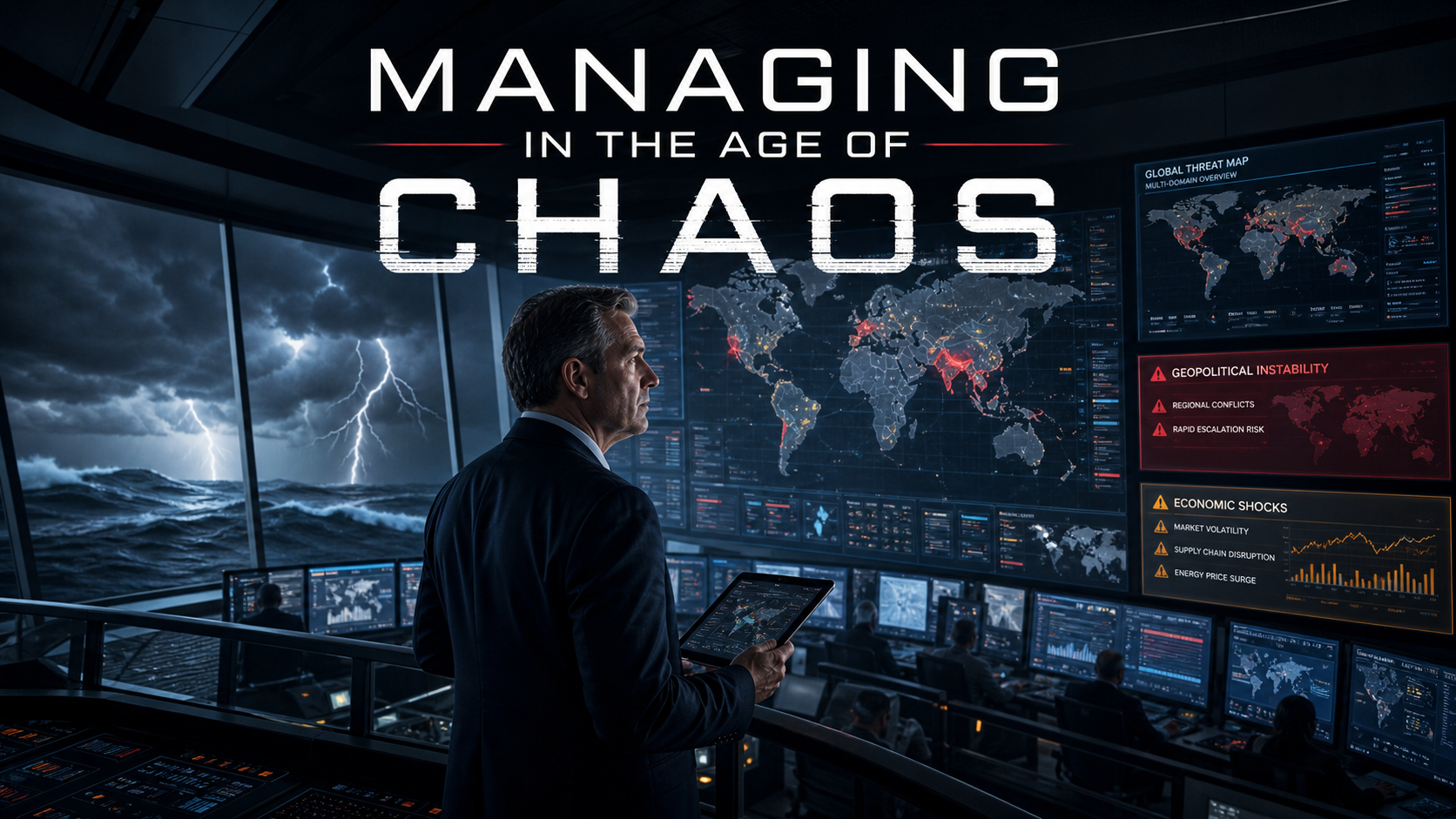
The global security environment has not entered a period of elevated risk. It has entered a permanent condition. The distinction matters enormously because organizations, militaries, and institutions built to manage crises and return to baseline are structurally mismatched to what we now face.
We are not in a turbulent interlude between stable periods. We are in the turbulence itself.
The post-WWII institutional architecture is fracturing under the weight of what I call the “anarchy of the moment” or a state of high-velocity, cascading disruption that renders traditional planning cycles not merely insufficient, but actively dangerous. The organizations most at risk are not those lacking resources or talent. They are those lulled into strategic complacency by the false comfort of historical baselines and the assumption that equilibrium will eventually return.
It will not.
The first conceptual pivot required of modern leaders is the hardest, because it demands abandoning a framework that served well for decades. Crisis management assumes a disruption occurs, a response is mounted, and normal operations resume. Chaos management operates under a fundamentally different premise: the disruption is the operating environment. There is no return to normal. The task is not restoration. It is coherence under permanent turbulence.
This demands a different kind of leader. Not the chess master, planning deliberate moves in a stable game with known rules, but the emergency room physician, triaging cascading emergencies, holding multiple conditions in mind simultaneously, acting while still learning.
Four structural shifts have made the chess-master model obsolete.
The first is deep interconnectivity and cascading failure. Modern systems are tightly coupled in ways that defy traditional risk assessment. The 2011 Tōhoku earthquake, a regional geological event, paralyzed global automotive production within days. The Ever Given blockage in the Suez Canal demonstrated how a single failure node propagates instantly across interdependent systems, triggering second- and third-order effects that no linear model can anticipate. In a tightly coupled world, the failure is rarely where it appears.
The second shift is the dual-edged nature of information flow. Digital platforms enable rapid coordination but simultaneously drown decision-makers in noise and accelerate the spread of misinformation. This creates what might be called a Transparency Paradox: organizations face more scrutiny than ever before while operating with less clarity. Speed of information does not equal quality of understanding.
The third is the proliferation of wicked problems, challenges like cyber warfare or systemic supply chain fragility that have no definitive resolution. Every intervention changes the problem itself. These are not puzzles to be solved; they require continuous stewardship rather than one-time resolution. Leaders who approach them expecting a victory condition will exhaust themselves and their organizations.
The fourth shift is temporal compression. The traditional sequence — detect, assess, implement — has collapsed. In tightly coupled systems, failure propagates faster than human decision cycles. Leaders must act while learning, adjusting in stride rather than waiting for clarity that will not come.
Taken together, these shifts point to an uncomfortable conclusion: when the environment is structurally chaotic, the primary unit of survival is no longer the plan. It is the cognitive capacity of the leader.
What distinguishes those who can operate effectively inside sustained chaos is not temperament alone. It is a specific cognitive architecture — learnable, trainable, and institutionalizable.
The poet John Keats called it “Negative Capability”: the capacity to remain in doubt and uncertainty without irritably reaching for premature fact or reason. It is a disciplined orientation toward reality rather than toward comfort.
But he individual Chaos Navigator is necessary but insufficient. The organizational architecture must match.
Rigid hierarchies are dangerously brittle in chaotic environments , not because hierarchy is wrong, but because single points of failure in tightly coupled systems propagate catastrophically. The required alternative is what might be called a Mesh or Kill-Web Architecture: distributed cognition in which the “mind” of the organization spans multiple nodes, actors, and tools rather than residing in a single command element.
This requires two foundational design choices.
The first is distinguishing Core from Surge. The Core is the minimum viable organization, the missions, people, and shared purpose that must endure regardless of circumstances. It is the cultural adhesive that maintains cohesion when central nodes are cut off or saturated. The Surge is the modular capacity that can be rapidly re-tasked as conditions change. This requires deliberately maintaining 10-20% reserves in exploratory capacity rather than allocating 100% of resources to current efficiency, a discipline that every budget cycle will pressure the organization to abandon, and that leaders must defend.
The second choice is information architecture. The conventional model abstracts and summarizes information as it moves up the hierarchy, progressively stripping signal to reduce cognitive load at the top. In chaotic environments, this produces the worst possible outcome: senior leaders making decisions from sanitized summaries while pattern-relevant raw data sits at the periphery. The Chaos Navigator model inverts this, moving toward direct sensor feeds and designing decision spaces to ensure edge data is heard before the dominant narrative filters it into unreality.
The leader who defines success as solving the crisis and restoring equilibrium will exhaust their organization against a reality that does not resolve. The leader who redefines the mission as stewarding long-term institutional survivability, building the human and structural capacity to maintain coherence inside the storm, is the one whose organization will be capable of action when it matters most.
In an age that will not settle down, that is the only leadership that works.