
MV 75 Tiltrotor Airpower for the Nordic Arctic and Land Corridor
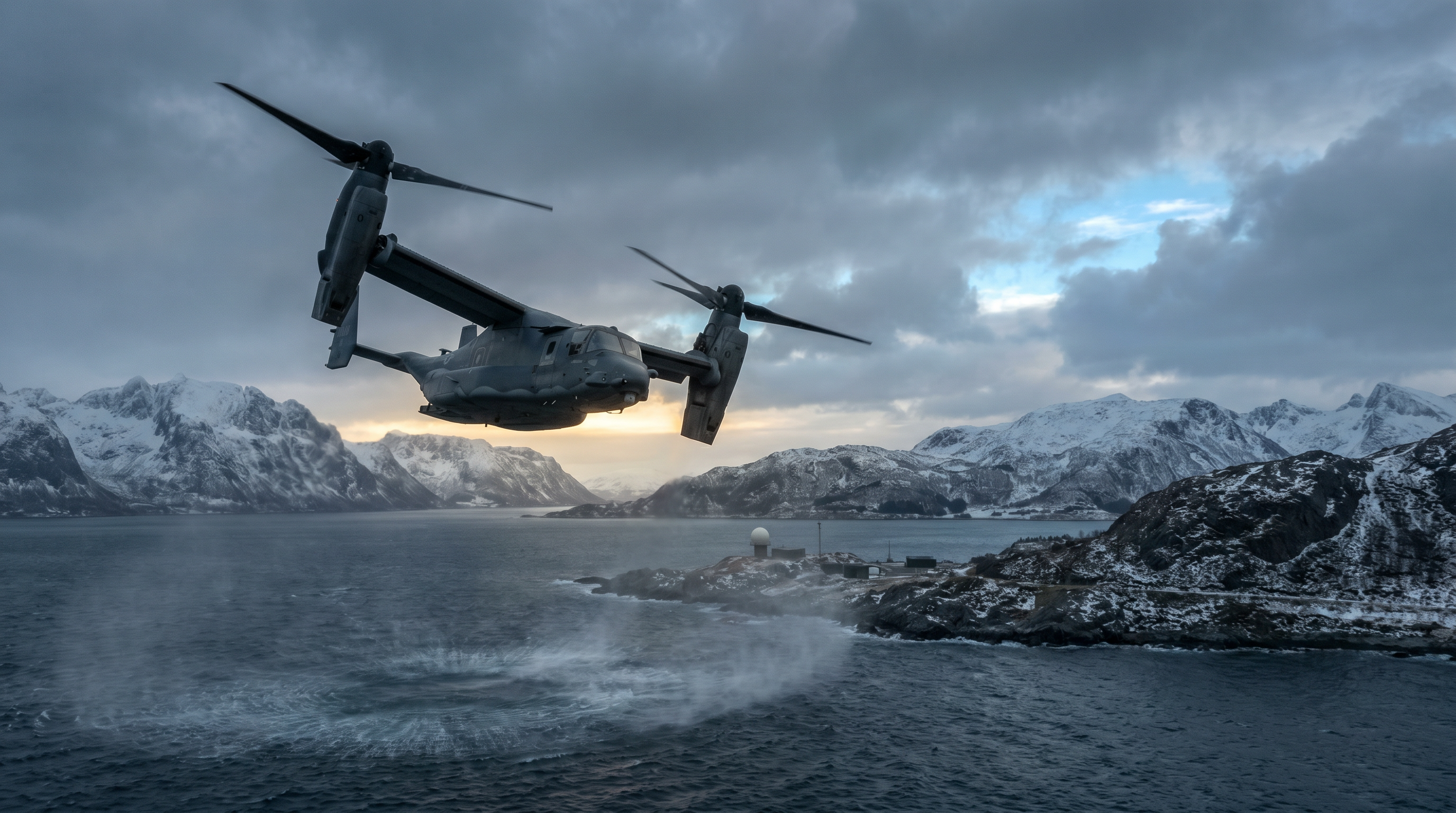
NATO’s northern flank has been transformed in just a few years. The accession of Finland and Sweden has turned the Alliance’s northern geography into a continuous arc running from the Baltic Sea, across Scandinavia, to the Arctic Ocean, a Nordic land corridor that joins together problems once treated separately: Baltic reinforcement, the defense of northern Norway, access to the Barents approaches, and support to Arctic operations.
At the same time, the Arctic and High North have stopped being peripheral theaters and become central arenas of great-power competition. Russia continues to consolidate its militarization of the Kola Peninsula and the Arctic sea routes, while China has declared itself a “near-Arctic” stakeholder with ambitions of its own in the region’s shipping lanes and resources.
Into this emerging battlespace comes the U.S. Army’s MV-75 Cheyenne tiltrotor. The MV-75 offers a qualitatively new vertical-lift option for the Nordic nations and the wider Alliance, a platform that combines helicopter-like vertical agility with near fixed-wing speed and long range. It is not simply a faster helicopter. It is a different category of tool for a theater defined by distance, sparse infrastructure, and punishing weather.
The core argument of this piece is straightforward: integrating the MV-75 into Nordic defense concepts would add theater-scale vertical maneuver to both Arctic defense and the Baltic-to-Barents land corridor, while providing a mobile hub for the autonomous systems that are becoming central to deterrence in the High North.
An Arctic Theater Under Transformation
NATO now explicitly frames the Arctic and High North as a zone of intensifying strategic competition. That recognition is reflected in the creation of the Arctic Sentry framework in 2026, conceived as a persistent, multi-domain activity that pulls national exercises, surveillance assets, and forces into a single operational construct rather than leaving them scattered across separate national sectors. Russia, for its part, has expanded the responsibilities of its Northern Fleet, refurbished Soviet-era bases, fielded novel systems such as hypersonic missiles and nuclear-powered undersea vehicles, and increased the tempo of activity moving from the Kola Peninsula into the Barents Sea and the North Atlantic. China has signaled its own interest in Arctic shipping routes and resources, adding a further layer of strategic uncertainty to a theater already defined by distance, climate, and fragile access.
In the era of chaos management, such contestations are ongoing. And being engaged in defending a nation’s interest the spectrum of conflict is not a one-off event.
Exercises such as Arctic Forge and Arctic Shock already rehearse trans-Arctic deployment and cold-weather maneuver, moving forces from North America, notably Canada in allied terms, into Norway and Finland and demonstrating that northern Europe and the wider Arctic are merging into a single operational space. The challenge now is not simply getting forces into the theater: the harder problem is giving that space greater intra-theater mobility once forces have arrived. That is precisely where the MV-75 becomes most relevant, because the aircraft is designed to solve a mobility problem, not just a lift problem.
MV-75: Twice as Far, Twice as Fast
Bell and U.S. Army officials consistently describe the MV-75 as providing roughly twice the speed and twice the range of legacy medium helicopters, while retaining vertical takeoff and landing and a squad-size passenger capacity. For Arctic and Nordic operations, that performance profile moves the aircraft from being a local lift asset to a genuine theater-mobility tool, one capable of reshaping how commanders think about time and distance in the north.
In operational terms, MV-75 detachments could launch assault forces, special operations teams, forward sensors, or fires elements from bases hundreds of kilometers behind the front line and still arrive over the objective in tactically relevant time. In the High North, that implies vertical maneuver across the theater as a whole, rather than merely within national sectors. A detachment based in northern Norway or Iceland could rapidly reinforce Greenland, the Faroe Islands, or forward locations along the Norwegian-Finnish-Swedish border without relying solely on fixed-wing transport into prepared airfields, airfields that may themselves be contested or degraded in a crisis. From bases in Alaska or northern Canada, the same aircraft type could push forces across the pole into European Arctic Sentry areas, or vice versa, all within a single, interoperable fleet built to a common standard.
For the Nordic land corridor specifically, this shift is decisive. The corridor’s sparse road and rail infrastructure, long internal distances, severe climate, and exposed transport nodes create a premium on distributed operations and mobility in depth. The Alliance must be able to move forces northward and eastward without depending exclusively on predictable roads, railheads, or fixed-wing bases that lie under Russian long-range strike and surveillance coverage from Kola. By adding theater-scale speed and vertical access, the MV-75 provides a credible answer to that operational problem, one that existing medium-lift helicopters, however capable, were never designed to solve.
Vertical Maneuver in the Nordic Land Corridor
The Nordic land corridor can be understood as a connected defense space stretching across Norway, Sweden, and Finland and linking the Baltic theater to the High North. It is a theater of movement, reinforcement, and denial, where the ability to shift forces under pressure, north toward the Arctic and east toward the Russian border, may prove decisive. In a crisis, commanders will face simultaneous demands: reinforce northern Norway, secure critical terrain along the Finnish-Russian frontier, protect Swedish lines of communication, and maintain access to the Barents approaches. No single axis can be allowed to absorb all available mobility assets, which means the corridor rewards platforms that can be redirected quickly from one mission to another.
The MV-75’s performance profile enables several specific functions in this environment:
- Reinforcing Norway, Sweden, or Finland from bases deeper in the rear, reducing dependence on vulnerable forward basing that would otherwise need to be defended and sustained under threat of long-range strike.
- Bypassing damaged roads, rail chokepoints, or airfield disruptions to move high-value teams, special operations forces, long-range fires detachments, engineers, command elements, rapidly across forests, tundra, and mountainous terrain that would otherwise slow or stop ground movement.
- Connecting small, dispersed force packages across archipelagic and northern terrain, supporting distributed operations rather than static, linear defenses that are easier for an adversary to locate and target.
- Compressing the timeline between decision and effect, allowing the Alliance to shape events before an adversary can consolidate local gains along any single axis of advance.
In effect, the MV-75 would add vertical maneuver in depth to the Nordic battlespace, turning the political fact of Nordic enlargement into operational depth that can be exploited under pressure. This matters because the future fight in the north is unlikely to revolve around a single front line. It is far more likely to involve dispersed operations across multiple axes, with intermittent communications and a high demand for rapid repositioning of forces that were never postured to move quickly by traditional means.
Arctic Defense: From National Sectors to a Theater Grid
Under Arctic Sentry, NATO is attempting to knit together national exercises, surveillance, and forces into a coherent, long-term presence that secures the Alliance’s northern approaches. One of the consistent themes in public descriptions of the framework is the need to keep sea lines of communication and reinforcement open, particularly around the Greenland-Iceland-UK (GIUK) gap and the Norwegian Sea. The GIUK gap is no longer simply a legacy Cold War chokepoint; it has become a multi-domain corridor where submarine operations, surface sorties, hybrid pressure on undersea infrastructure, and unattributed maritime activity all intersect and compete for attention.
Four Arctic functions stand out as particularly well matched to the MV-75’s characteristics:
- Rapid reinforcement of exposed nodes that cannot be permanently garrisoned at scale but can be reinforced quickly if the right platform is available on short notice.
- Movement of specialized teams, anti-submarine warfare specialists, sensor maintainers, special forces, forward air controllers, long-range fires cells, whose timely presence often decides whether a developing situation is contained or allowed to escalate.
- Linkage across the maritime battlespace, connecting ships, shore installations, and surveillance detachments into a fluid operational picture rather than leaving them as nationally compartmentalized sectors that struggle to share information in real time.
- High-speed response when Russian submarine sorties or hybrid pressure events threaten to exploit gaps before conventional reinforcement can be organized and moved into position.
In each of these cases, the MV-75’s combination of speed, range, and vertical access converts what would otherwise be discrete national problems into a shared theater grid that Arctic Sentry commanders can manage dynamically, shifting scarce assets to wherever the emerging threat picture demands them.
MV-75 as Mothership in a Drone-Dense North
Vertical lift is only one side of the emerging Arctic defense equation. Analysts increasingly emphasize polar-hardened drones across all domains as indispensable to future deterrence, both to maintain what is often called “deterrence by detection” and to protect critical undersea infrastructure from sabotage or surveillance by adversary forces. Such systems can loiter for long periods, operate in conditions that constrain manned platforms, and cover the enormous distances that define the Arctic operating environment far more economically than crewed aircraft alone ever could.
The MV-75 is being developed within the U.S. Army’s Future Vertical Lift ecosystem, which places heavy emphasis on manned-unmanned teaming and on Air Launched Effects, small, attritable drones and electronic-warfare payloads that can be carried by a crewed aircraft and released to extend its sensing and striking reach well beyond what the aircraft itself could otherwise observe or influence. The aircraft is built around a Modular Open Systems Approach digital backbone that standardizes interfaces and data models, so that new sensors, effectors, and mission software can be integrated as plug-and-play modules rather than through lengthy and expensive proprietary redesign cycles. Unlike legacy helicopters that had unmanned-teaming capability added after the fact, the MV-75 is a “born digital” tiltrotor designed from the outset to orchestrate multiple unmanned assets from a common cockpit and mission system.
Applied to the Nordic corridor and the wider Arctic, this architecture makes the MV-75 a mobile node in a distributed surveillance and effects network, capable of several distinct roles:
- Carrying, launching, and controlling ISR drones to monitor submarine choke points, surface traffic, and undersea infrastructure across the Barents, Norwegian, Greenland, and Labrador Seas, areas too vast and too remote to be covered persistently by fixed installations alone.
- Deploying electronic-warfare and communications-relay payloads to knit together dispersed forces and compensate for the sparse fixed infrastructure that characterizes much of the Nordic and Arctic operating environment.
- Delivering and sustaining small unmanned aircraft system detachments at austere forward outposts, with the tiltrotor providing both the logistics to keep those detachments supplied and the high-value extraction capability needed if the situation deteriorates.
This is kill-web logic applied to the High North: not a sequential chain running from sensor to decision-maker to shooter, but a fluid, networked system in which any node can contribute to the operational picture and in which the network’s center of gravity can be repositioned faster than an adversary can adapt to it. The MV-75, in this sense, is less a replacement for existing rotorcraft than a force multiplier that lets scarce manned and unmanned assets alike be used where and when they matter most.
Conclusion
The transformation of NATO’s northern flank from a set of separate national sectors into a connected Nordic-Arctic theater creates both an opportunity and a requirement. The opportunity is to treat Nordic enlargement as genuine operational depth rather than simply a larger map. The requirement is for platforms that can exploit that depth under the pressure of a crisis, moving forces and unmanned systems alike across vast, sparsely connected terrain faster than an adversary can react.
The MV-75 Cheyenne, with roughly twice the speed and range of the helicopters it is designed to succeed, and with a digital architecture built from the outset for manned-unmanned teaming, is a strong candidate to help fill that requirement. Its value is adding a theater-scale layer of vertical maneuver and drone-enabled sensing that turns the Baltic-to-Barents corridor and the wider Arctic into a single, dynamically manageable operational space.
Bibliography: Second Line of Defense and Defense.info Sources Supporting “MV-75 Tiltrotor Airpower for the Nordic Arctic and Land Corridor”
Laird, Robbin. “Enabling Arctic Sentry: The Key Role for Maritime Autonomous Systems.” Second Line of Defense, February 2026. https://sldinfo.com/2026/02/enabling-arctic-sentry-the-key-role-for-maritime-autonomous-systems/
Covers the February 2026 stand-up of Arctic Sentry under Joint Force Command Norfolk, its lineage from Baltic Sentry, and the emphasis on maritime autonomous systems for persistent surveillance.
“‘Baltic Sentry’: An Important Place to Start for Accelerating the Paradigm Shift in Maritime Operations.” Second Line of Defense, January 2025. https://sldinfo.com/2025/01/baltic-sentry-an-important-place-to-start-for-accelerating-the-paradigm-shift-in-maritime-operations/
Background on the Baltic Sentry model that Arctic Sentry extends northward.
Laird, Robbin. “U.S. Marines Complete Cross-Border Convoy into Finland.” Second Line of Defense, March 2026. https://sldinfo.com/2026/03/u-s-marines-complete-cross-border-convoy-into-finland/
Covers Exercise Cold Response 26 as a component of Arctic Sentry.
“A Look at Defense Competition in the Arctic Region.” Defense.info, December 2023. https://defense.info/re-thinking-strategy/2023/12/a-look-at-defense-competition-in-the-arctic-region/
Survey of Arctic air and missile defense competition among Arctic Council states.
“Chinese Arctic Ambitions: The Challenge for Greenland.” Defense.info, 2018. https://defense.info/re-thinking-strategy/2018/10/chinese-arctic-ambitions-the-challenge-for-greenland/
On China’s “near-Arctic” positioning and economic statecraft in Greenland.
“Denmark Expands Defense Capabilities Amid Arctic Tensions and Ukraine Support.” Second Line of Defense, August 2025. https://sldinfo.com/2025/08/denmark-expands-defense-capabilities-amid-arctic-tensions-and-ukraine-support
Danish Arctic investment package and surveillance posture.
“Russia Continues Arctic Militarization.” Second Line of Defense, 2018. https://sldinfo.com/2018/03/russia-continues-arctic-militarization/
Early documentation of Kola Peninsula build-up and Norwegian threat assessments; useful for the longer historical arc.
MV-75 / FLRAA Program and Performance
Laird, Robbin. “The Way Ahead with FLRAA: Insights from AUSA 2024.” Second Line of Defense, October 2024. https://sldinfo.com/2024/10/the-way-ahead-with-flraa-insights-from-ausa-2024/
Program schedule, Milestone B, and the digital-engineering approach.
Laird, Robbin. “Launching a New Manned Air System at the Dawn of an Age of Autonomous Systems: The U.S. Army Approach to its New Tiltrotor Aircraft.” Second Line of Defense, October 2024. https://sldinfo.com/2024/10/launching-a-new-manned-air-system-at-the-dawn-of-an-age-of-autonomous-systems-the-u-s-army-approach-to-its-new-tiltrotor-aircraft/
Source for the “twice as far, twice as fast” framing and Launched Effects integration; directly supports the article’s title theme.
Laird, Robbin. “The U.S. Army Approach to its New Tiltrotor Aircraft.” Second Line of Defense, October 2024. https://sldinfo.com/2024/10/the-u-s-army-approach-to-its-new-tiltrotor-aircraft/
Companion piece on con-ops development and USMC-to-Army knowledge transfer.
Laird, Robbin. “The Osprey Down Under: The MV-22 Operating in Australia.” Second Line of Defense, May 2025. https://sldinfo.com/2025/05/the-osprey-down-under-the-mv-22-operating-in-australia/
Contains the specific speed and range comparison against the Black Hawk (800 nm combat range, 280-knot cruise) cited in the article.
Laird, Robbin. “The Paradigm Shift in Maritime Operations: What Potential Role for Future Tiltrotor Systems?” Second Line of Defense, April 2025. https://sldinfo.com/2025/04/the-paradigm-shift-in-maritime-operations-what-potential-role-for-future-tiltrotor-systems/
MOSA architecture and manned-unmanned teaming, drawn from a Bell Naval Sales interview; supports the “born digital” argument.
Kill Web Framework and Arctic/Nordic Application
Timperlake, Ed, with Robbin Laird. “Greenland and the High Ground of the Kill Web: Why the Arctic Matters for Fighting at the Speed of Light.” Defense.info, February 2026. https://defense.info/defense-decisions/2026/02/greenland-and-the-high-ground-of-the-kill-web-why-the-arctic-matters-for-fighting-at-the-speed-of-light/
Applies kill-web logic directly to the Arctic and the GIUK gap; the closest existing piece to the article’s concluding argument and worth explicit cross-reference.
Laird, Robbin. “II Marine Expeditionary Force: A June 2021 Update.” Defense.info, June 2021 (PDF). https://defense.info/wp-content/uploads/2021/06/II-MEF.pdf
Early articulation of the Nordic shift from a Cold War “race to Norway” posture to Nordic-led High North defense, tied to kill-web-enabled USAF long-range strike.
Nordic Integration and 2nd Marine Aircraft Wing
Laird, Robbin. “2nd Marine Air Wing: A Force for Change in USMC Con-ops and Capabilities.” Defense.info, November 2025. https://defense.info/multi-domain-dynamics/2025/11/2nd-marine-air-wing-a-force-for-change-in-usmc-con-ops-and-capabilities/
Describes 2nd MAW’s reorientation toward Nordic integration and the “Fourth Battle of the Atlantic” framing; strong complement to the GIUK gap section.
Laird, Robbin. “Speed, Sensors, and Strategic Presence: The Evolution of 2nd Marine Air Wing.” Second Line of Defense, November 2025. https://sldinfo.com/2025/11/speed-sensors-and-strategic-presence-the-evolution-of-2nd-marine-air-wing/
Nordic Response 24 exercise and distributed/expeditionary basing concepts directly relevant to the article’s “vertical maneuver in depth” argument.
“Enhanced Nordic Operational Cooperation: September 2021 Declaration of Intent.” Defense.info, October 2021. https://defense.info/re-thinking-strategy/2021/10/enhanced-nordic-operational-cooperation-september-2021-declaration-of-intent/
NORDEFCO background; useful for institutional context on Nordic defense cooperation.