
Sensor, Shooter, Quarterback: The F-35’s Multi-Role Transformation Over Iran
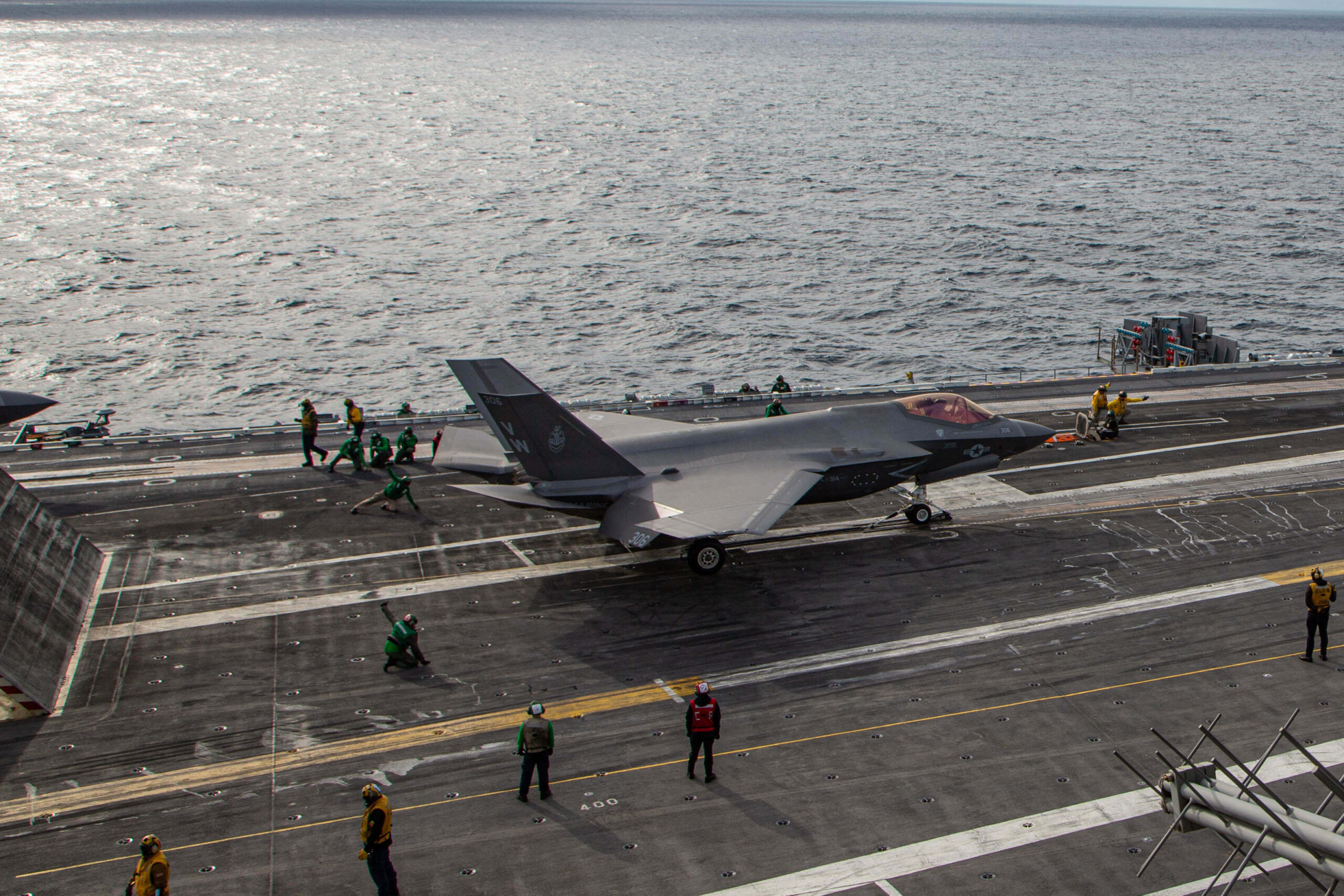
The air campaign over Iran has given the F-35 something no procurement debate, war game, or congressional hearing could ever deliver: a sustained, high-tempo combat test against a real integrated air defense system protecting a real state.
The aircraft is passing that test. Whether operating as a penetrating striker, a sensor-fusion quarterback, or a coalition battle-management node, the F-35 is validating and in some respects extending the operational concepts that have driven fifth-generation modernization for two decades.
That validation matters not just for the current campaign but for the broader debate about how Western air forces will fight the next major contingency. What is emerging over Iran is a template, imperfect, contested, still unfolding, for how stealth, networking, and distributed fires can be woven together into something more powerful than any individual platform or weapon.
Understanding what the F-35 is actually doing in this campaign, as opposed to what advocates and critics predicted it would do, is the starting point for drawing the right lessons.
From the opening hours of Operation Epic Fury, the F-35 was placed at the tip of the spear. U.S. Central Command imagery and press reporting confirm that F-35s led mixed packages, Tomahawk cruise missiles, legacy strike fighters, and low-cost one-way attack drones, against Iran’s integrated air defense system (IADS) and strategic infrastructure. Reuters reporting describes F-35s working alongside F/A-18s to suppress radar and missile sites, opening corridors for follow-on flows of bombers and fourth-generation aircraft that could not survive the same threat environment on their own.
Aviation Week frames the strategic concept as ‘regime change from 20,000 feet’, a U.S.-Israeli effort to dismantle Iran’s ballistic missile forces, IRGC infrastructure, and command-and-control architecture without committing large ground formations. It is an airpower-centric theory of victory, and the F-35 sits at its operational core. The aircraft’s combination of stealth, sensor fusion, and networking makes it the natural platform for executing that theory: it can go where other jets cannot, see what other sensors cannot reach, and connect shooters across the kill web in near real time.
One of the most striking features of the campaign has been the speed with which F-35s helped neutralize Iran’s much-advertised air defenses. Iranian S-300 and S-400 systems which Tehran had positioned as credible deterrents to Western airpower reportedly failed to achieve reliable locks on the low-observable jets as they penetrated deep into Iranian airspace. Israeli F-35I Adir formations struck critical infrastructure around Tehran, including energy nodes and IRGC facilities, and exited without loss, despite the density of surface-to-air missiles and radars the Iranians had fielded.
The mechanics of that achievement are instructive. Using the AN/APG-81 AESA radar, electro-optical targeting system, distributed aperture system, and an advanced electronic warfare suite, F-35s mapped radar sites, identified mobile launchers, and passed targeting data to other platforms in near real time. They employed anti-radiation and precision-guided munitions to blind sectors of the IADS, then followed with attacks on command nodes, air bases, and missile facilities, opening persistent corridors for larger strike formations and ISR aircraft to exploit.
The result, as Israeli commentary has noted, is an unprecedented degree of uncontested access over a major regional power. Iranian attempts at fighter sorties or coordinated missile responses were repeatedly disrupted or pre-empted.
For U.S. planners, this has reinforced a central argument of the fifth-generation modernization program: that stealth aircraft, properly integrated with electronic attack and command and control, can still outmatch Russian and Chinese air-defense exports. Iran has not proved that argument definitively, the adversary’s capabilities were real but dated, but the campaign has provided the most demanding real-world test yet.
The Iran campaign has also produced the F-35’s first confirmed kill against a manned aircraft, a milestone that carries significance beyond its immediate tactical weight. On 4 March 2026, an Israeli F-35I Adir shot down an Iranian Yak-130 light attack and advanced trainer aircraft over Tehran. Multiple outlets, including The Aviationist and Army Recognition, describe it as the first air-to-air kill by an F-35 against another manned platform in the aircraft’s history.
By the logic of platform matchups, this was asymmetric combat. The Yak-130 is a subsonic, modestly capable trainer with limited radar and defensive avionics; the F-35I combines low observability with powerful sensors and datalinks optimized for ‘first look, first shot, first kill.’ Open-source analysis suggests a beyond-visual-range engagement, with the Adir building a quiet track and launching before the Iranian pilot had meaningful warning. The tactical result was never in doubt.
What matters more is what the engagement demonstrates about the platform’s versatility. The F-35 had previously seen combat almost exclusively in air-to-ground roles. Over Iran, it is performing the full spectrum of its designed mission set: penetrating strike, suppression of enemy air defenses, air superiority, and drone intercept. Coupled with reports of F-35s providing air-defense coverage for Jordan and Gulf partners, the aircraft’s dual identity as both striker and defender is being showcased at operational scale for the first time.
Perhaps more consequential than any individual strike or engagement is the role F-35s are playing as airborne command-and-control and targeting nodes, what some analysts are calling a proto-sixth-generation function. Pre-war upgrades had aimed at enhancing AI-assisted sensor fusion and networking; the Iran campaign is the first high-tempo live test of those capabilities at scale.
In practice, F-35 formations are acting as forward quarterbacks for a distributed kill web. Aviation Week and other outlets describe how F-35s fuse data on emitters, aircraft, and ground targets, then push that picture over secure links to shooters ranging from B-2 bombers and F-15Es to PrSM launchers and low-cost LUCAS one-way attack drones.
Because they can operate closer to defended targets than most dedicated ISR assets, they compress the sensor-to-shooter loop against time-sensitive targets, mobile launchers, dispersed command nodes, deep inside Iranian territory.
This quarterback function extends to coalition management. U.S. and Israeli F-35s are operating alongside British and potentially other partner F-35 fleets deployed for regional air defense. A common tactical picture shared across those fleets enables real-time de-confliction, coordinated responses to missile and drone threats, and the orchestration of strike packages that mix stealth and non-stealth assets. The result is a multinational flying sensor-fusion hub operating in combat, not a concept brief, not a war game, but the real thing.
This is precisely the kill web architecture that Ed Timperlake and I have been writing about for years: not a platform-centric model in which one aircraft does everything, but a networked approach in which the F-35 serves as a high-value node connecting shooters and sensors across domains and coalition partners. Iran is providing the most compelling demonstration of that concept to date.
A persistent question before this campaign was whether the F-35 could generate sustainable sortie rates and prove affordable enough to function as a true workhorse in a sustained conflict, rather than a boutique asset to be rationed and protected. The early evidence from Iran is encouraging, though not without caveats.
Analyst Trevor Marr, writing in The Hub, argues that the war has given the F-35 ‘the most demanding combat test it is ever likely to face short of a direct war with China,’ and that the platform has delivered on its core promises of survivability and multi-role effectiveness against a sophisticated if aging adversary. He also cautions rightly that airpower alone still struggles to deliver decisive political outcomes, and that logistics, munitions production, and coalition will remain the limiting factors regardless of how well individual platforms perform.
Those cautions deserve weight. The Foreign Policy Research Institute has highlighted concerns about munitions stockpiles, maintenance demands, and pilot training throughput, suggesting that high-tempo F-35 operations may be stress-testing the broader industrial and organizational ecosystem needed to sustain fifth-generation air forces. Iran is simultaneously a validation of the F-35 as a platform and a warning about the depth of the bench required to keep that platform in the fight over time.
This is a distinction that procurement advocates and critics alike tend to collapse. The aircraft’s performance in combat is not the same question as whether the supply chain, the depot system, the training pipeline, and the munitions inventory can support that performance at sustained operational tempo. Iran is beginning to surface the answers to both questions simultaneously, and the second set of answers will shape force planning discussions for years.
Strategically, the Iran campaign reinforces the centrality of fifth-generation aircraft in Western warfighting concepts against defended states. The combination of F-35s backed by F-22s, bombers, stand-off missiles, and drones has produced a campaign that favors air and maritime power over ground maneuver. Daily air operations are targeting Iran’s missile and drone arsenals, degrading regime control nodes, and demonstrating that the United States can impose significant strategic costs without a large ground presence.
This experience is already being read through the lens of future contingencies, particularly in the Indo-Pacific. The ability of F-35s to penetrate, map, and dismantle a regional IADS; to manage a coalition kill web; and to coordinate long-range fires from distributed launchers offers a template for how the United States and allies might contest Chinese or Russian A2/AD networks.
At the same time, Iran’s use of drones, ballistic missiles, and potentially hypersonic systems underscores that adversaries will continue to saturate the air and missile environment, demanding even more integrated sensing, electronic attack, and layered defense in future conflicts.
Doctrinally, the campaign advances distributed operations and human-machine teaming in ways that will reverberate across NATO and partner air forces. F-35s are not acting alone but in concert with expendable drones, electronic-attack platforms, cyber operations, and ground-based fires. Lessons learned about how to task F-35 units simultaneously as shooters and C2 nodes, how to manage their signatures and emissions across a sustained campaign, and how to integrate allied F-35 fleets into a coherent operational whole will shape tactics, techniques, and procedures for years to come.
The challenge now is to capture those lessons systematically, not just in after-action reports filed away in classified drawers, but in doctrine, training, and acquisition decisions that shape what the joint force looks like a decade from now. Iran is the laboratory. The question is whether we build the institutional machinery to turn laboratory results into lasting capability.
The Iran air campaign has become the F-35’s coming-of-age conflict. In a compressed period of high-intensity operations, the aircraft has demonstrated the ability to penetrate a substantial air defense network, execute precision strike, score an air-to-air kill, and serve as the centerpiece of a multinational, multi-domain strike and defense enterprise. The debate over whether the F-35 can perform in high-end combat, the debate that consumed so much oxygen in procurement hearings and trade press for two decades, has, for most serious observers, been answered over the skies of Iran.
What replaces that debate is more consequential.
- How do we sustain fifth-generation air forces at operational tempo?
- How do we deepen the kill web architecture so that F-35s are not just the most capable nodes but the connective tissue of a genuinely distributed joint force?
- How do we translate the coalition integration demonstrated in this campaign into persistent allied interoperability rather than an improvised wartime workaround?
Those are the questions that the Iran campaign is now forcing onto the agenda. They deserve at least as much rigorous attention as the platform debate that preceded them.
Selected Sources
Aviation Week. “U.S. and Israel Attempt Regime Change in Iran From 20,000 Ft.” Aviation Week, March 5, 2026.
Euronews. “‘An Almost Invisible Fighter’: The Stealth Jet Striking Iran.” Euronews, March 8, 2026.
Foreign Policy Research Institute. “FPRI Experts React | Renewed Conflict in Iran.” FPRI, February 27, 2026.
Jerusalem Post. “Israeli F-35s Prove Total Air Superiority over Iran—Opinion.” Jerusalem Post, March 13, 2026.
Malay Mail / Reuters. “Tomahawks, F-35s and Kamikaze Drones: Inside the U.S. Strike on Iran.” Malay Mail, March 1, 2026.
SandBoxx News. “F-35 Gets Its First Ever Air-to-Air Kill Against a Manned Aircraft.” March 3, 2026.
Army Recognition. “F-35 Fighter Records First Air-to-Air Kill in History as Israeli F-35I ‘Adir’ Shoots Down Iranian Yak-130.” Army Recognition, March 14, 2026.
19FortyFive. “First Stealth Kill: How an Israeli F-35I Adir Fighter Downed a Russian-Made Yak-130 over Iran.” March 3, 2026.
The Hub. “The War (Over) Iran: The F-35 Debate Is Officially Over.” March 8, 2026.
Air & Space Forces Magazine. “Buildup Against Iran Continues: F-22s to Israel, F-35s, F-15Es to Europe.” February 26, 2026.
The Aviationist. “Updated: Israeli F-35I Shoots Down Iranian Yak-130 over Iran.” March 3, 2026.
Note: I focused on the paradigm shift in pilot training associated with learning how to be kill web quarterbacks in my book published late last year:
Training for the High-End Fight: The Paradigm Shift for Combat Pilot Training
See also, the following:
Featured Image: PACIFIC OCEAN (Nov. 15, 2021) An F-35C Lightning II, assigned to Marine Wing Fighter Attack Squadron (VMFA) 314, prepares to launch from the flight deck of the aircraft carrier USS Abraham Lincoln (CVN 72). Abraham Lincoln is underway conducting routine operations in the U.S. 3rd Fleet area of responsibility. (U.S. Marine Corps photo by 1stLt. Charles Allen/Released).