
Coast Guard Aviation at a Crossroads: New CBO Report Reveals Declining Readiness Amid Historic Investment
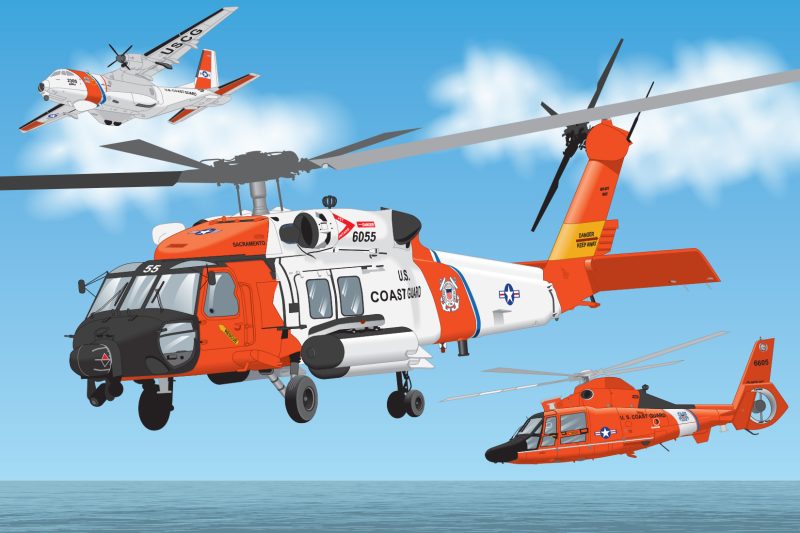
The U.S. Coast Guard’s aviation capability faces a critical juncture as new Congressional Budget Office findings reveal a two-decade decline in aircraft availability and inventory, even as Congress prepares to inject billions of dollars into fleet modernization.
The report provides a sobering assessment of the service’s airpower challenges while raising fundamental questions about resource allocation and strategic priorities.
The CBO’s analysis paints a nuanced picture of Coast Guard aviation readiness between 2006 and 2024. While the overall trend shows modest decline, the data reveals contrasting fortunes between rotary and fixed-wing assets that reflect deeper operational and maintenance challenges.
The Coast Guard currently operates approximately 200 aircraft across its inventory: roughly 100 H-65 Dolphin helicopters, 50 H-60 Jayhawk helicopters, and 50 fixed-wing aircraft ranging from medium-range surveillance platforms to heavy transport aircraft. This represents a net decline of just three aircraft compared to 2006 levels, but the composition has shifted significantly.
Fixed-wing aircraft numbers dropped from 68 to 53 over the period, while helicopter inventory actually increased from 134 to 146. More concerning than raw numbers, however, are the availability rates. Helicopter availability plummeted from 60.7 percent to 47.8 percent, meaning less than half the rotary-wing fleet is mission-ready at any given time. Fixed-wing availability improved from 41.8 to 50.5 percent, but this still means nearly half of these critical surveillance and transport aircraft remain grounded.
The CBO report provides important context by comparing Coast Guard aviation readiness to Department of Defense services. The findings suggest the Coast Guard’s challenges aren’t unique, but they aren’t universal either.
Coast Guard helicopters demonstrate availability rates below Army aviation levels, substantially above Navy helicopter readiness, and roughly equivalent to Air Force rotary-wing assets. This middle-of-the-pack performance raises questions about whether the Coast Guard’s maintenance infrastructure and operational tempo can sustain its expanding maritime security mission.
The comparison is particularly illuminating because it suggests systemic issues rather than service-specific failures. Across the military aviation enterprise, aging aircraft, supply chain constraints, and maintenance workforce challenges have created a readiness crisis that transcends individual services. The Coast Guard, despite its smaller size and more focused mission set, faces many of the same structural problems as its Pentagon counterparts.
Congress’s recent reconciliation legislation represents a watershed moment for Coast Guard aviation. The $3.7 billion appropriation for aircraft procurement, coupled with $2.2 billion for depot-level maintenance facilities, constitutes the largest single investment in Coast Guard aviation capability in recent memory.
Admiral Kevin Lunday, nominated to become the Coast Guard’s next Commandant, testified before the Senate that the service plans to procure up to 40 MH-60 helicopters and six C-130J transport aircraft with these funds. This acquisition strategy addresses both immediate readiness gaps and long-term capability requirements.
The MH-60 procurement is particularly significant. These aircraft represent the Coast Guard’s heavy-lift helicopter capability, essential for long-range search and rescue, law enforcement operations, and maritime security missions. Expanding this fleet by 40 aircraft would represent an 80 percent increase in H-60 inventory, fundamentally transforming the service’s operational reach and responsiveness.
The six C-130Js would modernize the Coast Guard’s fixed-wing transport and surveillance capability. The C-130J represents a generational leap over the service’s aging HC-130H fleet, offering improved range, payload, fuel efficiency, and advanced sensors. These aircraft are essential for long-range patrol, fisheries enforcement, drug interdiction, and humanitarian operations across vast maritime domains.
The $2.2 billion for depot maintenance facilities addresses a critical infrastructure gap. The Coast Guard has long struggled with inadequate maintenance capacity, forcing aircraft to wait longer for scheduled maintenance and repairs. This creates a vicious cycle where delayed maintenance leads to unexpected breakdowns, which further strains maintenance capacity and reduces availability rates.
Not everyone views the Coast Guard’s recent spending priorities favorably. During Lunday’s confirmation hearing, Democratic senators sharply questioned the service’s purchase of two executive jets for more than $172 million, suggesting these funds could have sustained search and rescue stations now facing potential closure.
Lunday defended the aircraft as necessary for secure command and control capabilities for senior Department of Homeland Security and Coast Guard leadership during emergencies. The argument reflects a broader debate about how the Coast Guard should balance operational requirements with institutional overhead.
The controversy intersects with the Coast Guard’s ongoing force restructuring efforts. Under current administration guidance, the service is analyzing potential station closures as part of a broader effort to align resources with strategic priorities. While Lunday emphasized that no final decisions have been made and that any closures would follow statutory processes including public comment, the prospect of closing search and rescue stations while purchasing executive jets has created political friction.
This tension reflects a fundamental challenge for the Coast Guard: how to modernize and invest in future capability while maintaining the community-based presence that defines much of its identity and public support. Search and rescue stations represent tangible Coast Guard presence in coastal communities, generating constituency support and local relationships that prove invaluable during operations. Executive aircraft and advanced helicopters may provide greater strategic capability, but they lack the same political and community resonance.
The CBO report and subsequent testimony illuminate challenges that extend beyond simple procurement decisions. The Coast Guard’s aviation readiness crisis stems from multiple interconnected factors that require sustained attention and resources.
The service operates what might charitably be called a mature fleet. Many H-65 helicopters have been in service for decades, accumulating wear that demands increasing maintenance. Parts availability becomes more challenging as aircraft age, with some components requiring custom fabrication as original manufacturers cease production. Maintenance takes longer and costs more, driving down availability rates despite maintainers’ best efforts.
The Coast Guard also faces unique operational demands. Unlike military services that can concentrate maintenance capacity at major bases, the Coast Guard must maintain operational capability at dozens of air stations across vast geographic areas. This distributed posture complicates maintenance logistics, parts availability, and workforce management.
Maintenance workforce challenges compound these difficulties. The Coast Guard competes with commercial aviation, defense contractors, and other military services for skilled aviation maintenance technicians. Retention remains an ongoing challenge as experienced maintainers are recruited away by higher-paying private sector positions.
The service’s operational tempo doesn’t help matters. Coast Guard aircraft don’t have the luxury of sustained down periods for maintenance. Search and rescue, law enforcement, and maritime security operations demand constant availability. Aircraft are launched in harsh maritime environments, exposed to salt spray and corrosive conditions that accelerate wear. The mission set doesn’t accommodate peacetime readiness targets.
The incoming $3.7 billion represents a historic opportunity, but money alone won’t solve the Coast Guard’s aviation challenges. The service must execute smart procurement strategies, develop robust maintenance infrastructure, and sustain focus on readiness even after new aircraft arrive.
The MH-60 procurement, while substantial, will take years to complete. Aircraft production, crew training, maintenance preparation, and operational integration don’t happen overnight. The Coast Guard will need sustained congressional support through multiple budget cycles to realize the full benefit of this investment.
The depot maintenance facility funding may ultimately prove more transformative than new aircraft purchases. Adequate maintenance infrastructure creates sustained readiness across the entire fleet, not just new platforms. If executed well, these facilities could reverse the declining availability trends and extend service life for existing aircraft while new platforms arrive.
Admiral Lunday’s confirmation and subsequent leadership will be crucial. He inherits an organization at a pivotal moment, with unprecedented resources but also significant challenges. His ability to balance modernization with operational demands, navigate political pressures around station closures, and maintain congressional support will shape Coast Guard aviation for decades.
Beyond budgets and readiness rates lies a strategic question: What role should Coast Guard aviation play in American maritime security? As great power competition intensifies, as Arctic waters open, as drug trafficking evolves, and as climate change drives more extreme weather requiring humanitarian response, the Coast Guard’s aviation capability becomes increasingly central to national security.
The service operates in gray-zone scenarios where military force would be inappropriate but federal presence is essential. Coast Guard aircraft conduct fisheries enforcement in contested waters, interdict drug shipments before they reach U.S. shores, rescue mariners in distress regardless of nationality, and provide visible American presence across vast ocean domains.
This unique position requires aviation capability that can sustain operations across enormous distances, respond rapidly to emergent situations, and operate in harsh conditions with minimal support infrastructure. The current readiness challenges undermine this strategic capability precisely when it’s most needed.
The CBO report on Coast Guard aviation readiness serves as both warning and opportunity. The decline in helicopter availability and overall inventory signals systemic challenges that require more than incremental fixes. Yet the historic congressional investment creates potential for transformation if executed strategically.
Success will require sustained focus beyond the initial procurement excitement. It demands building maintenance infrastructure, retaining skilled personnel, managing aging aircraft through their final years of service, and integrating new platforms effectively. Most fundamentally, it requires clear strategic vision about Coast Guard aviation’s role in American maritime security.
The next few years will reveal whether this historic investment marks a turning point toward renewed readiness or merely a temporary respite before continued decline. For mariners in distress, communities threatened by hurricanes, law enforcement combating transnational crime, and American interests across maritime domains, the stakes couldn’t be higher.
Admiral Lunday and his leadership team inherit both unprecedented resources and profound challenges. Their success will be measured not in budget figures or aircraft counts, but in the Coast Guard’s sustained ability to execute its diverse missions across the vast maritime domains Americans depend on for security and prosperity.
The featured image is taken from the CBO webpage where the report can be found.