
Steel Knight 2025: An Overview
I have been in Southern California for the past few days talking with Marines involved in the Steel Knight Exercise with 3rd Marine Air Wing. I will publish those interviews next month.
But before I return to the East Coast, I would like to provide an overview of the exercise based on the available public sources.
I have been working parts of the exercise and need to provide an overview perspective for myself so it makes sense to share what I have found with our readers.
The Marine Corps has long understood that the character of warfare is shaped not merely by weapons systems or technological innovation, but by how forces are trained, organized, and conceptually prepared for the operational environment they will face.
Steel Knight 2025, is being conducted from December 1-14, 2025, across Southern California and the greater Southwest, represents a significant evolution in how I Marine Expeditionary Force (I MEF) prepares for the demands of Indo-Pacific contingencies.
This exercise transcends the traditional model of large-scale training events as discrete readiness checks, instead functioning as a “campaign laboratory” or a venue where operational concepts are tested, refined, and validated against the friction of realistic scenarios before they are deployed in actual theater operations.
The Shifting Paradigm: From Force Closure to Distributed Operations
The design architecture of Steel Knight 2025 reflects a fundamental shift in Marine Corps readiness philosophy. Rather than organizing training around the assumption of linear force buildup and eventual force closure at secure bases, this iteration has been deliberately constructed to validate the ability to fight as a distributed, networked stand-in force from the opening moments of a crisis.
This represents a doctrinal departure from the force-on-force engagements that characterized Cold War-era exercises and even many post-9/11 training events, where the implicit assumption was that U.S. forces would have time to aggregate combat power before engaging a near-peer adversary.
The exercise brought together the core components of I MEF, 1st Marine Division, 3rd Marine Aircraft Wing, and 1st Marine Logistics Group, operating as an integrated Marine Air-Ground Task Force at division scale. But rather than executing a single scripted battle, the exercise has been structured around a campaign-like sequence of problem sets: embassy reinforcement, noncombatant evacuation operations (NEO), dispersed fires and maneuver, and sustained logistics under threat. The through-line connecting these vignettes is the requirement to synchronize sensors, decision-makers, and shooters across extended ranges and under compressed timelines, while sustaining dispersed ground and aviation elements from an expeditionary infrastructure rather than relying on the fixed-base sanctuary that characterized operations in Iraq and Afghanistan.
This approach mirrors what military historians have observed in other periods of doctrinal transition most notably the interwar period when the Marine Corps developed amphibious doctrine not through abstract theorizing alone, but through iterative experimentation at exercises like Fleet Landing Exercises (FLEXs).[3] Steel Knight 2025 serves a similar function for the stand-in force concept: translating strategic guidance into operational practice through repeated rehearsal under realistic constraints.
The MRF-D Certification Imperative: Linking Training to Operational Deployment
Steel Knight 2025 is a dual function exercise as both a MEF-level training event and the formal certification venue for the regiment deploying as Marine Rotational Force – Darwin (MRF-D). Rather than treating certification as a discrete pre-deployment exercise separate from higher-level training, Steel Knight 2025 integrates the regimental certification process into a MEF-level campaign rehearsal, ensuring that the deploying unit validates its capabilities within the broader operational architecture it will support in theater.
The embassy reinforcement scenario at Camp Pendleton serves as the most visible manifestation of this integrated approach. The 5th Marines and associated aviation and logistics enablers rehearsed rapid reinforcement of a U.S. embassy under pressure, integrating MV-22 Ospreys and CH-53E Super Stallions to deliver a reinforced security element and the logistics backbone necessary to stabilize the situation and, if necessary, support noncombatant evacuation. The training environment incorporated urban terrain, role-players, and complex injects ranging from crowd control to casualty care and information operations, forcing commanders to manage simultaneous tactical, political, and humanitarian dimensions, precisely the kind of ambiguous crisis scenarios that characterize actual embassy reinforcement and NEO missions in contested regions.
This scenario is not a generic crisis-response drill but a tailored proof of concept: can this specific regiment, with this aviation and logistics package, function as a credible, rapidly deployable stand-in force capable of responding on short notice to crises affecting U.S. missions and citizens across the vast Indo-Pacific theater?
The answer to that question has direct operational consequences, as the certified regiment will deploy to Darwin as part of the forward-postured force architecture designed to provide regional combatant commanders with responsive options below the threshold of major combat operations.
Distributed Aviation Architecture: Spokes, FARPs, and the Kill Web
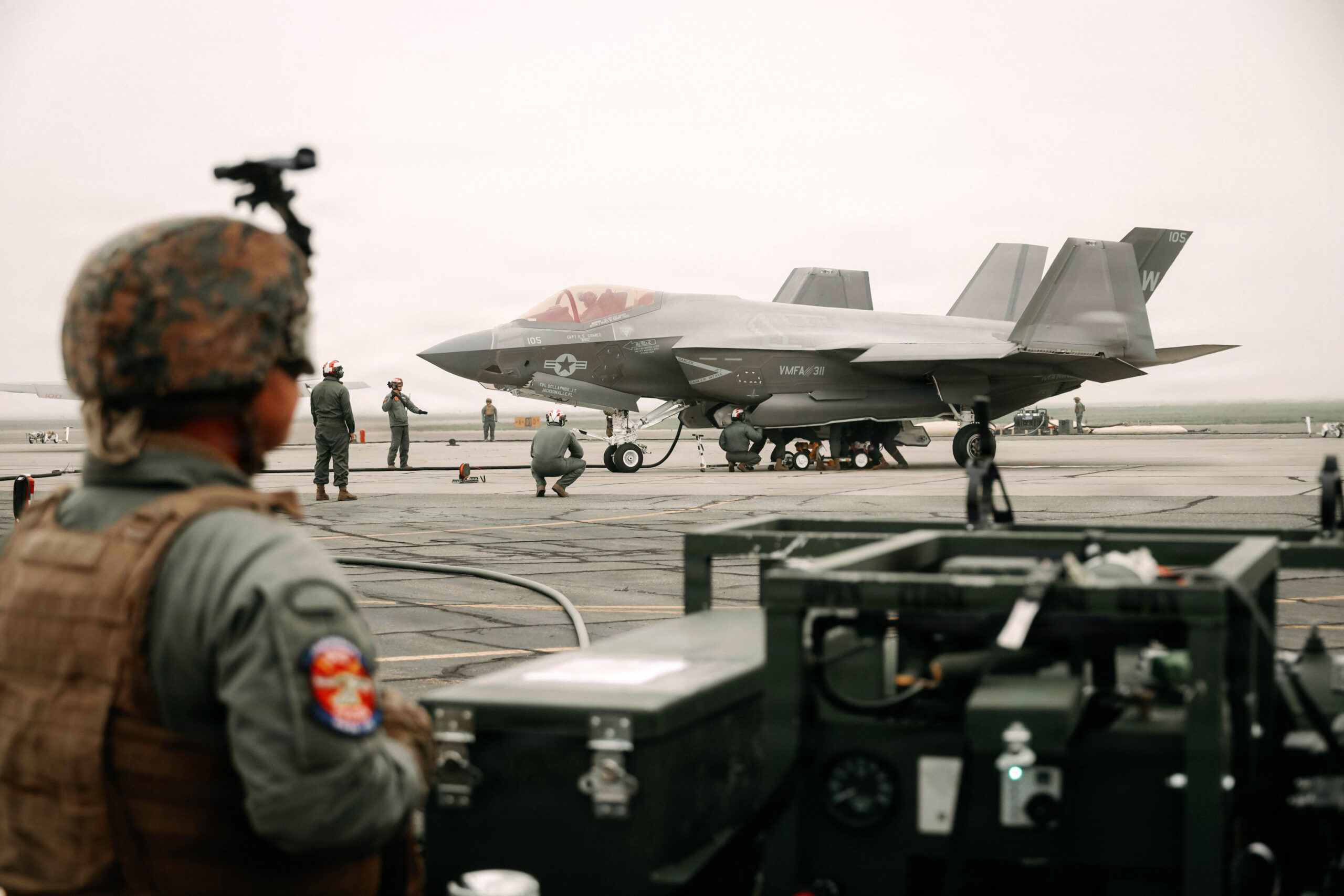
Perhaps the most operationally significant innovation demonstrated during Steel Knight 2025 has been 3rd Marine Aircraft Wing’s experimentation with a distributed aviation support architecture built around expeditionary “spokes” and forward arming and refueling points (FARPs). During the exercise, 3rd MAW units established aviation spokes at Camp Pendleton and a FARP at Sacramento Mather Airport, approximately 400 nautical miles from Pendleton, demonstrating the wing’s ability to project fuel, ordnance, maintenance, and command and control well beyond its main air stations.
These nodes allowed assault support and attack platforms to operate within striking distance of notional adversary targets while remaining supported from an agile, relocatable logistics network rather than a single, easily targeted base. This construct operationalizes the Corps’ kill-web logic: instead of viewing each airfield as a standalone hub, 3rd MAW is treating spokes and FARPs as interlocking nodes that can sustain aircraft, share data, and support fires across a widely dispersed battlespace.
In practical terms, this means tying together support squadrons, Marine Air Control Group 38 (MACG-38) air command and control detachments, and the ground combat element so that helicopters and tiltrotors supporting embassy reinforcement or other crisis-response tasks can be retasked, refueled, and rearmed through multiple routes. For a future Indo-Pacific campaign, this capability represents the difference between an aviation wing that must operate from a small number of vulnerable “big bases” and one that can rapidly establish and disestablish a web of survivable sustainment sites across a theater of operations.
During Steel Knight 25, Marines from Marine Wing Support Squadron 372, Marine Air Control Group 38, 3rd Marine Aircraft Wing, established and operated a Forward Arming and Refueling Point at Sacramento Mather Airport, California, on 8 December 2025.”
This distributed architecture also addresses a fundamental vulnerability in modern military operations: the concentration of critical capabilities at fixed, targetable locations. By dispersing aviation support across multiple expeditionary nodes, 3rd MAW complicates adversary targeting and increases the resilience of the overall force. If one spoke or FARP is neutralized, the network can adapt and reconstitute support through alternate nodes, a form of operational redundancy that is essential when facing adversaries with sophisticated intelligence, surveillance, and reconnaissance capabilities and long-range precision strike weapons.
The Coalition Dimension: Steel Knight as Theater Engagement
Steel Knight 2025 has also retained and expanded its multinational dimension, with International Observation Programs and partner-nation delegations present at Camp Pendleton and other venues. These observers use the exercise as a window into how I MEF trains for high-end conflict and crisis response in a contested maritime region. While embassy reinforcement and NEO scenarios are familiar tasks to many regional partners, the way I MEF integrates these missions within a larger campaign construct, complete with distributed aviation support, integrated fires, and sustained medical and logistics operations, offers a concrete model of how a stand-in MAGTF might operate alongside allies.
This coalition-building aspect should not be underestimated. In an era where strategic competition is as much about building and maintaining alliances as it is about combat capabilities, exercises like Steel Knight serve a theater-shaping function by demonstrating U.S. operational concepts to partners and by creating opportunities for professional military education and relationship-building. The presence of international observers transforms Steel Knight from a purely national training event into a form of security cooperation, where the exercise itself becomes a medium for communicating operational approaches and building shared understanding of how U.S. and partner forces might operate together in a crisis.
Conclusion: Campaign Readiness in the Indo-Pacific Context
The public narrative surrounding Steel Knight 2025 positions it as more than an annual readiness check; it is portrayed as an iterative step in building a Marine Expeditionary Force that can function as a theater-shaping stand-in force, one that can reinforce an embassy today, support an ally’s coastal defense tomorrow, and feed targeting and sustainment into a joint and combined kill web over time.
The embassy event at Camp Pendleton’s training village and the spoke/FARP construct at Pendleton and Mather provide tangible, observable anchors for this broader strategic concept, bridging the abstract language of kill webs and stand-in forces with the concrete realities of operational execution.
What emerges from Steel Knight 2025 is a vision of Marine Corps readiness that is fundamentally different from the garrison-to-deployment model that dominated the service for decades. Instead of viewing training as preparation for eventual combat operations, this exercise treats training as continuous campaign rehearsal, a way of maintaining a force that is perpetually ready to operate as a distributed network rather than a concentrated formation.
This approach acknowledges the reality that in the Indo-Pacific theater, crisis response and warfighting exist on a continuum rather than as discrete phases, and that the force must be equally prepared for ambiguous below-threshold operations and high-intensity combat.
For strategic analysts and defense planners, Steel Knight 2025 offers important insights into how the Marine Corps is operationalizing the stand-in force concept and preparing for the operational demands of great power competition.
The exercise demonstrates that the service is not simply proclaiming new concepts but systematically validating them through realistic, stressful training that integrates all elements of the Marine Air-Ground Task Force.
As the certified regiment deploys to Darwin and as subsequent rotations prepare for similar forward deployment, the lessons and validated procedures from Steel Knight 2025 will shape how the Marine Corps postured across the Indo-Pacific executes its mission as a crisis-response and theater-denial force.
The success or failure of this operational model will ultimately be judged not in training areas but in actual contingencies, but Steel Knight 2025 represents an essential step in building the institutional competence and operational confidence necessary for that future mission.
Featured Photo: U.S. Marines with Marine Wing Support Squadron 372, Marine Air Control Group 38, and Marine Aviation Logistics Squadron 11, Marine Aircraft Group 11, 3rd Marine Aircraft Wing, refuel and load ordnance on to an F-35B Lightning II assigned to Marine Fighter Attack Squadron (VMFA) 311 during exercise Steel Knight 25 at Sacramento Mather Airport, California, Dec. 9, 2025. The forward node at Mather enabled aircraft to arm and refuel before launching a simulated Maritime Strike, demonstrating 3rd MAW’s ability to sustain fixed-wing operations from distributed locations. Steel Knight is an annual exercise that strengthens the Navy-Marine Corps team’s ability to respond forward, integrate across domains, and sustain Marine Air-Ground Task Force readiness. (U.S. Marine Corps photo by Sgt. Brian A. Stippey)