
The Elizabeth City Case: Always Ready but Persistently Underfunded
Next year, I am publishing my book on the USCG, appropriately entitled: Always Ready: Persistently Under-Resourced. It is based on my extensive work with the USCG from Deepwater through to 2012 with updates since then as well.
The book presents a blunt commentary of the way the United States treats one of its most essential security institutions: a Coast Guard that is always ready, but structurally, politically, and financially condemned to remain persistently under-resourced. It argues that the modern Coast Guard story from 9/11 through the Deepwater era to 2025 is not a tale of organizational failure, but of a system that loads the Service with expanding missions while denying it the platforms, people, and infrastructure required to match those demands.
A case in point is the story of the Elizabeth City USCG facility. In this article I am reposting my 2010 interview based on my visit to the facility.
In the next, I will fast forward to today and see what has happened since to deal with this infrastructure in decay to support critical assets for the USMC to perform its core missions.
The Challenge of Modernizing USCG Infrastructure: The Case of the Elizabeth City USCG Base
August 24, 2010
Earlier this summer, I interviewed Captain Bennett, base commander at the Elizabeth City Coast Guard Station. Captain Bennett discussed the challenges facing the facility, with aging infrastructure impacting operations and capabilities. Our website examines concepts of operations and capabilities. Clearly, one key aspect affecting both is the nature of the bases from which U.S. and allied forces operate. Con-ops and capabilities are clearly intertwined with the physical assets available to the forces.
But while there has been much debate about the platforms the USCG is acquiring to replace its aging fleets of aircraft and ships, little attention has been focused in the public debate on the base of the pyramid: the basing infrastructure.
Comment: One of the things that people generally don’t understand is the role of infrastructure and how its condition affects the operational capability of the Coast Guard. Give me a sense of how the condition of the infrastructure here on the base which is so central to the entire air capability of the USCG affects operations.
Captain Bennett: Essentially, this is a World War II vintage base. It has a deep legacy here within the community in Elizabeth City and has played a key role over the years since World War II. Really, any rescue that you see at sea or anything the Coast Guard is doing out there on the high seas or picking up people locally in lakes and inland waterways all that portion of operations can be reverse-engineered back to a base like Elizabeth City.
It is here where the folks go to do the mission, where they’re trained, where they eat, where they sleep, and where the equipment is maintained and the training facilities are located.
So you can connect all the dots and go back to where our personnel are trained and where the equipment is maintained, and there’s a key linkage there. If that foundation of support is not there, it’s hard to get those Coast Guard men and women out there doing the mission with the right tools, the right training, at the right time.
It’s something that the public at large doesn’t see, but it’s very important to our Coast Guard men and women.
Question: One of the things that’s striking to me is that we rely on the Coast Guard to surge to deal with a national crisis like the Gulf oil spill. And we now have on this base the complete support element for the entire air capability of the Coast Guard.
Yet the warehouse that functions as the FedEx Memphis facility equivalent is in very old facilities that one certainly cannot call state-of-the-art. How important would it be to get more modern infrastructure to support the Coast Guard air fleet?
Captain Bennett: Absolutely essential. As you stated, we have a FedEx-style approach to aircraft maintenance. Elizabeth City maintains all the aircraft in the entire United States Coast Guard. This is the hub where it all happens, all the spare parts, all major maintenance comes through here, Elizabeth City, North Carolina.
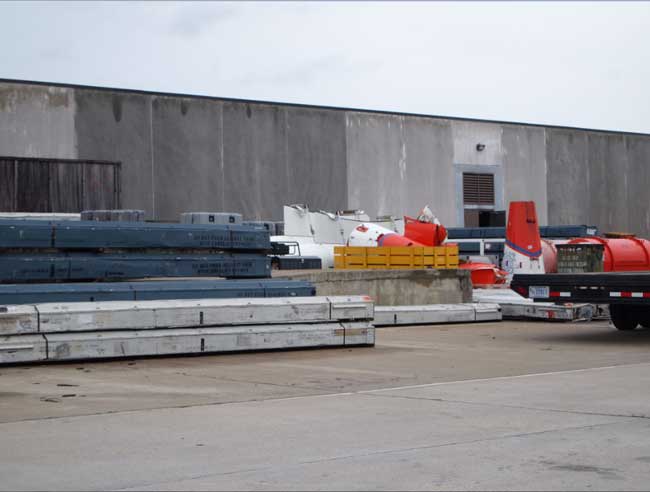
Currently, our warehouse, which houses many of these spare parts, is in great need of repair. We have a crumbling floor right now that we’re shoring up. This part of the country is close to the Dismal Swamp, and we have a lot of underground water. Actually, the warehouse sits on top of what amounts to an underground river.
So the floor is sagging, and we’re looking forward to getting a new warehouse so we can adequately house all the spare parts with state-of-the-art warehousing.
Because if we have a failure here within Elizabeth City for aircraft maintenance, it will affect the whole fleet throughout the Coast Guard. We are a single point of failure. So that’s a huge infrastructure issue that we’re looking forward to working through.
But right now, we have a bridging strategy with a temporary fix on the floor, if you will.
Comment: Well, one way to look at the situation is that we’ve had a public debate for a long time about the aging fleet, the aging aircraft, the various aging assets, and the challenge of retaining Coast Guard personnel in difficult financial times.
But there’s absolutely no public visibility regarding the state of the infrastructure, and I would look at the infrastructure as the base of the pyramid for modernization and recapitalization of the platforms for the USCG. But there seems to be little traction for that view. Give me a sense of the nature of this pyramid that’s crucial to the actual capability of the Coast Guard.
Captain Bennett: Currently, this base, as I mentioned, is the hub of aircraft maintenance for the entire Coast Guard. One of the issues that the base commanding officer deals with and that I deal with—is just the actual roadways here on the base. Basically, again, we’re dealing with World War II-era roads.
Question: Quite literally?
Captain Bennett: Yes, literally. We have a lot of traffic, almost 3,000 people coming in and out of the base every day, between the folks who work here and those who come in for their ID cards, medical appointments, pharmacy visits, or to use our small exchange. So we have tremendous use of our roadways.
As our trucks and deliveries come in, there’s a lot of wear and tear on the roadways. In our construction projects, we typically focus on buildings or air station hangars on the shore side. We never get down to the level where literally you’re dealing with the ground. But it’s a key issue. We have one main road here that runs along the Pasquotank River, and it’s critical that we maintain it. Currently, my folks in facilities patch up the potholes as they can and keep things going.
I tell my staff we’re like electricity: until you don’t have it, you don’t care about it. The roadways just don’t get a lot of visibility. Similarly, starting from the ground and working up, we have many other buildings, but we can’t house all of our outdoor equipment—our trucks and some of our yellow equipment.
It’s all out in the weather right now. We’d like more garages for those. So all those things that are behind the scenes are very important to any municipality running a town or a base well. This base is really a small city, and I call myself the mayor. We focus on keeping the utilities operating, the electricity, the water, the roadways, all those things that are behind the scenes. They’re behind all the rescues that you see at sea and all the Coast Guard men and women doing the operational mission.
One of the things in our tour we just looked at was our old gym. The gym used to be a chapel, and then it was a movie theater in World War II. Now we have aerobic equipment in there and free weights and whatnot. It’s adequate and it works, but it’s not the optimal solution.
We’ll get a state-of-the-art gym and rescue swimmer training facility, but still, we have needs across the board for this base—state-of-the-art physical fitness equipment for all the folks who come through the base.
Question: And the point is you have 2,100 personnel, and they’re not all going to be rescue swimmers?
Captain Bennett: Correct.
Comment: When you showed me all the outdoor storage—things that are exposed outdoors—and the World War II structures, one of the things that folks should realize is this is hurricane country. Given that we’ve decided to consolidate all our aircraft support structure here, one thing that would concern me is the need to improve protection from the high winds and hurricanes in the area.
And so, it would probably be optimal if we had some new capacity here that was more state-of-the-art and also more hurricane-protective.
Captain Bennett: Yes, that’s spot-on. We do have a lot of sheds, as you mentioned, and equipment outside that should be properly secured and housed in substantial buildings. One of my initiatives when I got here was to try to get rid of some of our sheds in case we have a big blow here.
We’re working toward that, but it’s been slow going because we’ve grown a lot faster than we’ve been able to build the infrastructure. So what we do when we have a threat of a hurricane is take some items inside and secure things as best we can. But it is a concern, because this is North Carolina, and we’ve been known to get some pretty big hurricanes through here.
Ironically, as we discussed, sometimes the aftermath of a hurricane will be so bad that we lose equipment and may have building damage. We do typically get some supplemental funding, which helps in the rebuild.
We were able to reconstitute our waterfront on the Pasquotank River after the last major hurricane we had. We purchased new riprap and reroofed some of our buildings.
So that’s the plus and minus of hurricane season, but it’s certainly not the way to hope for hurricanes or whatever to get money to help recapitalize your base.
An example of the many shortfalls I saw when visiting the base was the condition of the warehouse with the lack of permanent storage space necessitating placing significant material outside of the warehouse. If one remembers that this warehouse is the “Fed Ex” support center for the entire USCG fleet one gets a since of perhaps a weak link in the system.