How to Characterize the U.S. Intervention in Venezuela: Bold Global Geopolitical Move or Neo-Imperialism?
The Trump Administration’s intervention in Venezuela is certainly dramatic and controversial.
But what I find fascinating is how dramatically different interpretations there are of what the geopolitical impacts of the intervention might be.
I will contribute my own analysis soon on one key aspect of its geopolitical meaning but I will start by simply comparing two recent analyses which start from very different assumptions about the intervention and as a result reach strikingly different interpretations of the meaning and significance of the Trump Administration intervention.
The first was published in The Australian and was written by David Kilcullen and was entitled: “Trump’s New World Order: Venezuela, Greenland and the Stark Reality for Us” with the us being Australians. The second was published by The Wall Street Journal and was written by Lingling Wei and was entitled: U.S. Blows up China’s Latin America Ambitions With Maduro Ouster.”
Both pieces on the Maduro takedown start from the same set of events but use them to tell very different strategic stories. One, by David Kilcullen in The Australian, reads the Venezuela raid together with U.S. moves over Greenland and the GIUK Gap as evidence of a bluntly neo‑imperial American strategy that forces Australia toward “national adulthood.” The other, by Lingling Wei in The Wall Street Journal, treats Maduro’s ouster as the detonator that blows up a decade of Chinese political‑economic investment in Latin America and forces Beijing to recalibrate its thinking about Taiwan and the Monroe Doctrine.
Taken together, they illuminate how a single operation can be refracted through three lenses at once: U.S. power, Chinese strategy, and middle‑power positioning.
Kilcullen writes as an Australian strategist addressing Canberra’s predicament inside a fragmenting order. His audience is a polity that has long taken for granted a broadly benign American hegemony and now confronts a U.S. administration that openly disavows the language of rules and community in favor of “iron laws” of power. The Maduro raid, in his telling, is only one of three tightly connected moves: the multi‑domain operation to seize Maduro himself, renewed U.S. pressure to subsume Greenland into an American security and resource sphere, and the long‑range seizure of a Russian‑escorted “dark fleet” tanker in the GIUK Gap. Each step is used to show how Washington is operationalizing its 2025 National Security Strategy and a Western Hemisphere–centric “Donroe Doctrine.”
Wei writes as a China‑specialist reporter mapping the shock inside Zhongnanhai. Her core audience is interested in how Beijing processes risk and opportunity when U.S. power is reasserted vigorously in what Americans still call their backyard. Rather than embedding the raid in a triad with Greenland and GIUK, she embeds it in a map of Chinese projects across Latin America, ports, railways, mines, EV plants, and major loans, and traces how those bets are suddenly repriced. The Maduro operation becomes the moment when an “all‑weather” Latin American partner is removed and a decade‑long strategy to anchor Chinese influence in the hemisphere is abruptly derailed.
In both accounts, the event is decisive, but the system it decisively alters differs. For Kilcullen, it is the global order that Australians imagined they inhabited, anchored in U.S. commitment to norms and institutions. For Wei, it is China’s quiet but consequential strategy to turn the Western Hemisphere from an American preserve into a region of competing alignments and economic dependencies.
Both authors see the Maduro raid as a deliberate assertion of U.S. primacy in the Americas, but they characterise the underlying U.S. strategic logic in divergent ways.
Kilcullen leans on the language of 19th‑century empire. He argues that the concepts that best fit the emerging Trump approach are suzerainty, protectorates and spheres of influence, not the familiar late‑20th‑century idiom of democracy promotion or responsibility to protect. In Venezuela, the U.S. does not attempt regime change in the sense of installing an opposition democratic leader, but instead removes Maduro, leaves Delcy Rodríguez in place as interim president, and asserts control over Caracas’s external economic and security relations. This is described as suzerainty: internal autonomy retained, but foreign policy, defence and key revenue streams effectively subordinated to Washington. He explicitly situates this in a “Trump Corollary” to the Monroe Doctrine, now openly justified as the natural exercise of force by a strong power rather than as guardianship of a liberal order.
Wei also uses the Monroe Doctrine, but from the other side of the Pacific. For her sources in Beijing, the doctrine is not a historical curiosity but a living constraint that Chinese planners must either challenge or accommodate. The U.S. ouster of Maduro is read as a vivid reminder that, when core hemispheric interests are at stake, American interventionism is not a “paper tiger,” but something China must “take seriously.” In her account, the Trump administration’s strategy is labelled the “Trump corollary” to the Monroe Doctrine by U.S. officials themselves, reinforcing the idea that Washington once again claims exclusivity in the Western Hemisphere.
Yet Wei’s focus is less on the normative break and more on the bargaining logic that might follow. She reports that some Chinese policymakers are exploring an implicit trade: if the Western Hemisphere is conceded as an American sphere, then the Taiwan Strait becomes a Chinese sphere. Where Kilcullen sees a unilateral American move toward 19th‑century practice, Wei records Chinese attempts to translate that practice into a reciprocal understanding about zones of control and “core interests.”
Both pieces describe the same raid, but they dwell on different features and implications.
Kilcullen is interested in the raid as a prototype of contemporary multi‑domain operations. He details how roughly 150 aircraft and drones from land and sea bases attacked Venezuelan radar, missile sites, bases and command‑and‑control nodes, combined with cyber attacks, jamming and space‑based disruption of GPS, to open a narrow window for helicopters carrying a joint special operations and FBI team into Caracas. The team overpowers Maduro’s Cuban‑provided bodyguard, captures him and his wife, extracts to USS Iwo Jima, and then transfers them to New York for indictment on drug and weapons charges. He underlines the operation’s tactical success, modest but real casualties, the endurance of a damaged helicopter that completes the mission, and, crucially, the apparent ineffectiveness of Russian and Chinese‑supplied air defenses, including the Chinese JY‑27A “anti‑stealth” radar. The raid is framed as an exemplary integration of special forces, electronic warfare, cyber and space systems to achieve limited objectives with a small ground footprint.
Wei mentions the firefight and the suddenness of the U.S. incursion, but her center of gravity is elsewhere. The decisive fact is that the raid occurs hours after Xi Jinping has dispatched a special envoy, Qiu Xiaoqi, to Caracas to stabilize China’s position and secure repayment of more than 10 billion dollars in Venezuelan debt and continued access to oil. The operation humiliates Beijing’s timing and leaves it holding “toxic IOUs” from a regime that now must orient toward Trump, who styles himself “acting president” of Venezuela. For Wei, the raid’s tactical sophistication matters mainly because it demonstrates both capability and will; the more salient point is that it instantaneously turns Venezuela from China’s most important Latin partner into a contested space where U.S. leverage is dominant.
In Kilcullen’s narrative, the military operation is the main exhibit; geopolitics and political economy are then layered atop it. In Wei’s narrative, the operation is the trigger; the central drama plays out in debt ledgers, oil concessions, and the recalculation of Latin portfolios.
China appears in both articles, but its role is radically different.
In The Australian piece, China is one of several external powers whose tools and ambitions are being blunted. Kilcullen notes that Venezuelan air defences, supplied by Russia and China, fail to contest U.S. operations; Taiwanese defence analysts are said to be paying close attention to the combat failure of the JY‑27A radar, while others note the poor performance of Russian missiles. In his discussion of Greenland, he highlights Chinese rare‑earth and resource interests and a growing Chinese presence in Greenland as a factor motivating American desire to deny adversaries access to Arctic resources and energy. China is a competitor whose systems are being embarrassed and whose options are being constricted by U.S. hemispheric consolidation, but it is not the main subject.
In The Wall Street Journal piece, China is the protagonist. Wei lays out a geography of Chinese economic statecraft in Latin America: port projects such as Chancay, metro lines, solar plants, copper mines, lithium plays, and a BYD EV plant in Brazil, along with Honduras’s switch from Taipei to Beijing and adhesion to Belt and Road. She shows how these moves have been stringing together an arc of influence, even as some nodes have begun to wobble under renewed U.S. pressure, Mexico’s tariffs on Chinese EVs, Panama’s withdrawal from Belt and Road and re‑embrace of U.S. military presence, Honduras’s buyer’s remorse over shrimp exports and a possible shift back to Taiwan under Nasry Asfura.
Maduro’s fall, in her telling, is the moment when this whole strategy looks suddenly precarious. Beijing now faces the prospect of those Venezuelan debts never being fully repaid, its oil interests subordinated to American restructuring, and its political ally replaced by a leadership far more beholden to Washington. The article notes that Chinese officials are now mainly playing defense: trying to avoid being written out of Venezuela’s oil ledger altogether and considering inducements, such as buying large volumes of long‑term U.S. Treasurys, to shape American behaviour in the Taiwan Strait. Where Kilcullen emphasises Chinese systems that fail in combat, Wei emphasises Chinese strategies that fail in political‑economic competition.
One of the most revealing contrasts lies in how the two authors use the episode to speak to third parties.
Kilcullen’s third party is Australia. He draws on Clinton Fernandes’s concept of Australia as a “sub‑imperial power,” historically operating within British and then American imperial frameworks to secure regional influence in support of a stabilizing global order. That role, he argues, only made sense when Canberra and its imperial patron shared core values and a commitment, at least rhetorically, to some notion of rules‑based order. If U.S. policy is now openly framed in terms of raw power, commercial extraction and spheres of influence, without even the pretense of global norms, Australia risks becoming a mere vassal unless it adjusts.
The prescription is an invitation to “national adulthood” more than a blueprint. Australia, he contends, is now economically and militarily more capable than ever, has repeatedly punched above its weight in convening middle‑power coalitions, and must shift toward self‑reliance, national resilience, regional partnerships and selective great‑power engagement on its own terms. None of this necessarily entails abandoning the U.S. alliance; it does require abandoning the assumption of a benevolent, unipolar American order that will take care of systemic stability. The Maduro raid, Greenland gambit and GIUK seizure together become the shock that should wake Canberra from strategic adolescence.
Wei’s third parties are different. She focuses on: Latin American states such as Mexico, Panama and Honduras, each repositioning amid renewed U.S. assertiveness and Chinese retrenchment. Taiwan, whose status is central both to Washington’s 2025 National Security Strategy and to Chinese debates about reciprocity and red lines.
Her piece notes that Taiwan’s President Lai Ching‑te may seek to attend Asfura’s inauguration in Honduras, and that Beijing is watching closely to see whether the Trump administration will permit a U.S. transit, a privilege previously denied. This becomes a near‑term test of whether the U.S. is prepared to translate its Venezuelan resolve into a more confrontational posture in the Taiwan Strait, or whether its focus on the Western Hemisphere will leave a vacuum in the Asia‑Pacific. The article also shows how Latin governments are recalculating: Mexico aligning trade policy with Washington ahead of a key NAFTA review; Panama re‑tilting toward U.S. security ties; Honduras potentially reversing its recognition of Beijing as economic promises fall flat.
Thus, where Kilcullen wants Australians to see the Maduro raid as a mirror showing them their dependency, Wei wants readers to see it as a mirror showing Beijing the limits of its push into America’s backyard and as a hinge between two theatres, Latin America and the Taiwan Strait.
Despite their differences, the articles converge on several themes that matter for any strategic reader.
First, both see the operation as part of a broader U.S. effort to restore deterrence. Kilcullen lists recent perceived failures, the Afghanistan withdrawal, inability to deter Russia’s invasion of Ukraine, stalemate over Gaza, and U.S. impotence against Houthi interdiction in the Red Sea and presents the Maduro raid and GIUK tanker seizure as attempts to demonstrate that the U.S. can still act decisively and at long range. Wei, quoting analysts such as Yun Sun, emphasises that the operation forces Beijing to admit that American power is not a hollow shell; its willingness to use force in the Western Hemisphere must be factored into any calculation about Taiwan.
Second, both explicitly frame policy in terms of spheres. Kilcullen uses 19th‑century language, protectorates, suzerainty, spheres of influence, to explain what U.S. policy is becoming. Wei reports that Chinese policymakers are themselves now discussing a de facto partition of spheres: the Western Hemisphere as American, the Taiwan Strait as Chinese. Both see the Monroe Doctrine, or its updated “Donroe” or Trump corollary variant, as the central conceptual anchor, even if they weigh its implications differently.
Third, both underscore the erosion of the post‑Cold War liberal order frame. Kilcullen is explicit about this: he argues that U.S. policy as stated in the 2025 NSS is “purely national,” detached from any sense of obligation to maintain institutions or norms, and that Trump’s blunt rhetoric merely states aloud what others had begun to practice. Wei shows the same shift indirectly: the Trump team is happy to describe its hemispheric policy in Monroe‑Doctrine terms and is comfortable trading structural concessions (for example, over Chinese buying of Treasurys) for acknowledgment of U.S. priority in its own region.
For analysts and policymakers, the juxtaposition of these two pieces is instructive.
One shows how America’s closest allies can no longer assume alignment between their values and Washington’s methods and therefore must mature strategically. The other shows how America’s principal rival must now weigh whether to confront the Monroe Doctrine head‑on, seek a bargain that codifies mutual spheres, or test whether U.S. resolve extends beyond its backyard into the Western Pacific.
Between them lies the space in which middle powers, from Australia to Panama to Honduras, will be forced to choose, hedge and sometimes, as Kilcullen suggests, finally grow up.
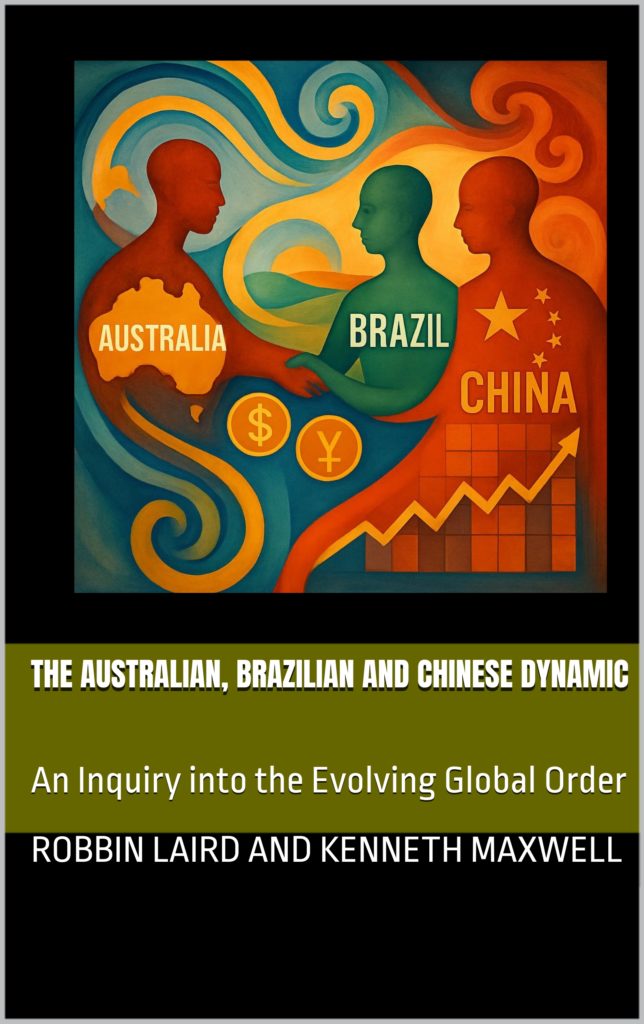
Note: Kenneth Maxwell and I address these broader questions in our book to be published later this year entitled: The Australian, Brazilian and Chinese Dynamic: An Inquiry into the Evolving Global Order.
The book argues that Australia and Brazil, as pivotal democratic middle powers deeply enmeshed in China-centered economic networks yet tied in different ways to the United States and the liberal order, illuminate how the emerging global system is being reshaped from below as much as from above. It contends that the 21st‑century environment is no longer defined by classical “great power competition” in an 18th–20th century sense, but by a dense web of interdependence in which China’s bid to construct an “informal empire” and alternative governance architecture hinges critically on how states like Australia and Brazil manage sovereignty, prosperity, and democratic resilience under conditions of asymmetric economic dependence.