
The H-1 Helicopter’s Digital Revolution: HMLA-267 Leads Marine Corps into Distributed Aviation Operations

The Marine Corps has long understood that the character of warfare is shaped not merely by weapons systems or technological innovation, but by how forces are trained, organized, and conceptually prepared for the operational environment they will face. Steel Knight 2025, was conducted from December 1-14, 2025, across Southern California and the greater Southwest, represented a significant evolution in how I Marine Expeditionary Force (I MEF) prepares for the demands of Indo-Pacific contingencies. This exercise transcends the traditional model of large-scale training events as discrete readiness checks, instead functioning as a “campaign laboratory” or a venue where operational concepts are tested, refined, and validated against the friction of realistic scenarios before they are deployed in actual theater operations.
I was a guest of 3rd Marine Air Wing during the exercise, and I conducted a number of interviews during the exercise. This is the second of these interviews.
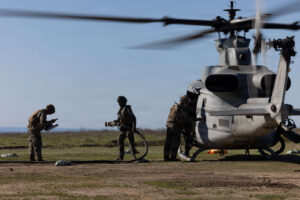
While much attention focuses on fifth-generation fighters and unmanned systems, Marine Light Attack Helicopter Squadron 267 (HMLA-267 is quietly pioneering a transformation that may prove decisive for future combat operations. As the first Marine Corps Light Attack Helicopter OR H-1 squadron to achieve full digital interoperability with a complete unit of employment, HMLA-267 is demonstrating how the H-1 helicopter platform, sometimes dismissed as vulnerable or obsolete, is evolving into a critical command and control node for distributed aviation operations. Their experience reveals not just technological advancement, but a fundamental reimagining of how rotary-wing aviation integrates with the joint force in contested environments.
First to Full Digital Capability
HMLA-267 holds a unique distinction within Marine aviation: they are the first squadron to field a complete unit of employment with fully upgraded, digitally interoperable, Link 16-capable aircraft. This unit consists of five AH-1Z Vipers and four UH-1Y Venoms, all equipped with the digital interoperability upgrade that fundamentally changes how these platforms operate in the battlespace.
As one squadron officer explained, “We’re the first ones to really get all of them, all that hardware and everything upgraded, and then start the training syllabus, which isn’t super well defined. So we’re kind of the pioneer squadron.” While other Marine Light Attack helicopter squadrons possess some digitally interoperable aircraft, HMLA-267 is the first to have an entire operational unit equipped and beginning to develop the tactics, techniques, and procedures for employing this capability at scale.
This pioneering status comes with challenges. The squadron is simultaneously learning the technology, developing training protocols, and proving operational concepts, all while maintaining their traditional close air support mission for the ground combat element. They are, in effect, writing the manual while flying the aircraft.
The Forgotten Platform’s Critical Role
One persistent theme in discussions about Force Design 2030 and future Marine Corps operations has been the question of rotary-wing aviation’s relevance. In an era of long-range precision fires and unmanned systems, some have questioned whether helicopters, particularly attack helicopters, remain viable in contested environments.
The HMLA-267 officers pushed back firmly on this narrative. “When you say that the helicopters, the H-1 specifically, kind of were left out or forgot about, I think people just forgot that regardless of whatever fight that we’re in, we are one of the ones closest to support the ground combat element, always have been, always will be,” one officer stated. “We were almost always paired at the hip with the Blue Diamond.”
The 1st Marine Division, headquartered at Camp Pendleton and serving as the principal ground combat element of I MEF, is commonly known as the “Blue Diamond.” The name comes from its distinctive shoulder patch: a blue diamond-shaped background with a red numeral “1” and the word “Guadalcanal,” commemorating the division’s World War II campaign.
This relationship between HMLA-267 and the Blue Diamond isn’t merely historical; it’s structural. MAG-39, the parent organization for HMLA-267, is uniquely positioned as the only Marine Aircraft Group stationed on both an air station and a training base sharing Camp Pendleton with the 1st Marine Division. “We take our relationship with them and the ground combat element very, very seriously,” the officer continued. “Everything we do supports them.”
This proximity to the ground combat element isn’t a weakness to be overcome but a strength to be exploited. While the H-1s may not possess the sensor suite of an F-35 or the standoff range of a long-range missile, they bring something equally valuable: the ability to operate in close coordination with ground forces while now possessing the digital connectivity to integrate with higher-end systems.
Digital Interoperability as Force Multiplier
The digital interoperability upgrade transforms the H-1 from a platform that primarily receives targeting information via voice radio to one that can participate in the broader digital network. This seemingly technical change has profound operational implications.
“Once we have that common operational picture, and we’re speaking the same language, we’re in the same digital ecosystem, that’s where it really pays dividends,” one officer explained. The upgrade enables H-1 crews to see the same tactical picture as F-35s, MQ-9 unmanned systems, and command elements and to contribute to that picture in real time.
The most immediate benefit manifests in the targeting cycle. Previously, prosecuting targets required extensive voice coordination: confirming location, verifying friendly positions, coordinating timing, and managing airspace. Each of these steps introduced delay and potential for error. “The question of where is it, or what is out there, and where is it, and then can I shoot that is something that can happen through a variety of different players,” an officer noted. “Using the exquisite sensors that come off of those different systems, be they F-35, MQ-9, at least inside of the Marine Corps, and then we add assets outside of the Marine Corps to that picture as well, whether it’s E-2, whether it’s Growler… we can do that at a speed that previously was much more difficult to do.”
This speed matters tactically and operationally. Targets can be identified by one platform, prosecuted by another, with battle damage assessment conducted by a third, all without extended voice coordination. If a target has already been engaged, H-1s can immediately shift to alternative targets without cycling back through command nets. The efficiency of prosecution, as the officers described it, is dramatically enhanced.
Integration with Fifth-Generation Systems
A particularly significant aspect of HMLA-267’s digital upgrade is its integration with F-35 operations. The F-35’s sensor fusion and data-sharing capabilities are well-documented, but much of the discussion has focused on peer-to-peer F-35 networking or integration with Aegis systems. The H-1’s ability to tap into this information flow represents a different dimension of fifth-generation integration.
The officers described how MV-22 Ospreys already operate with Link 16, creating a template for how rotary-wing platforms can integrate into the broader network. The H-1 upgrade builds on this foundation, but with the added dimension of being a strike platform that can both receive targeting data and contribute to the kill chain.
This integration enables what one officer called “a unified language” across diverse platforms. F-35s can detect and track targets with their sophisticated sensors, share that information via Link 16 to H-1s positioned closer to the battlefield, which can then prosecute those targets while remaining in coordination with ground forces. The alternative, voice coordination between platforms with different tactical pictures, introduces delays that can prove decisive in a fast-moving tactical situation.
Autonomous Systems Integration: The Next Frontier
Perhaps the most forward-looking aspect of HMLA-267’s digital transformation is the potential for integration with autonomous systems. This represents a paradigm shift in how rotary-wing aviation is understood and employed.
Current autonomous systems operate at “Level Two autonomy” where they can be tasked to perform specific missions but require human oversight and intervention. For maritime autonomous systems, ground-based unmanned systems, or loitering munitions, the question becomes: who tasks them, who monitors their operations, and who integrates their data into the broader tactical picture?
The digitally interoperable H-1, operating in close proximity to ground forces, represents an ideal command and control node for these systems. An H-1 crew maintaining station in support of a ground unit could task an unmanned aerial system to conduct reconnaissance, receive its sensor feed, and integrate that information with input from ground forces and higher-echelon systems, all while maintaining the ability to provide immediate kinetic support.
This concept challenges the notion that helicopters are obsolete in modern warfare. Instead, it positions them as critical nodes in a distributed network or platforms that combine mobility, persistence in proximity to ground forces, kinetic capability, and now digital connectivity.
The Reality of Distributed Aviation Operations
The discussion of Distributed Aviation Operations (DAO) within the Marine Corps has often remained at a conceptual level, focused on dispersal to avoid adversary targeting. The HMLA-267 experience reveals both the promise and the practical constraints of distributed operations.
One officer drew on experience in the Philippines to illustrate the operational environment the squadron is preparing for. In the Indo-Pacific theater, characterized by distances, limited infrastructure, and dispersed objectives, the ability to operate from austere locations becomes crucial. The squadron has practiced expeditionary operations, demonstrating their ability to deploy, operate, and sustain H-1s from locations far from major bases.
However, the officers emphasized that realistic distributed operations require more than dispersal. “You still have to make a difference. You have to be lethal and survivable and sustainable,” they noted. Sustainability becomes the limiting factor. An H-1 detachment operating from an expeditionary location requires fuel, ammunition, maintenance support, and parts. The unit must remain combat-effective, not merely dispersed.
Digital interoperability addresses part of this challenge by reducing the need for co-location to achieve coordination. H-1s need not be based with F-35s or command elements to operate in close coordination with them. They can be positioned to support ground units while maintaining digital connectivity with the broader force. This enables genuine distributed operations where distribution serves operational purpose rather than merely complicating adversary targeting.
Training and Tactics Development
As the first squadron with full digital capability, HMLA-267 faces the challenge of developing training syllabi and tactical employment concepts without established templates. This pioneering work occurs in parallel with operational commitments, creating what one officer described as learning “much more quickly” than in previous generations of technology adoption.
The squadron leverages exercises to test and refine their digital capabilities. These exercises provide opportunities to integrate with F-35s, work with ground units, and operate in joint environments. Each iteration reveals new possibilities and new challenges, informing the development of tactics and procedures.
One key learning: digital interoperability doesn’t simply make existing operations easier—it enables fundamentally different approaches to mission execution. The speed of the targeting cycle, the ability to dynamically re-task based on real-time information, and the integration with diverse platforms creates opportunities that didn’t exist in voice-only coordination regimes.
The squadron must also address the human factors of operating in this new environment. Crews must develop comfort with digital systems while maintaining proficiency in traditional skills. The cognitive load of monitoring multiple information streams while flying and employing weapons requires new training approaches. Building crew coordination when both pilots can access rich digital information represents a different challenge than traditional instructor-student or aircraft commander-copilot relationships.
Command and Control Evolution
The digital transformation HMLA-267 is pioneering has implications beyond tactical efficiency. It challenges fundamental assumptions about command and control in military operations. The squadron’s experience illuminates a tension between the centralized availability of information and the decentralized execution required by operational tempo.
One officer articulated this challenge: “If commanders grow up with all these sensors providing information, and they’re readily having all this information, I’m concerned about that centralized control even being more centralized… But I think the Marine Corps, if we stay true to our doctrinal execution with regards to maneuver warfare, and we go out and execute on mission-type orders… things are going to be changing in real time. We have to be able to trust the operator to execute via decentralized control and execution of mission-type orders.”
This observation captures a fundamental question facing not just the Marine Corps but the joint force: does increased information availability enable more effective decentralized operations, or does it create pressure for increased centralized control? The technology enables both possibilities.
The H-1’s role as a tactical-level node, operating in close proximity to ground forces, argues for the former approach. Crews can observe effects in real time, adjust to changing circumstances, and exploit fleeting opportunities. Requiring approval cycles through higher echelons would negate the speed advantages that digital interoperability provides.
Yet the temptation exists to use digital connectivity to exert greater control. Senior commanders, able to see the same tactical picture as forward units, may struggle to resist the urge to direct tactical actions. This tension isn’t unique to the Marine Corps, but the Corps’ doctrinal emphasis on mission command and maneuver warfare provides a framework for addressing it.
Joint Force Integration
A significant aspect of HMLA-267’s digital capability is its potential for joint operations. The Link 16 standard enables interoperability across services, and the officers described how this opens new opportunities for Marine H-1s to contribute to joint operations.
“As we all find ourselves working in the same digital sphere, our conversation or the language that we use becomes more unified,” one officer explained. “We have the ability to contribute to the joint force and also contribute to the discussion around how to prosecute the environment and affect change in a way that we typically have not had the chance to really get an invite to the table.”
This is more than symbolic. In joint operations, Marine rotary-wing aviation has sometimes operated in a supporting role, dependent on other services for situational awareness and targeting. Digital interoperability enables Marine H-1s to operate as full participants in joint kill chains, receiving targeting data from Navy E-2s or Air Force platforms and contributing their observations to the broader joint picture.
This capability becomes particularly relevant in the Indo-Pacific, where joint and combined operations will be the norm rather than the exception. Marine H-1s supporting expeditionary advance base operations or ship-to-shore operations can maintain connectivity with Navy strike groups, Air Force agile combat employment elements, and allied partners, all operating in the same digital ecosystem.
Looking Forward: The Evolutionary Path
HMLA-267’s experience represents an early stage in a longer transformation. The squadron is proving the concept and developing initial tactics, but the full potential of digitally interoperable H-1s operating with autonomous systems in support of distributed ground operations remains to be realized.
Several evolutionary paths appear probable.
First, integration with maritime autonomous systems will become increasingly important as the Marine Corps fields unmanned surface and subsurface vessels for reconnaissance and fires. H-1s operating in support of expeditionary advance base operations could serve as C2 nodes for these systems, tasking them and integrating their data.
Second, the proliferation of small unmanned aerial systems at the tactical level will require integration into the H-1’s digital picture. Rather than treating these as separate capabilities, future operations may see H-1 crews controlling or monitoring multiple unmanned systems while maintaining their traditional close air support role.
Third, improvements in data-link capacity and sensor integration will enable richer information sharing. The current Link 16 implementation represents a starting point; future upgrades will likely expand bandwidth and enable new forms of coordination.
Finally, as the Marine Corps fields the AH-1Z replacement, whatever that platform may be, the lessons learned by HMLA-267 will inform requirements and design. The next-generation attack helicopter will be designed from inception as a digital node, not retrofitted with digital capability.
Conclusion
HMLA-267’s role as the first squadron with fully digitally interoperable H-1s positions them at the forefront of a transformation in rotary-wing aviation employment. Far from being obsolete, the H-1 is evolving into a critical node in distributed operations—a platform that combines the traditional strengths of rotary-wing aviation with the connectivity and integration capabilities of modern digital warfare.
The squadron’s experience demonstrates that digital interoperability isn’t merely a technical upgrade but an operational enabler that fundamentally changes how rotary-wing aviation contributes to the fight. By dramatically compressing the targeting cycle, enabling integration with fifth-generation systems and autonomous platforms, and facilitating joint operations, digitally interoperable H-1s represent a bridge between traditional close air support and future distributed operations.
As the Marine Corps continues to refine Force Design 2030 and develop concepts for operating in contested environments, HMLA-267’s pioneering work provides crucial operational insights. Their ability to maintain relevance in a rapidly changing technological landscape while staying true to the Marine Corps’ doctrinal emphasis on mission command and maneuver warfare suggests a path forward that leverages new capabilities without abandoning proven operational approaches.
The ultimate test will come not in exercises but in operations, where the speed, flexibility, and integration that digital interoperability enables will either prove decisive or expose limitations. But for now, HMLA-267 is writing the manual for how Marine rotary-wing aviation will operate in future conflicts, one flight, one mission, one digital upgrade at a time.
Officers in the interview:
LtCol Michael Oates, MAG-39, CO of HMLA-267
Maj Jonathan Moss, MAG-39, HMLA-267