From Kill Chains to Kill Webs: 3rd Marine Aircraft Wing’s Communications Revolution

At 3rd Marine Aircraft Wing headquarters, a group of communications and intelligence professionals are working through one of the most fundamental challenges facing modern military operations: how to separate the sensor from the shooter while maintaining the speed and precision required for contested combat. This isn’t an abstract doctrinal exercise. It’s the practical reality of what future Pacific operations will demand.
Within 3rd Marine Aircraft Wing, the G-6 is the commanding general’s staff section responsible for communications and information technology: it plans, builds, secures, and manages the command-and-control (C2) and IT networks that let the wing command, coordinate, and fight. The G-6 provides a number of capabilities and functions for 3rd MAW:
• Provides the 3rd MAW commander with planning, management, and execution of C2 systems so the wing can exercise tactical and operational control of aviation forces in garrison and deployed.
• Serves as the principal advisor on communications, IT, and cyberspace matters, integrating these into operations and exercises across the wing.
• Plans, installs, operates, and maintains the wing’s communications and IT infrastructure, including classified and unclassified networks, telephony, data services, and collaboration tools.
• Designs and manages the communications architecture for exercises and operations so aviation C2, fires, logistics, and support elements can share data and orders reliably.
• Enforces cybersecurity and information assurance policies on wing networks, protecting data, systems, and services against intrusion and disruption.
• Oversees COMSEC (communications security) management to ensure voice and data links used by 3rd MAW remain secure and compliant with higher headquarters directives.
• Coordinates with higher and adjacent commands (e.g., I MEF, MCEN entities, and joint/coalition partners) to ensure interoperability of networks and C2 systems during joint and combined operations.
• Supports information environment and electromagnetic spectrum operations by aligning network and data service priorities with the intel, fires, and IE Ops planners.
• Advises on IT resourcing, modernization, and lifecycle management of communications and C2 capabilities used by 3rd MAW headquarters and subordinate units.
• Develops and enforces wing-level C4/IT standards, contributing to broader Marine Corps enterprise network initiatives and ensuring readiness of communications capabilities.
The conversation with the G-6 team reveals something often overlooked in discussions about military transformation: the revolution isn’t just about new platforms or weapons systems. It’s about fundamentally reimagining how information flows through combat operations, how commanders make decisions under pressure, and how forces separated by vast distances can coordinate effects with precision and economy.
Beyond the Kill Chain
“We’re trying to design a kill chain that separates the sensor from the shooter,” explained one of the G-6 officers, cutting straight to the operational challenge. “Both adversary and friendly munitions now go further than our sensors can see from the shooter itself. To achieve true standoff, you have to leverage sensors that aren’t on board the shooter.”
This seemingly simple observation carries profound implications. The traditional model of a platform carrying both its sensors and weapons worked well enough when engagement ranges were relatively short. But modern missiles and precision weapons have outpaced the sensor range of individual platforms. An air platform might be able to launch a weapon 100 miles away, but can it see the target at that range? Often not. This creates what military planners call an “engagement zone” problem.
The solution requires creating a network of sensors positioned to give shooters the data they need, when they need it, with the precision modern weapons demand. “We need to create an engagement zone of sensors to allow the shooters to actually do the kills that we need to do,” as the discussion framed it.
This isn’t just a technical challenge. It’s an organizational one, requiring Marine aviation, ground forces, naval elements, and potentially joint partners to share information with unprecedented speed and reliability. The digital link between sensor and shooter becomes the critical enabler, and that’s where the communications professionals come in.
The Communications Architecture Behind Modern Operations
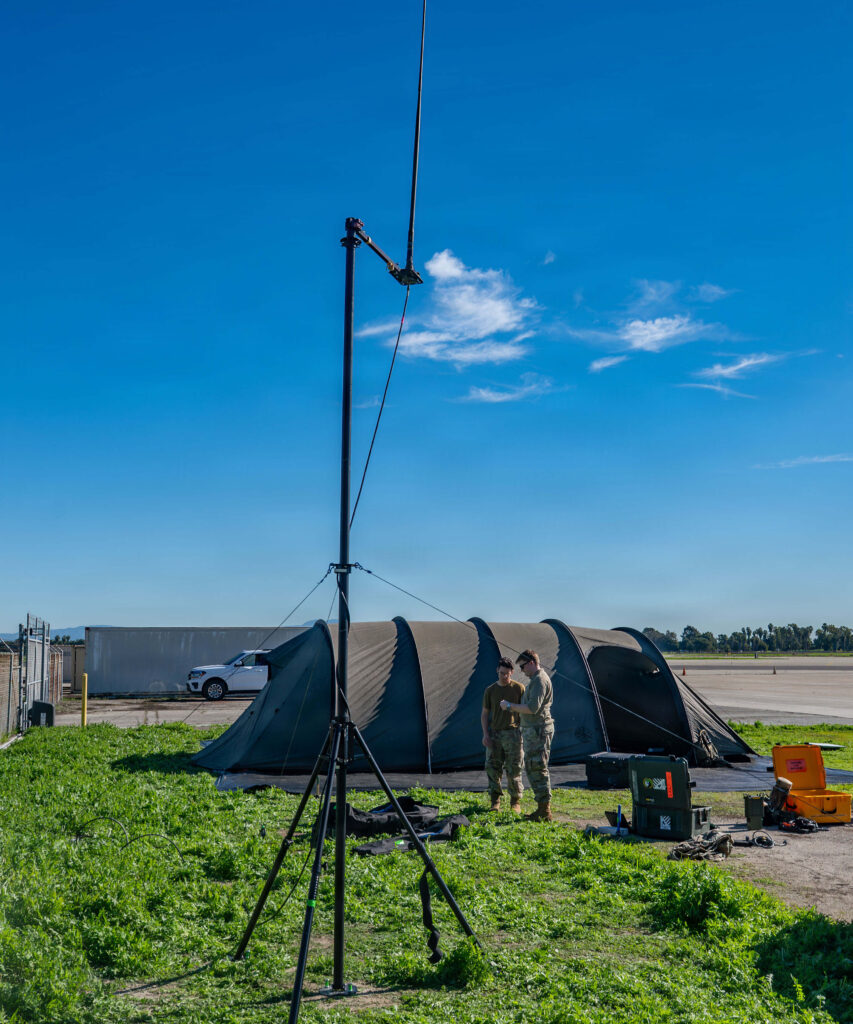
For the G-6 team at 3rd Marine Air Wing, their mission is clear: ensure that critical targeting data can flow from sensor platforms to shooters regardless of domain, service, or location. This means leveraging everything from space-based sensors to terrestrial ISR platforms, from Link 16 tactical data networks to commercial satellite communications.
“We’re trying to leverage a complement of terrestrial sensors and space-based sensors,” one officer explained, describing the find-fix-track portion of the kill chain. “Then when it gets to target and engage, we’re really trying to leverage Link 16 as our primary path to get that message to an airborne shooter.”
But here’s where it gets complicated. Link 16 is a proven tactical data link, but it’s not the only communications path available. The G-6’s approach reflects a practical reality: redundancy is survival.
“I have a personal rule of thumb,” said one officer: “I need three ways to win, three ways of getting a message across the wire. I’ll take commercial SATCOM, whether it’s Starlink or ViaSat. I’ll take cellular. I’ll take fiber. I’ll take anything.”
This comprehensive approach to communications reflects a fundamental shift in military thinking. The old model assumed that military-specific, highly secure communications would always be available and sufficient. The new reality acknowledges that in contested environments, communications will be disrupted, jammed, or denied. Having multiple pathways, including commercial systems, military SATCOM like the V-SAT family, and even leased DISA circuits, provides the resilience that operations require.
Speed, Adaptation, and the Ukrainian Example
The conversation repeatedly returned to a theme that has dominated military thinking since 2022: the lessons of Ukraine. But not in the way many analysts discuss the conflict.
“The Ukrainians’ ability to adapt is key, but it has to include speed,” an officer emphasized. “The speed of adaptation is critical. Going back to Commandant Gray’s warfighting doctrine and maneuver warfare, it’s about speed at which a commander can make decisions. AI won’t make us win by itself, but it can prioritize what’s important to help us key in on what’s essential in our thinking process.”
This gets at something deeper than just buying new technology. The Ukrainian forces have demonstrated an ability to rapidly integrate commercial drones, modify tactics, and create new operational approaches faster than their adversary can adapt. In one operation, when Russian forces penetrated several miles into Ukrainian territory using motorcycles and tanks, Ukrainian defenders used a combination of HIMARS rockets, APCs, and drones in a coordinated strike they had never practiced before. That’s the kind of speed and flexibility that future operations will demand.
But speed requires more than just willingness to experiment. It requires empowering junior leaders to make decisions based on commander’s intent rather than waiting for specific authorization. “How do we empower our young field grade officers and staff NCOs to execute on commander’s intent?” an officer asked. “There’s a sergeant who understands what’s truly going on, speeding information up the pipe. How do we change that so the sergeant in the battlefield has full awareness?”
This connects directly to the kill web concept. If every sensor can potentially become a shooter, or enable a shooter, then the traditional hierarchical command structure becomes too slow. The decision to engage a target can’t always wait for authorization to travel up the chain of command and back down. There has to be a balance between fires control authority and operational necessity.
The Joint Synchronization Challenge
One of the major challenges is the question of targeting authority and joint synchronization. When operating across vast Pacific distances with limited resources, how do you ensure that Air Force, Navy, and Marine Corps elements aren’t redundantly engaging the same targets while missing others?
“In the modern battlespace, especially across the Indo-Pacific, we need to synchronize joint effects across all domains in a very timely and well-coordinated manner,” explained one of the officers. “Some of these higher tier threats require synchronized effects that operational commanders need to plan carefully.”
This creates a tension between tactical flexibility and strategic coordination. At the tactical level, speed matters. A fleeting target might only be vulnerable for minutes. But at the strategic level, striking certain targets might have implications for escalation control, coalition politics, or nuclear signaling.
Commercial Integration and Unclassified Networks
One of the most interesting developments discussed was the push to integrate sensors through unclassified networks wherever possible. This reduces the security management footprint, eliminates the need for extensive encryption overhead, and allows for much more rapid experimentation and integration.
“We’ve pushed out a lot of these sensors, and the data paths come back and enter a central point, fusing the sensor inputs,” explained one officer. “A lot of that we’ve been experimenting with riding over unclassified networks to make it more agile and expand the pool of usable data.”
This has profound implications. During the Steel Knight exercise, 3rd MAW has been working to integrate unmanned water vessels operated by 1st Marine Division into the common operational picture. The goal is to take sensor data from these platforms and proliferate it throughout the network so that any shooter can potentially use it.
“Last year we had UAVs operating and the adjacent units couldn’t see them in their system,” an officer noted. “They could see them with their eyeballs, but not in their picture. That’s a problem. Now we’re working on including that in the air picture, because eventually those systems become targets that any sensor should be able to identify and any shooter should be able to engage.”
This gets at the heart of the kill web concept: any sensor should be able to support any shooter. The platform doesn’t matter. What matters is the effect you’re trying to create and having the communications architecture to enable it.
The Generational Advantage
An interesting sideline in the discussion touched on generational differences in approaching technology. The younger Marines and sailors coming into the service have grown up in a digitally connected world. They’re more comfortable experimenting with new systems, more willing to take risks with unfamiliar technology.
“The younger folks are more willing to incorporate new technologies,” an officer observed. “They’ll play with a gadget and figure it out. They can look at a new device and immediately figure out how to log on, take a picture, make it work. That willingness to experiment is valuable.”
But this cultural advantage only matters if leadership creates an environment where that experimentation is encouraged and failure is treated as a learning opportunity rather than a career-ending mistake. The Marine Corps’ emphasis on mission command and commander’s intent theoretically enables this, but organizational culture doesn’t always match doctrinal aspiration.
The Force Design Dilemma
The conversation touched on the broader challenges facing the Marine Corps as it navigates the transition to Force Design 2030 (now just “Force Design” without a specific timeline). The service has made deliberate trades, accepting reduced readiness in some areas to invest in future capabilities.
“We’re in a crux period where we need forces ready now while we’re still building for the future,” an officer acknowledged. “The infantry has challenges with force size. We’re transitioning from fourth-generation to fifth-generation fighter attack aircraft. We’re waiting on TPS-80 radar systems that were delayed by Air Force procurement decisions.”
This creates a fundamental tension. The Marine Corps has always prided itself on being adaptable, on being the force-in-readiness that can respond to crises. But that readiness is based on having mature, proven systems and well-rehearsed tactics. Transformation means accepting periods of reduced capability while new systems are integrated and new tactics are developed.
The G-6’s role in this transformation is crucial but often invisible. While attention focuses on new platforms, F-35s, CH-53Ks, unmanned systems, the communications architecture that allows these platforms to work together is what actually enables new operational concepts.
The Logistics Elephant in the Room
Perhaps the most sobering part of the discussion centered on logistics. All the advanced communications in the world don’t matter if forces can’t be sustained in theater. “Contested logistics” is the euphemistic phrase, but the reality is starker: the U.S. military currently lacks the capability to sustain distributed forces across Pacific distances against a peer adversary.
Modern logistics depends heavily on IT systems. This points to a broader truth: the communications ecosystem that enables kill webs also have to enable logistics webs, intelligence webs, and all the other functions that military operations require. It’s not just about putting warheads on foreheads. It’s about creating an integrated ecosystem where information flows efficiently enough to enable economy of force across all functions.
Looking Ahead: Steel Knight and Beyond
Steel Knight exercises provide the Marine Corps with opportunities to rehearse these complex operations in conditions short of actual combat. The value isn’t just in testing equipment, though that matters. It’s in building the muscle memory for how units communicate, coordinate, and make decisions under pressure.
The G-6 team’s work in these exercises is foundational. They’re building the digital infrastructure that allows a distributed force to act as an integrated whole. They’re experimenting with commercial systems, testing new data paths, and working through the hard organizational questions about who needs what information when.
But exercises also reveal gaps. Every Steel Knight exposes shortfalls in equipment, doctrine, or training. The question is whether the acquisition system and organizational culture can adapt rapidly enough to address those gaps. The Ukrainian example suggests that rapid adaptation is possible when necessity drives it and bureaucracy doesn’t block it.
The challenge for the Marine Corps and for the joint force more broadly is whether it can develop that culture of rapid adaptation in peacetime.
• Can we create organizations agile enough to integrate new capabilities in months rather than years?
• Can we empower junior leaders to experiment and fail without career consequences?
• Can we build the communications infrastructure that modern operations demand?
Conclusion: The Ecosystem Matters
What the conversation with 3rd MAW’s G-6 reveals is that modern military operations rest on an ecosystem of communications, logistics, and organizational culture that has to work seamlessly. The platforms get the attention, the F-35s, the unmanned systems, the long-range missiles. But without the communications architecture to coordinate them, they’re just expensive individual platforms.
The kill web isn’t just a technical concept. It’s an organizational one. It requires separating sensors from shooters but maintaining the links between them. It requires empowering junior leaders while maintaining strategic coherence. It requires integrating joint and coalition partners while protecting essential secrets. It requires being agile enough to adapt rapidly while maintaining the discipline and professionalism that military operations demand.
The G-6 professionals working these challenges don’t have all the answers. But they’re asking the right questions, experimenting with new approaches, and building the foundations for how future forces will operate. In an era of major power competition, that might be the most important work happening anywhere in the Department of War.
Participating in the conversation were the following Marines:
• 1stlt Richard Patton
• LtCol Richard Larger
• MGySgt Adam White
• Maj Joseph Laffey
• Maj Brendan Mulcahy
• Col Michael Anthony
I am publishing my latest book on USMC transformation this summer: