
From Crisis to Confidence: How the V-22 Nacelle Improvement Program Delivered the Readiness Revolution the Osprey Needed
The story of the V-22 Osprey’s transformation from a maintenance-intensive platform to a readiness success offers critical lessons for defense acquisition and sustainment.
At the heart of this transformation lies the Nacelle Improvement (NI) program which is a data-driven engineering effort that has delivered double-digit readiness gains and saved thousands of maintenance hours. More importantly, it validates a decade-old blueprint for fixing complex defense systems through integrated, holistic approaches rather than fragmented initiatives.
When Lt. Gen. Keith Stalder, USMC (Ret.) led the Osprey Independent Readiness Review (OIRR) in 2015, he uncovered systemic problems that were driving V-22 fleet readiness to dangerously low levels. His findings painted a sobering picture: a proliferation of aircraft configurations, insufficient investment in reliability enhancements, supply chains unable to meet material demands, depot maintenance struggling to keep pace, and foundational weaknesses within the sustainment system itself.
A decade later, the recent GAO report on the V-22 echoes many of these same concerns, as does the comprehensive NAVAIR review completed in April 2025. Yet between these bookend assessments lies a remarkable success story—one that demonstrates how an approach grounded in operational data, maintainer feedback, industry expertise, and adequate funding can break through bureaucratic barriers to deliver transformational results.
The Nacelle Challenge: Understanding the Bottleneck
To understand why the NI program represented such a pivotal breakthrough, it’s essential to grasp the nacelle’s central role in V-22 operations—and why it became the fleet’s single largest readiness constraint.
The V-22’s nacelles house the power and propulsion components of the aircraft. It is the technological heart that enables the Osprey’s revolutionary tiltrotor capability. These units contain the complex systems that allow the aircraft to take off and land vertically like a helicopter, then transition to horizontal flight like an airplane. This versatility makes the V-22 indispensable for everything from special operations to carrier onboard delivery to expeditionary logistics.
But that capability came at a cost. Roughly 60 percent of all V-22 maintenance actions occur within the nacelle area. More than half of every maintenance hour, grounded aircraft, and delayed mission could be traced to this component alone.
The original nacelle design relied on a highly complex architecture—numerous wires, junction boxes, and tightly packed components—making troubleshooting slow and repairs difficult. When maintainers spend the majority of their time working in one confined area, availability declines and operational tempo slows.
The concentration of maintenance burden in the nacelle area created a direct bottleneck to fleet readiness, exactly the kind of critical chokepoint that Lt. Gen. Stalder’s OIRR identified as requiring immediate attention.
Blueprint for Success: The 2015 Readiness ReviewStalder’s 2015 review was comprehensive, evaluating the entire V-22 enterprise across U.S. government stakeholders and major contractors. The OIRR assessed several critical lines of effort, including Configuration Management, Reliability, Supply, Manpower, Training, and Maintenance. The review concluded that meaningful improvements in readiness would require a fundamental shift in how the V-22 fleet is sustained—demanding an integrated, holistic approach rather than incremental fixes.
The OIRR offered several recommendations that would later shape the nacelle improvement effort:
- Implement the Common Configuration Readiness and Modernization (CCRAM) Plan to address configuration proliferation.
- Incorporate the End-to-End Nacelle program within CCRAM or pursue it as a standalone initiative—a forward-looking recommendation that recognized the nacelle as a critical area requiring focused attention.
- Prioritize and accelerate reliability improvements based on operational data.
- Adopt integrated management structures to ensure coordinated and timely execution.
- Enhance supply support through improved logistics frameworks.
These recommendations reflected a central insight: the V-22’s readiness challenges could not be solved through isolated adjustments or piecemeal interventions. Instead, they required system-wide reform, strategic alignment, and a commitment to reimagining the aircraft’s sustainment across its full operational lifecycle.
Industry Steps Up: Bell’s Data-Driven Redesign
The Nacelle Improvement (NI) program that emerged reflects precisely the kind of integrated approach Stalder advocated. Beginning in 2014, Bell Boeing launched a comprehensive effort to improve nacelle maintainability and reliability using data derived directly from fleet operations.
David Albin, Bell’s Nacelle Readiness Program Manager—and a former Air Force CV-22 instructor pilot with more than 200 combat sorties—described the methodology:
“When we started the nacelle improvement effort in 2014, we had access to data that allows industry to generate solutions using the fleet’s data. We worked with government on the input from maintainers about the aircraft and looked for solutions to enhance the MC rate and lower cost per flight hour.”
This approach was revolutionary in its systematic application. Rather than relying on theoretical engineering improvements or responding to anecdotal complaints, the NI program used rigorous data analysis to identify exactly which components and areas needed redesign. The Reliability and Maintainability Team parsed operational data from thousands of flight hours to determine maintenance pain points, then engineers translated these findings into specific, realistic solutions.
The program focused on two main goals: reducing variable costs by lowering component demand and improving diagnostic system accuracy to eliminate false positives that unnecessarily grounded aircraft. Redesign efforts targeted issues such as cracked frame stations, failed baffles, inadequate hinges and latches, and high-failure-rate service components—all of which consumed maintainer hours and reduced aircraft availability.
The resulting effort centered on four major lines of effort:
- New build nacelles incorporating improved designs from the ground up.
- Enhanced reuse of repairable components, reducing waste and supply chain burden.
- Comprehensive new wiring design that improved maintainability, enhanced reliability, and dramatically reduced part count through point-to-point architecture.
- New structure consisting of targeted improvements directly addressing fleet needs identified through maintainer feedback.
In total, the program re-engineered more than 1,300 parts. This was not incremental modification—it was a fundamental reimagining of how the nacelle should be built to support operational efficiency.
Critically, the modifications were designed based on direct feedback from Air Force and Marine Corps maintainers who work on these aircraft daily. MSgt Bryan Sohl, the CV-22 division superintendent, emphasized this point:
“We wanted to make sure that the individuals actually doing the hard work, opening up the nacelles, having to replace wires and troubleshoot, reap the benefits of this program.”
This maintainer-centric approach ensured solutions addressed real operational needs rather than theoretical concerns. Redesigned hinges, latches, and access panels reduced daily maintenance time. The simplified wiring architecture made troubleshooting more direct. Improved component reliability reduced failures—and therefore reduced maintenance demand—in the first place.
Proof of Concept: CV-22 Results Exceed Expectations
The NI program began with the Air Force Special Operations Command’s CV-22 fleet, and the results have been transformative. As of late 2024, thirty-one of AFSOC’s fifty-one CV-22 aircraft have completed the nacelle improvement modifications.
At the Air Force Association’s Air, Space & Cyber Conference in September 2024, Lt. Gen. Michael Conley, Commander of AFSOC, offered a clear assessment:
“We’ve got 31 of the 51 aircraft that have had the nacelle improvement complete, and we are seeing very tangible positive gains on that: double-digit increases in mission readiness on those tails, and close to double-digit reduction in maintenance man-hours.”
The data supports that claim:
- Nearly 9,000 flight hours accumulated on modified aircraft as of August 2025, with over 7,000 hours documented by late 2023.
- Over 20,200 maintenance hours saved as of August 2025, growing from 10,000 hours saved in early 2024 and over 17,000 hours by late 2024.
- Dramatically reduced maintenance requirements across the board.
- 10.8 percent mission-capable rate improvement observed in October 2023 for NI-modified aircraft compared to legacy nacelle aircraft in the AFSOC fleet.
- Zero component failures on NI-modified components after more than 4,000 flight hours, versus a predicted 140 failures based on legacy reliability rates.
- Maintainability improvements have exceeded the 75 percent reduction objective, with only 12 maintenance man-hours accrued on NI components versus a predicted 2,195 hours after 4,000 flight hours.
These aren’t marginal improvements. Rather, they represent transformational enhancements in operational availability. Industry predictions suggest an overall mission-capable rate improvement of 7 percent or higher for the CV-22 fleet once all fifty aircraft are modified.
But the operational difference is even more compelling. Maintainers report that when an upgraded Osprey flags a fault during pre-flight checks, they can return it to mission-ready status in about an hour. On a legacy nacelle aircraft, the same issue can ground the platform for an entire day.
One hour versus one day. That is not merely faster maintenance—it is the difference between mission success and mission failure, between delivering critical lift capability on demand or leaving forces unsupported.
General Conley’s confidence in the platform following these modifications is particularly significant given his role as the lead investigator for the Accident Investigation Board following the November 2023 CV-22 crash off Japan that killed eight Airmen. At AFA 2024, he stated:
“I have complete confidence in the aircraft, and I have even more confidence in the crews and maintainers that operate and fix them.”
That confidence underscores a central theme of the NI program: system-level engineering improvements, informed by real operational data and maintainer experience, can materially improve safety, reliability, and combat readiness.
Overcoming Bureaucratic Barriers: Congressional Support
Lt. Gen. Stalder’s op-ed identified several systemic barriers that plague defense programs: bureaucratic reservations regarding Performance-Based Logistics, constraints on Original Equipment Manufacturers, fragmentation caused by “colors of money” funding restrictions, and policy statutes that prevent adequate staffing to meet readiness goals.
The Nacelle Improvement program’s success required overcoming several of these obstacles, and recent congressional action demonstrates political will to sustain this progress.
In the recent budget reconciliation package, Congress authorized $160 million to accelerate the V-22 Osprey nacelle improvement program. This investment represents a strategic masterstroke, rather than chasing flashy new programs that won’t see combat for years, Congress invested in proven reliability improvements that deliver immediate returns in combat effectiveness.
This is what strategic thinking looks like: identify the critical bottleneck, apply resources where they’ll have maximum impact and deliver enhanced capability to operators who need it now.
The “fight tonight” force needs solutions that work today, not a decade from now.
The congressional authorization came with an important caveat, however. It represents a down payment on readiness, not the complete solution. Funding for nacelle improvement must be maintained at consistent levels until the job is done. The Air Force needs to complete modifications on the remaining CV-22s, and the Navy and Marine Corps need to begin implementing NI on their CMV-22B and MV-22 fleets respectively.
The strategic imperatives are clear. The global security landscape isn’t waiting for 2035. While future force planning matters, the urgent priority is maximizing the combat readiness of warfighters deployed right now, particularly in the Indo-Pacific theater where the tyranny of distance creates unique logistical challenges.
Navy Needs Nacelle Improvement: The CMV-22B Case
The U.S. Navy faces significant readiness challenges in the Indo-Pacific, and the proven NI program solution is directly applicable to the CMV-22B fleet. The Navy’s carrier onboard delivery variant entered service on the West Coast in 2020 and on the East Coast in 2024, meaning the Navy has a critical window to implement NI modifications before extensive flight hours compound maintenance challenges.
The requirement to move forces and cargo between dispersed bases, forward logistic support sites, and ships at sea prioritizes the need for a dedicated logistics connector that can achieve the speed, range, and versatility that only tiltrotor technology provides. The CMV-22B can reach remote locations up to 400 nautical miles away on a single tank of fuel, with auxiliary tanks and aerial refueling enabling missions lasting five hours or more.
However, this capability only matters if the aircraft are available to fly. Recent data reveals troubling trends: CV-22 Osprey mission-capable rates plummeted from 51 percent in 2021 to just 30 percent in 2024. While the Navy’s CMV-22B fleet is newer, it faces the same fundamental maintenance challenges that plague older variants.
The technical similarities between CV-22 and CMV-22B variants mean that Air Force NI program results will translate directly to the Navy fleet. Allen Williamson, Fleet Readiness Center East V-22 Branch Head, confirmed: “Everything, we presume, is the same.” While the CMV-22B includes additional capabilities like extended-range fuel systems and enhanced communications equipment, maintenance specifications remain largely consistent across variants.
The increasing need for naval services to execute Expeditionary Advanced Base Operations (EABO) and Distributed Maritime Operations (DMO) exposes vulnerable logistical capability gaps. If deterrence fails and naval commanders must “fight tonight,” they will need to resupply forces at range in contested environments where traditional supply chains may be disrupted or destroyed.
Adding a CMV-22B NI program to the end of the AFSOC production run would provide the Navy, Marine Corps, and potentially Japanese partners the decision space to enter an NI program of their own. This approach leverages existing production infrastructure and expertise, reducing risk while maintaining industrial base capacity.
For the Marine Corps, which intends to fly the MV-22 to 2055, nacelle improvement could be an essential part of any future V-22 readiness and modernization program. If the Marine Corps wants to maximize the operational value of its Osprey fleet over the next three decades, implementing proven reliability and maintainability improvements makes both operational and fiscal sense.
The Strategic Lesson: Data-Driven Sustainment Works
The Nacelle Improvement program’s success validates several critical principles that should guide defense sustainment efforts across all platforms:
- Operational data is an indispensable asset. As a digital aircraft, the V-22 generated detailed performance data that enabled systematic identification of maintenance pain points. This ensured engineering efforts targeted real-world issues rather than assumptions or anecdotal feedback.
- Maintainer input must shape design. The personnel opening nacelles, replacing wiring, and troubleshooting faults possess insight that cannot be replicated through engineering analysis alone. Direct engagement with maintainers ensured improvements addressed practical operational needs.
- Industry–government collaboration drives results. Bell Boeing’s partnership with AFSOC, NAVAIR, and fleet maintainers created an integrated team focused on common objectives. This collaboration overcame the traditional stovepiping that fragments defense programs.
- Measurable targets create The NI program established clear performance goals—75% maintenance reduction and a fourfold reliability improvement—enabling rigorous evaluation and validating success when results exceeded expectations.
- Sustained funding enables execution. Congressional authorization of $160 million reflects political commitment, but predictable funding must continue to complete CV-22 upgrades and expand modifications across Navy and Marine Corps platforms.
- Holistic sustainment beats piecemeal efforts. As identified in Lt. Gen. Stalder’s OIRR, improving V-22 readiness required coordinated action across reliability engineering, configuration management, logistics, and maintenance processes. The NI program succeeded because it addressed these dimensions simultaneously rather than treating them as isolated issues.
These principles aren’t unique to the V-22. They apply across defense aviation and can guide efforts to improve readiness for aging fleets facing similar challenges.
Conclusion
The V-22 Osprey has provided the Joint Force with transformational warfighting capability. As Lt. Gen. Stalder notes, its impact is comparable to the helicopter’s emergence in Korea, stealth in Desert Storm, or unmanned systems in Iraq and Afghanistan. Today, the Osprey stands as one of the most important aircraft in the U.S. inventory.
We owe it to the men and women who fly and maintain this aircraft to ensure it is sustained properly. The Nacelle Improvement program demonstrates that when sustainment is approached with operational data, maintainer feedback, industry expertise, sufficient funding, and integrated engineering strategies, maintenance challenges can be transformed into operational advantages.
Every hour saved in the hangar is an hour returned to the mission. Every incremental readiness gain is a step toward operational success. A nacelle improvement effort delivering 10–12 percent readiness increases is not a technical upgrade—it is a force multiplier for commanders operating under tyranny-of-distance constraints in the Indo-Pacific or rapid-response demands in other theaters.
When Congress committed $160 million to the NI program, it did not simply authorize an equipment modification. It invested in victory for the “fight tonight” force—those who stand ready to defend American interests whenever and wherever required. But that investment must be sustained, and the lessons learned must be institutionalized across the defense enterprise.
The V-22 Nacelle Improvement program proves that Lt. Gen. Stalder’s vision for transformative sustainment reform is both achievable and replicable. The question now is whether defense leadership will apply these lessons to other critical platforms or continue accepting fragmented approaches that leave readiness an aspiration rather than a reality.
The warfighters depending on these systems deserve better. The Nacelle Improvement program shows we can deliver—if we commit to overcoming bureaucratic barriers and advancing integrated, data-driven, maintainer-informed approaches that put operational readiness first.
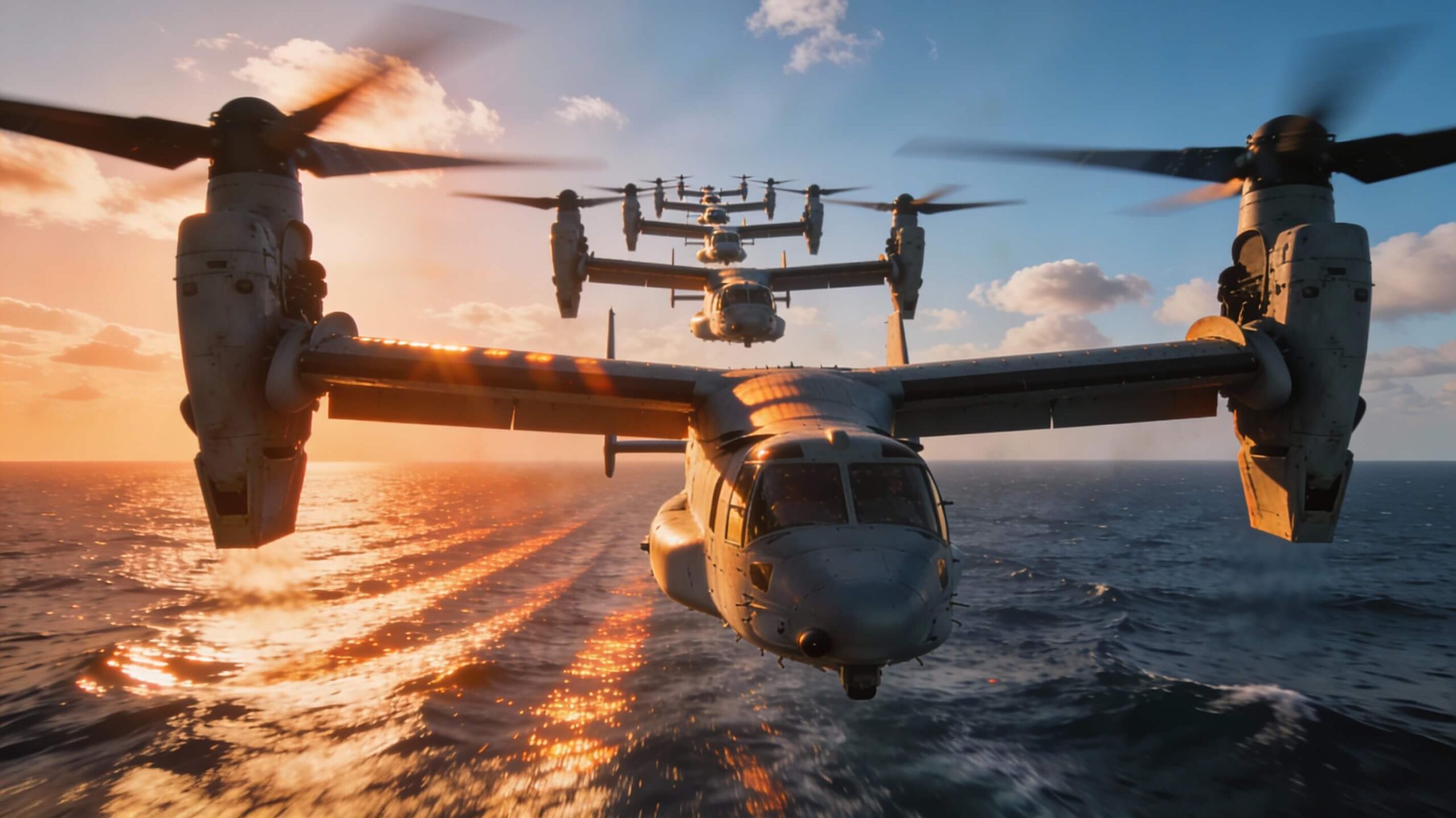
The featured photo was generated by an AI program and highlights the global fleet concept of the Osprey.
The “global Osprey enterprise” today consists of roughly 450 V‑22 tiltrotors built or on order across all variants and operators, centered on U.S. services (USMC, USAF, USN) with Japan as the sole export customer.
The V‑22 fleet of about 450 aircraft that has accumulated more than 750,000 flight hours, reflecting the total production run across all customers and variants.
The three main variants are the USMC MV‑22B (assault support), USAF CV‑22B (AFSOC long‑range special operations), and USN CMV‑22B (carrier onboard delivery), with Japan operating a configuration based on the MV‑22.
The Department of Defense has procured about 360 V‑22s for the Marine Corps, which constitute the bulk of the global Osprey fleet and underpin the assault support and expeditionary role of the aircraft.
These aircraft equip multiple active and reserve VMM squadrons and MEU/ARG deployments, forming the core of USMC medium‑lift and ship‑to‑objective maneuver capability.
The Air Force has acquired around 56 CV‑22s for Air Force Special Operations Command, focused on long‑range infiltration, exfiltration, and resupply in contested environments.
CV‑22s operate from CONUS and overseas bases (including Europe and the Pacific), giving the tiltrotor enterprise a global special operations footprint.
The Navy program of record originally envisioned 48 CMV‑22Bs, but current plans call for 44 aircraft, replacing the C‑2A Greyhound for carrier onboard delivery.
CMV‑22B squadrons (VRM‑30, VRM‑40, VRM‑50 and supporting test units) provide COD support to carrier strike groups, including long‑range logistics and F‑35C engine transport.
Japan is the only foreign customer and is procuring 17 V‑22s, which form an “Air Transport Squadron” under the JGSDF for rapid deployment and island defense missions.
As of 2025, the Japanese V‑22 unit has completed relocation from its temporary base at Kisarazu to its permanent base at Camp Saga on Kyushu, positioning the fleet closer to the Nansei/Southwest Islands and the East China Sea.
Industry and Navy sources describe a fleet that has now surpassed 600,000 flight hours and has grown to more than 400 operational aircraft, consistent with the broader “~450 aircraft” enterprise figure when including aircraft in production and on order.
The global enterprise thus spans multiple services and one key ally, with common industrial support from Bell and Boeing and shared sustainment, upgrade, and safety initiatives across this ~450‑aircraft tiltrotor community.