
IBCS at the Crossroads: From Flight Tests to the Fight That Matters
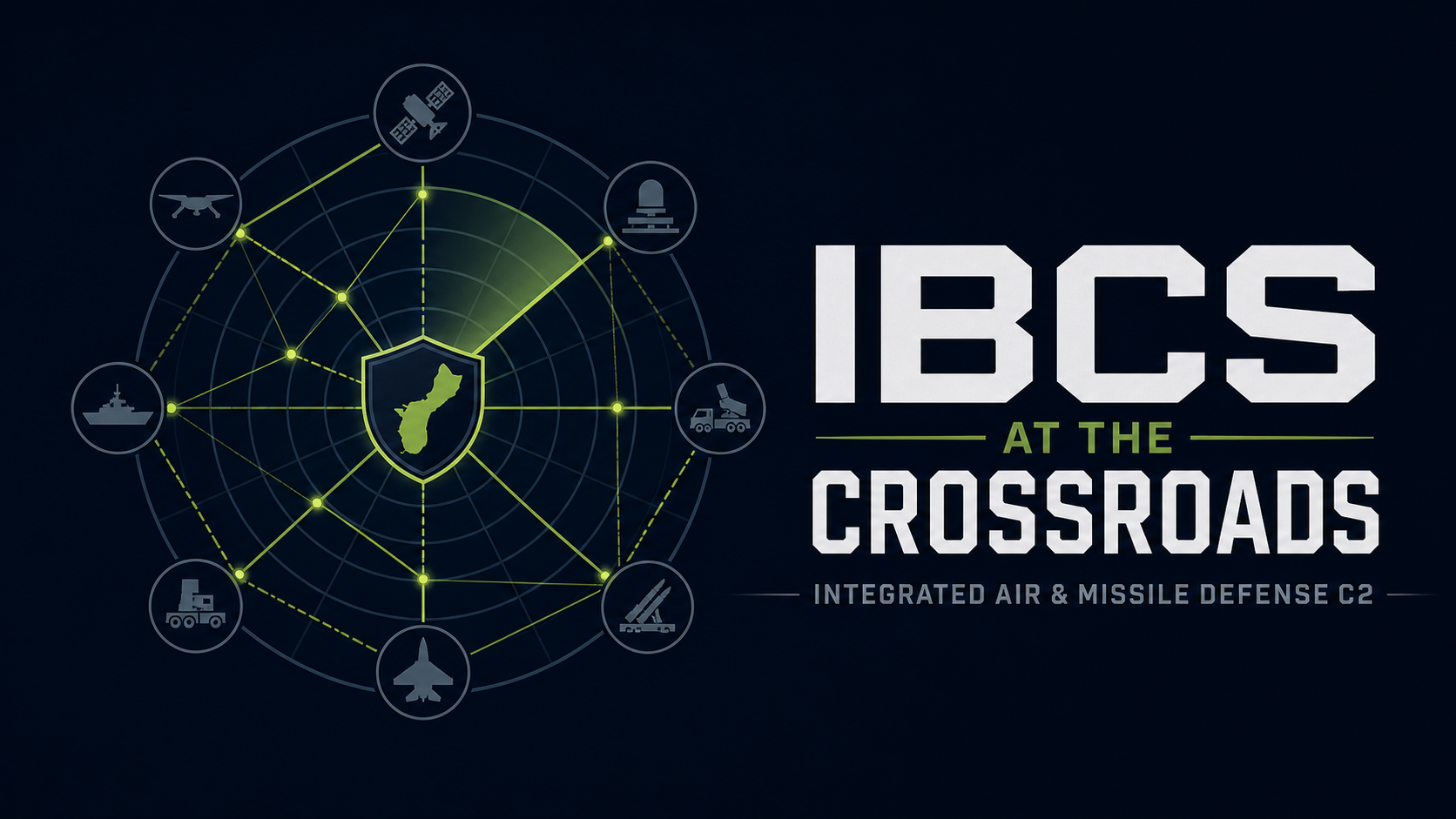
The Integrated Battle Command System did not spring from a blank sheet. It emerged from a growing recognition within the U.S. Army that the stovepiped, single-system architecture governing air and missile defense (AMD) was structurally incapable of meeting the threat environment taking shape in the 2010s. Legacy Patriot batteries, THAAD systems, and short-range air defense assets each carried their own radar picture, their own fire control logic, and their own command post. When threats arrived from multiple vectors simultaneously, the seams between these systems were not bugs. They were mortal vulnerabilities.
The concept that drove IBCS was disarmingly straightforward: build an open-architecture, software-defined command and control (C2) backbone that could ingest sensor data from any source, regardless of service, domain, or national origin, fuse it into a single integrated air picture, and distribute fire-control-quality tracks to any shooter on the network. The result would be the “any sensor, best shooter” paradigm: using the most appropriate interceptor against each threat, extending the defended area, and preserving scarce missile inventories by avoiding duplicative engagements. For an Army accustomed to platform-centric acquisition, this was genuinely transformative thinking.
Development was not painless. Early schedules slipped. Integration challenges with legacy systems proved more demanding than some anticipated. Critics questioned whether the Army could actually deliver a software-intensive program of this complexity within an acquisition culture built around hardware. Yet the program survived those early storms, and by the late 2010s the test record had begun to speak for itself.
The Vision Born at Fort Sill
In 2018, my visit with Ed Timperlake to Fort Sill, home of Army Air Defense Artillery, crystallized what IBCS was becoming. This was not a program in distress, as critics had long characterized it. It was a program maturing into strategic relevance at a moment when the threat environment was itself accelerating. The practitioners at Fort Sill understood something Washington analysts often missed: the value of IBCS was not in any single test success or contract milestone, but in the accumulation of time-on-station learning that cannot be replicated by starting over. The architecture was taking shape. The operators were learning to fight with it. The allied interest, from Warsaw to Canberra, was beginning to signal how far this system’s reach could extend.
That foundational period and the work done at Fort Sill, at Huntsville, and across allied capitals in the years before the current strategic moment is the heritage that makes IBCS irreplaceable today. The program moved into full-rate production, from domestic test ranges to operational validation in Poland, from a single-nation concept to a growing allied network. That trajectory was not accidental. It was the product of sustained investment, hard-won integration work, and a community of practitioners who understood what the program was for.
The Test Record: Proof at Range
By the early 2020s, IBCS had compiled one of the more impressive flight-test records in modern Army acquisition history. Across roughly three dozen tests, the system achieved 32 successes out of 32 in one accounting, and 41 out of 41 in another, integrating a wide range of sensors and interceptors including Patriot, Sentinel, F-35, Giraffe, LTAMDS, and PAC-3. These were not sterile single-sensor, single-shooter drills. They involved network-distributed engagements where fire control quality tracks flowed across the architecture in real time, pairing sensors and shooters that in legacy configurations would never have communicated at all.
Three things stood out from this test record. First, IBCS demonstrated that open architecture actually works at operationally relevant scale. Second, the program demonstrated genuine cross-domain integration: the ability to ingest F-35 passive sensor data and convert it into actionable fire control tracks represented a qualitative leap beyond what any single-service AMD system had achieved. Third, the test history validated the resilience of the architecture: the network continued to function when individual nodes degraded or were taken offline, exactly the property that matters most in contested environments.
These accomplishments translated into concrete operational milestones. IBCS reached full-rate production. It was fielded in Poland as the command-and-control backbone of the Wisła medium-range air defense system, Warsaw’s most significant defense investment in a generation. And it was designated as the central C2 architecture for the Guam defense system, the most demanding integrated missile defense requirement in the current U.S. force structure. For a program that critics had written off multiple times, this was a remarkable trajectory.
The Operational Proving Ground: From Ukraine to Operation Epic Fury
If the flight-test record validated IBCS’s technical claims, the wars of the 2020s validated the strategic logic that drove the program in the first place. Ukraine provided a running laboratory for air and missile defense under contested, high-intensity conditions. Patriot and other high-end systems demonstrated impressive lethality against Russian ballistic missiles, but any battery that remained in place after a series of successful engagements quickly became a magnet for precision follow-on strikes. The lesson was blunt: success buys targeting. Static systems, high-signature command posts, and large tactical footprints attracted attention, and attention ended with strike packages.
Israel’s April 2024 defense against a complex Iranian-led barrage extended that lesson to the operational level. The multi-layered defense that Israeli and U.S. forces assembled held together under a coordinated 360-degree attack involving ballistic missiles, cruise missiles, and drones launched from multiple directions simultaneously. But the engagement exposed the cost of coordinated rather than truly integrated defense: high interceptor expenditure, incomplete situational awareness at the margins of the defended area, and the strains inherent in stitching together national systems that had not been designed to share fire control data in real time.
Operation Epic Fury brought these lessons to the most demanding context yet. Iran’s ballistic missile arsenal was heavily degraded, thousands of military targets were destroyed, and key nodes of its nuclear infrastructure were left in ruins. By any conventional measure, Epic Fury was a decisive engagement. But beneath the headline results lay a set of costly vulnerabilities. The United States and its coalition partners burned through interceptors at a rate the industrial base could not easily sustain. More starkly, Kuwaiti forces misidentified U.S. F-15s as incoming Iranian missiles during a dense barrage and engaged them, a fratricide incident that traced directly to the gap between national radar pictures operating without a shared fire control picture. Epic Fury succeeded, but it demonstrated that success under today’s conditions is fragile, expensive, and dependent on C2 integration that the coalition had achieved only partially.
C2, Magazine Depth, and the Cost of Getting It Wrong
One of the clearest lessons from Epic Fury and from the sustained drawdown of interceptor stocks across Ukraine and the Middle East is that C2 quality is not a secondary consideration in AMD. It is the primary factor determining how efficiently a force uses its missiles. A well-integrated C2 system that provides a single, fused air picture to all shooters avoids the duplicative engagements, the sensor gaps at track handoff boundaries, and the fratricide risk that degraded C2 produces. The “any sensor, best shooter” logic is not only about extending kill chains. It is about approaching a one-to-one kill ratio—ensuring that each interceptor fired is the right interceptor, fired by the right platform, guided by the best available sensor track.
As U.S. and allied interceptor inventories face sustained pressure from ongoing operational commitments, the cost of poor C2 becomes measurable in real terms: additional missiles expended per raid, degraded magazine depth for follow-on engagements, and the political and industrial burden of replacing costly interceptors consumed in avoidable duplicative shots. IBCS was designed precisely to close this gap. The operational record now makes clear what the test record only suggested: that C2 integration is not a capability enhancement layered on top of AMD. It is the foundation that determines whether everything else in the AMD inventory can be used effectively.
Golden Dome and the New Strategic Context
Against this backdrop, President Trump’s executive order launching Golden Dome landed with particular resonance. The initiative’s significance was not primarily technical. It was strategic. By naming homeland defense and forward node protection as central tests of U.S. seriousness, the order explicitly acknowledged that the threat environment confronting the continental United States, Guam, and U.S. bases abroad had moved from theoretical to immediate. The growing range and variety of threats from China, Russia, Iran, and North Korea; the vulnerability of population centers, ports, and critical infrastructure; and the demonstrated willingness of adversaries to target air defense systems themselves, all of these demanded a response at a scale and speed that peacetime acquisition culture had not delivered.
What often gets lost in the Washington debate is that Golden Dome is less about inventing something wholly new and more about fielding proven capabilities in coherent, mobile, integrated architectures at scale and speed. The C2 technology exists. The test record exists. The production line exists. The question is whether the Department of War and Congress are willing to use these tools with sufficient urgency. Secretary Hegseth’s emphasis on “speed to capability” signals that the Army understands it must treat integrated AMD as a portfolio problem rather than a sequence of stovepiped programs. Golden Dome, Guam, and Epic Fury together supply the operational logic: agile, mobile, integrated C2 first, everything else follows.
Guam: The Urgent Requirement That Changes the Acquisition Calculus
No single operational context makes the urgency of IBCS more concrete than Guam. The island’s role in U.S. Pacific strategy has undergone a fundamental transformation: it is no longer conceived primarily as a base to be defended, but as a hub from which the entire Indo-Pacific operational architecture radiates. Guam as hub means that it must be able to sustain operations under attack, maintain connectivity to allied forces across the first and second island chains, and serve as the logistical and C2 backbone for a distributed, mobile force that cannot mass forces in ways that present lucrative targets. Defending Guam is not a point-defense problem. It is a network-defense problem, and IBCS with its any-sensor, best-shooter architecture and its demonstrated capacity to integrate joint and allied nodes is the only fielded system designed from the ground up to solve it.
The connection from Guam to Taiwan is direct and operationally load-bearing. Taiwan has developed its own sophisticated defensive capabilities, some of which could be integrated into a broader regional kill web if the C2 architecture exists to support that integration. IBCS provides that architecture. But Guam must exist as a functioning hub for the regional network to be real. Without a defended, capable Guam hub, the Indo-Pacific kill web that operational commanders are building toward cannot be sustained. That is why Guam is not merely an interesting use case for IBCS. It is the reason why accelerating IBCS, not experimenting with alternatives, is the correct operational decision.
Indo-Pacific Command has made clear that Guam is a high and pressing priority. F-35 networks operating across the region depend on the kind of sensor fusion and fire control integration that IBCS provides at the air defense layer. The Guam defense architecture, the Marine Corps’ distributed maritime operations concept, and the ADF’s evolving integrated air and missile defense posture are all converging on the same requirement: a C2 backbone that can fuse joint and allied sensor data, distribute fire control quality tracks, and survive in a contested environment by moving rather than by hardening. IBCS is that backbone. It is fielded, tested, and in production.
The Survivability Gap: Big Tents in a Small-Signature Age
For all its technical achievements, IBCS carries into the Golden Dome era a paradox that must be resolved. The system was designed to enable dispersed, resilient, mobile air and missile defense. Its open architecture, distributed network design, and software-defined fire control are precisely suited to the moving, disaggregated concept of operations that Ukraine, Israel, and Epic Fury have demonstrated is now essential for survival. Yet the way IBCS is currently packaged and employed at the tactical level remains rooted in an earlier era: large tents, fixed towers, heavy vehicles parked in recognizable clusters, and sprawling tactical operations centers that are legible from space, from high-altitude ISR platforms, and from cheap commercial small satellites.
The Army’s own modernization efforts have explicitly identified this gap. The solicitation to make IBCS more adaptive, able to operate from smaller footprints, from office buildings, from distributed nodes rather than massed command posts, reflects an operational judgment that the current physical packaging undermines the survivability that the architecture was designed to provide. A single large tactical operations center remains a single point of failure. Disrupt it, and local AMD is blinded. In a world where adversaries deliberately target air defense systems, not just what they protect, that is an unacceptable vulnerability that must be corrected through sustained investment in the existing program, not abandoned through acquisition experimentation.
The path forward has been defined clearly by practitioners who have worked the problem from both the acquisition and operational sides. It involves size and signature reduction, software containerization and automation, and the development of configurable mission packages, expeditionary sets for forward operations, urban plug-in sets that leverage existing infrastructure, and heavier robust sets for fixed strategic sites. Investments channeled through existing contracts to contractors who already understand the system in depth could prototype and begin fielding these variants on timelines that match the operational requirement.
From Static Shield to Moving Net: The Operational Concept
The conceptual shift required is as important as the hardware investment. The Army must move from thinking about IBCS as a command post, a place where the C2 function lives, to thinking about IBCS as a moving net: a network of small, mobile, resilient nodes that collectively perform the integrated air picture and fire control function while constantly displacing to deny the adversary a stable targeting solution.
In practical terms, this means replacing the single sprawling command tent with multiple smaller IBCS nodes mounted on vehicles, in hardened shelters, or embedded in urban and fixed infrastructure, each capable of operating as a full participant in the distributed network. At any given moment, some nodes would be hot, executing the fight. Others would be displacing to new positions after firing sequences. Still others would be in reserve or undergoing maintenance. The network persists even as individual nodes constantly shift, making it vastly harder for an adversary to blind the system with a handful of well-placed strikes.
This logic is not novel in other domains. Maneuver brigades routinely fight dispersed and reconnect periodically to share data and resupply. Space and cyber forces assume constant attack and build redundancy and reconstitution into their architectures from the outset. Air and missile defense C2 must adopt the same logic. The task force organizational model, multi-layered AMD formations under an IBCS-centric headquarters, with diverse sensors feeding into the same picture and multiple effectors orchestrated as a single scheme of fires, is the right vehicle for this concept.
Allies as Network Partners: Poland, the Gulf, and the Indo-Pacific
The strategic logic of IBCS reaches beyond U.S. formations. Poland’s Wisła program has demonstrated what an ally-integrated IBCS architecture looks like in practice: Patriot radars and launchers tied into IBCS C2, providing Warsaw with 360-degree medium-range defense that can operate as part of a broader allied network. As Poland now pursues the complementary NAREW short-range program, the architecture is scaling into a genuine layered national defense that can plug into U.S. and NATO architectures rather than operating as an isolated national system.
Germany’s defense awakening under Chancellor Merz, the Nordic and Baltic states’ accelerating investment in integrated air defense, and the emerging requirements across the Gulf states all point toward the same conclusion: the nations that will anchor the next generation of integrated AMD are those whose systems can plug into the IBCS network rather than operating alongside it. Qatar, Kuwait, and the UAE operate a patchwork of national radar networks and legacy C2 systems that do not integrate cleanly with U.S. architectures. An IBCS-compatible approach across these states would substantially enhance their defensive depth and allow U.S. forces operating from those bases to fight from a shared picture.
The force multiplier effect of a common C2 system across multiple purchasing nations is not primarily a commercial argument. It is a military argument. When an Army ADA task force, a Navy Aegis destroyer, an F-35 network, and allied Patriot batteries all see and fight from the same IBCS-enabled picture, the risks of duplication, gaps, and fratricide fall sharply. That is the argument the operational record now makes available to policymakers, if they choose to use it.
Operational Logic vs. Acquisition Experimentation: Getting the Priorities Right
The technology is ready. The test record is established. The operational requirements have been written in blood across Ukraine, Israel, and the Gulf. The remaining constraint is political will and acquisition velocity.
The argument for continuity is not a defense of the status quo. It is an operational argument. Integrating new software architectures and new vendors into a system that is already in production, already fielded with allies, and already designated as the C2 backbone for the most demanding AMD requirement in the force, Guam, introduces technical risk, schedule delay, and interoperability uncertainty at exactly the moment when operational commanders are asking for capability now.
The Army’s mandate should be clear: empower the existing industrial ecosystem to deliver the spiral upgrades, the configurable mission packages, and the signature-reduction investments that convert IBCS from a system with excellent architecture into a system that can fight, move, and reconstitute in the threat environment it was designed to master. Scale production to meet the Golden Dome requirement. Accelerate integration of new sensors and AI-enabled decision aids through the architecture’s existing upgrade pathways. Treat C2 as the primary weapon system in the AMD inventory because the operational record now confirms that it is.
Under current plans, IBCS production is sized to deliver just under two battalion sets per year. The same full-rate production contract could support a fourfold increase for approximately $720 million annually, with additional engineering funds to develop a Golden Dome configuration and accelerate integration with joint and multi-domain C2 systems. In budget terms, these are not staggering figures measured against the requirement to defend the American homeland and sustain U.S. forces in forward theaters already under missile threat.
Conclusion
IBCS was built to solve a specific problem: the inability of stovepiped, single-system air defense architectures to fight coherently in complex, multi-axis threat environments. It has solved that problem with a test record and operational deployments that validate its core technical claims. The question before policymakers and acquisition executives now is not whether IBCS works. The question is whether they will give it the physical form, the production scale, and the organizational protection it needs to do what the operational moment demands.
This article has laid the foundation: the heritage, the test record, the operational validation, and the C2-first logic that links Epic Fury to Golden Dome to Guam. The shift from Guam-as-base to Guam-as-hub is the most urgent AMD requirement in the current force structure, and it cannot be addressed by fragmented acquisition approaches, and why the entire Indo-Pacific kill web that operational commanders are building toward depends on getting Guam right, now.
The adversaries that confronted U.S. and coalition forces in Operation Epic Fury understood something that American acquisition culture is still absorbing: the fastest path to defeating a technologically superior air defense is not to build a better missile. It is to find the C2 node and destroy it. The answer to that logic is not a better tent, and it is not a new vendor. It is a network that cannot be found because it never stops moving, built on an architecture that a decade of testing, fielding, and allied integration has already validated. IBCS has that architecture. The task now is to build the body it deserves and to do it at the speed the operational moment demands.