
Marine Raiders, MARTAC Boats, and the Making of a Philippine Porcupine Defense
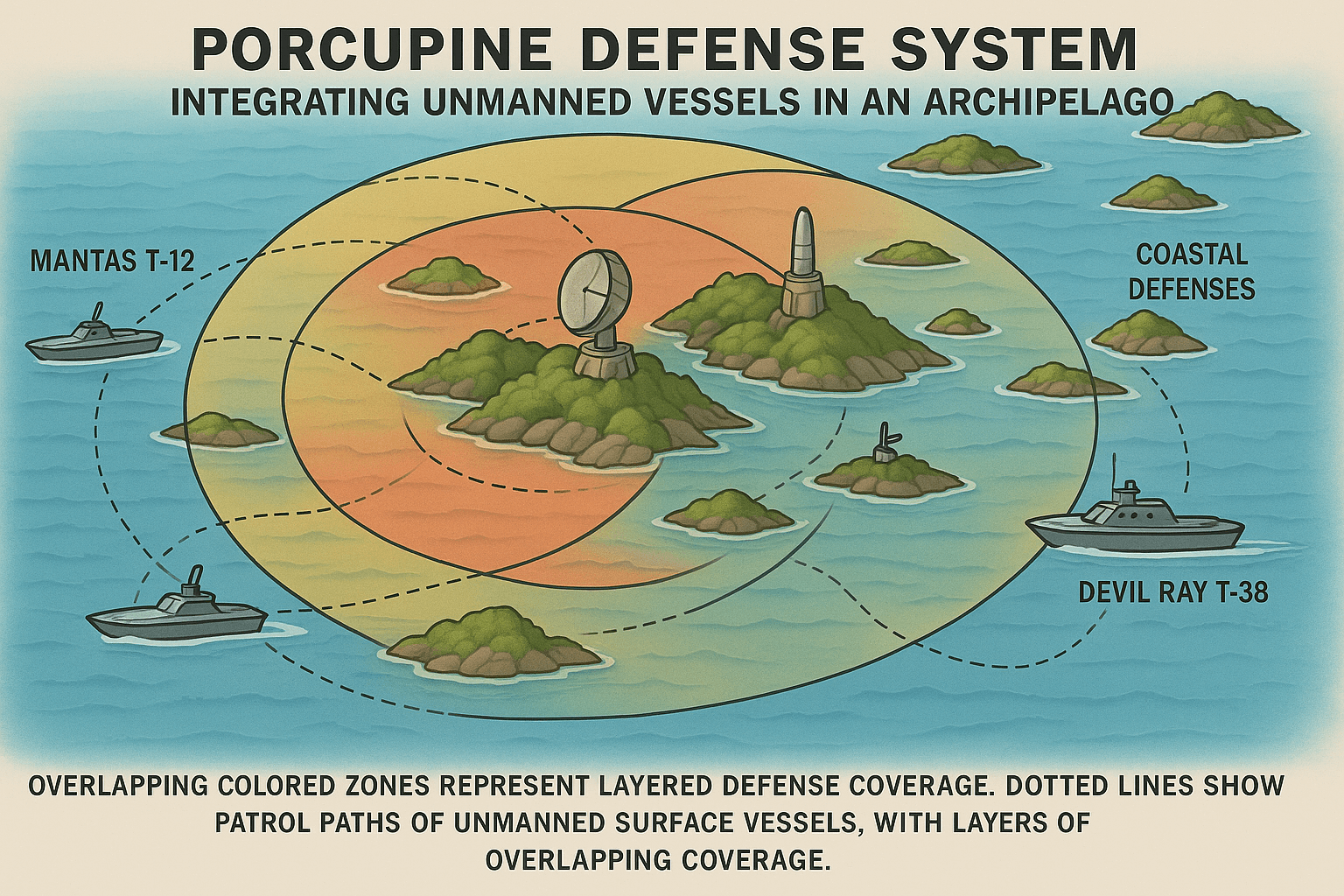
The intersection of Marine special operations expertise, maritime autonomous systems, and Philippine archipelagic geography is generating a new model of deterrence in the West Philippine Sea. What is emerging is not simply a new platform acquisition story. It is a story about how the United States and the Philippines are co-developing a maritime kill web, one built for the specific geography and strategic circumstances of the first island chain.
Official communications rarely invoke MARSOC by name when describing current activities in the Philippines. But the pattern is clear enough: U.S. Marine and special operations forces are working alongside the Armed Forces of the Philippines (AFP) to operationalize MARTAC unmanned surface vessels (USVs), embedding them into an emerging SOF-enabled porcupine defense construct at sea. The platforms are new: the logic is not. What is different is the sophistication of the integration and the urgency that the Chinese challenge in the South China Sea has injected into the effort.
From COIN Partnering to Archipelagic Denial
Marine Forces Special Operations Command was shaped in the era of counterinsurgency and counterterrorism, including the long-running Operation Enduring Freedom–Philippines. In that earlier period, Marine Raiders and other U.S. SOF were focused on building Philippine unit capacity for jungle operations, maritime interdiction, and intelligence fusion against non-state actors. The geography was essentially the same, southern Luzon, the Visayas, Mindanao, the Sulu archipelago, but the problem set was predominantly land-centric and insurgent-driven.
The strategic pivot is now well underway. The threat is no longer primarily Abu Sayyaf and allied groups. It is the People’s Republic of China and its systematic coercive behavior in the South China Sea. The Philippine Navy and Philippine Marine Corps are at the forefront of high-profile confrontations with Chinese Coast Guard and maritime militia vessels around Second Thomas Shoal and other contested features. Washington has responded with expanded security assistance, more frequent exercises, and new Enhanced Defense Cooperation Agreement (EDCA) sites oriented toward northern Luzon and Palawan.
Within this context, the United States is now equipping Manila with the tools of a maritime denial strategy rather than simply instruments of internal security. The MARTAC MANTAS T-12 and Devil Ray T-38 USVs are emblematic of that shift. They represent the leading edge of what I have described as intelligent mass, proliferated, affordable, attritable systems that extend awareness and contested presence across a geography that no traditional fleet could adequately cover.
MARTAC USVs in Philippine Service
The first tranche of MARTAC systems for Manila included four MANTAS T-12 USVs and one Devil Ray T-38, transferred under U.S. security assistance to bolster maritime domain awareness and coastal defense. These platforms are now operational with the Philippine Navy, deployed for frontline use in Palawan and other locations facing the South China Sea. Two additional T-38s are being delivered in 2026, with continued discussions about expanded roles and further systems.
The T-12 is a compact unmanned craft, roughly 3.6 meters, capable of carrying payloads for surveillance, electronic warfare, and swarming operations. It can operate in a semi-submersible “gator mode,” with the hull awash to reduce visual and radar signatures for stealthier missions close to an adversary’s presence. It is being used as well with a sonar package for seabed mapping, monitoring underwater pipes and cables and many other underwater tasks.
The Devil Ray T-38 is a substantially larger, dual-sponson high-speed platform of approximately 38 feet, capable of carrying up to roughly 4,000 pounds of payload at speeds exceeding 70 knots. In Philippine Navy service, these craft are configured primarily for ISR and maritime domain awareness but they are inherently multi-mission, readily reconfigured for anti-mining, anti-surface warfare, or logistics support depending on the payload package.
The Philippine Navy has stood up a specialized unmanned surface vessel unit as part of its Horizon 3 modernization effort to operate these systems and integrate them with manned ships in a manned-unmanned teaming concept. MARTAC USVs have been deployed in Subic Bay and with Western Command (WESCOM) in Palawan, and they have been showcased during visits by Philippine Coast Guard Auxiliary leadership and other senior officials.
U.S. Special Operations and Marine Roles
What connects these platforms to Marine special operations is less the hardware itself than the pattern of employment, training, and concept development visible in open sources. U.S. special forces have been reported training with USVs in the Philippines, explicitly using MARTAC T-12 and T-38 systems during bilateral exercises oriented on improving Philippine maritime domain awareness. Philippine defense reporting similarly highlights U.S. special forces working with Philippine Navy USV operators during demonstrations and asymmetric warfare events.
Parallel reporting on U.S. Marines assisting with coastal and archipelagic defense concepts emphasizes the by-with-and-through approach that is the hallmark of SOF practice: American personnel are not simply operating these systems themselves, but are co-developing tactics, techniques, and procedures, conducting after-action reviews, and embedding the unmanned capability into Philippine operational patterns. This is the MARSOC model at its core, enabling partner forces, joint experimentation, and rapid field iteration rather than waiting for doctrine to arrive fully formed from a distant headquarters.
Available public documents describe “U.S. Marines” or “U.S. special forces” generically rather than naming Marine Raiders explicitly, but the doctrinal and organizational fit is clear. Marine Raiders are configured as small, highly deployable teams trained in maritime and littoral operations, foreign internal defense, and special reconnaissance—precisely the combination required to establish a network of fast-boat and unmanned nodes across a sprawling archipelago. As concepts such as Expeditionary Advanced Base Operations (EABO) and stand-in forces have matured, MARSOC has been exploring complementary roles in sensing, targeting, and enabling partner capabilities across contested maritime spaces.
The Philippine MARTAC effort provides an ideal laboratory for this convergence. U.S. Indo-Pacific Command’s Maritime Security Initiative and related funding lines provide a steady flow of relatively low-cost unmanned systems. Philippine forces contribute geography, access, and operational urgency. Marine SOF provide the connective tissue of concept development, training, and integration with broader joint and allied plans.
Building a Maritime Porcupine
In my work on porcupine defense strategy for the Philippines, the core logic is to harden the archipelago through distributed offensive and defensive capabilities that make coercion or invasion prohibitively costly for a larger power. The concept extends naturally into the maritime domain through what I have described as mesh fleets of autonomous vessels, distributed awareness and dispersed striking power woven across the archipelago.
In that construct, MARTAC USVs are not simply new platforms for the Philippine Navy. They are key nodes in a layered denial grid. At the lowest level, T-12s operating singly or in swarms, patrol reef complexes, straits, and approaches to key bases, using electro-optical, infrared, radar, and electronic support measures to detect and track foreign vessels. Their data feeds into a fused maritime domain awareness picture shared among Philippine Navy, Coast Guard, and Marine units and, where politically acceptable, with U.S. and allied forces.
The larger Devil Ray T-38 extends this screen further outward and operates as a fast, reconfigurable truck for payloads: persistent ISR in one mission, non-lethal effects in another, and more kinetic options in a crisis. High speed allows rapid massing at a focal point, complicating adversary planning because a seemingly empty stretch of sea can be populated with unmanned craft on short notice.
Marine and SOF advisors help Philippine counterparts knit this unmanned layer into land-based coastal defense missiles, manned surface combatants, rotary-wing and fixed-wing surveillance assets, and law enforcement elements, turning disaggregated platforms into a coherent denial system. The resulting posture is not about matching Chinese hull numbers. It is about making every kilometer of sea and coastline contested space, covered by a mix of human and machine sensors and shooters that are inexpensive, proliferated, and difficult to neutralize in a single blow. This is the kill web logic applied to the Philippine archipelago.
Implications for MARSOC and the Region
For MARSOC and Marine special operations more broadly, the Philippine experience with MARTAC boats and maritime autonomous systems is shaping a genuinely new repertoire of missions. The trajectory is moving well beyond advising partner counterterrorism units or conducting direct action raids. What is emerging instead is a Marine SOF role centered on:
- Designing and rehearsing distributed maritime kill-and-sense webs that can be handed off to allied and partner navies and marine forces.
- Conducting special reconnaissance and operational preparation of the environment to identify locations for forward MAS launch and recovery sites, fast-boat bases, and sensor nodes across the first island chain.
- Supporting experimentation with mesh fleets, swarming tactics, and manned-unmanned teaming in complex coastal and archipelagic waters, and capturing those lessons for wider application across the Indo-Pacific.
For the Philippines, this cooperation accelerates a qualitative leap in maritime defenses at a moment when quantity will always favor China. The combination of U.S.-funded unmanned systems, joint training, and evolving doctrine gives Manila a more credible ability to monitor and contest activity in its exclusive economic zone. It also creates a prototype that other frontline states from Taiwan to Vietnam can adapt as they seek to complicate Chinese military planning without relying exclusively on large platforms and expensive acquisitions.
More broadly, the Philippines is becoming a test case for a new alliance approach to defense transformation: one in which U.S. SOF and Marines help partners leap directly into the era of distributed, autonomous, and attritable systems. If the model holds, Marine Raiders quietly standing behind a Philippine mesh fleet of MARTAC boats may prove as consequential for twenty-first century deterrence as earlier generations of SOF partnerships were for counterinsurgency and counterterrorism. The age of exquisite scarcity is giving way to intelligent mass and the first island chain is where that transition is being written.
The Philippine MARTAC story you have just read is one concrete instance of a much larger shift underway in the Pacific, the move from platform‑centric naval power to mesh fleets, porcupine defense, and distributed kill webs. In Part Five of my book, Lessons from the Drone Wars, I follow this shift from Guam and the wider Marianas, to Vietnam and ASEAN, to the Philippines’ Comprehensive Archipelagic Defense Concept, showing how autonomous systems and allied cooperation are rewiring Pacific defense from Hawaii to the South China Sea.
Note: If you want to explore how security webs, deterrence webs, and kill webs are being built out across the First and Second Island Chains and how mesh fleets of autonomous maritime systems give smaller states real leverage against Chinese naval mass, I invite you to read the Pacific defense section of Lessons from the Drone Wars. It provides the strategic backdrop for the operational vignettes highlighted in this article and offers a roadmap for how the United States and its allies can turn intelligent mass into credible twenty‑first‑century deterrence at sea.
Bibliography
“ACDC: A Milestone in Philippine Coastal Defense.” U.S. Marine Corps Forces, Pacific, June 5, 2024. https://www.marforpac.marines.mil/Media-Room/Pacific-Marines-Stories/Article/Article/3798430/acdc-a-milestone-in-philippine-coastal-defense/
BlueZone Group. “MARTAC T12 & T38 USVs Enhance Philippine Sovereignty in the South China Sea.” November 24, 2024. https://bluezonegroup.com.au/announcements/martac-t-12-and-t-38-usvs-enhance-philippine-sovereignty-in-the-south-china-sea/
“Philippine Navy Eyes USV Unit to Monitor Waters, Aid Warships.” Naval News, October 6, 2024. https://www.navalnews.com/naval-news/2024/10/philippines-navy-eyes-usv-unit-to-monitor-waters-aid-warships/
“Philippine Navy Receives U.S. Funded USVs for SCS Operations.” Naval News, November 18, 2024. https://www.navalnews.com/naval-news/2024/11/philippine-navy-receives-u-s-funded-usvs-for-scs-operations/
Sanchez, Wilder Alejandro. “SAS 2026: MARTAC Announces Upcoming USV Delivery to the Philippines, New Projects.” Future Warfare (FW Mag), April 23, 2026. https://www.fw-mag.com/shownews/1032/sas-2026-martac-announces-upcoming-usv-delivery-to-the-philippines-new-projects
“Shaping a Porcupine Defense Strategy for the Philippines: The Role of Maritime Autonomous Systems.” Defense.info, August 3, 2025. https://defense.info/special-reports/2025/08/shaping-a-porcupine-defense-strategy-for-the-philippines-the-role-of-maritime-autonomous-systems/
“U.S. Special Forces Train with USVs in the Philippines.” Naval News, May 30, 2025. https://www.navalnews.com/naval-news/2025/05/u-s-special-forces-train-with-usvs-in-the-philippines/
United States Marine Forces Special Operations Command (MARSOC). “About MARSOC.” https://www.marsoc.marines.mil/About/
“US Strengthens Philippine Maritime Defense Against China With Mantas T12 Drones.” Army Recognition, November–December 2024. https://armyrecognition.com/news/navy-news/2024/us-strengthens-philippine-maritime-defense-against-china-with-mantas-t-12-drones
“The T12 USV and Filipino Security and Defense.” Defense.info, November 19, 2024. https://defense.info/defense-systems/the-t-12-usv-and-filipino-security-and-defense/
“Philippine Navy Operates the MARTAC T38 Devil Ray.” Philippine Military & Defense Update (Facebook), January 30, 2026. (Facebook post; direct URL dependent on account access.)
“Philippine Fleet Showcases MARTAC Devil Ray USV During PCGA Visit.” Philippine Fleet (Facebook), April 21, 2026. (Facebook post; direct URL dependent on account access.)
“Philippine Navy Modernization Accelerated by US Deployment of Unmanned Systems.” Army Recognition, November 24, 2024. https://www.armyrecognition.com/news/navy-news/2024/philippine-navy-modernization-accelerated-by-us-deployment-of-advanced-unmanned-technologies