
Maximizing Flexibility: MAG-11’s Approach to Multi-Domain Aviation Operations
In a conversation conducted during Steel Knight 2025 at a simulated forward-deployed location, Colonel Jarrod DeVore, Commanding Officer of Marine Aircraft Group 11 (MAG-11) within 3rd Marine Aircraft Wing, provided an overview of how the Marine Corps is evolving its aviation capabilities to meet the challenges of distributed operations in contested environments.
MAG-11 is 3rd Marine Aircraft Wing’s primary fixed-wing combat aircraft group, centered at MCAS Miramar. MAG-11’s primary mission is to provide air support to Marine Air-Ground Task Force (MAGTF) commanders, including offensive air support, anti-air warfare, assault support, aerial reconnaissance, and terminal area control of aircraft. It also generates critical aviation logistics and significant aviation ground support functions to keep those fixed-wing forces sustained in combat.
Within 3rd MAW, MAG-11 is the main fixed-wing group responsible for training, deploying, and integrating F/A-18, F-35C, and KC-130 units, and for providing squadrons to Navy carrier air wings when required. The group can deploy its headquarters as a site command to run high-tempo sortie generation for the Marine Tactical Air Commander in support of I MEF and other combatant commanders.
MAG-11 currently includes F/A-18C squadrons, two F-35C squadrons, a fleet replacement squadron, a KC-130J tactical aerial refueling/transport squadron, and a Marine Aviation Logistics Squadron. Collectively, these units fly over 40,000 hours annually in training and operations, maintaining readiness for rapid deployment and sustained combat air operations.
The discussion ranged from the tactical versatility of the KC-130J to the strategic implications of the F-35C, revealing an organization deeply committed to realistic experimentation and learning from operational experience rather than PowerPoint presentations.
The KC-130J: More Than Just a Tanker
Colonel DeVore’s characterization of the KC-130J as the aircraft that “makes the MEF move” captures an essential truth about modern Marine aviation: flexibility is survival. During the exercise, MAG-11 was maximizing the full capability suite of the KC-130J across multiple mission sets, aerial delivered ground refueling, traditional drop zone resupply, equipment and logistics movement, personnel transport, close air support, and aerial refueling. This comprehensive employment strategy reflects a fundamental shift from platform-centric thinking to capability-based operations.
The beauty of the KC-130J platform, according to DeVore, lies not just in its multifaceted capabilities but in the adaptability of its crews. “It’s not really a hard transition to say, tomorrow I need you to take this many gallons of fuel to this node, and then tomorrow I need you to go drop off folks at a DZ. And then the next day, hey, I need you to haul these certain things into a node,” he explained. This operational flexibility becomes crucial in distributed operations where forces must rapidly shift mission profiles based on evolving tactical requirements.
The discussion also highlighted an often-overlooked complementarity issue within Marine aviation. With the MV-22 Osprey fleet consistently overtaxed, the potential for the KC-130J to offload some lift missions, particularly for specialized equipment like ground-based radars, represents an important force-multiplier consideration. The Osprey’s unique capabilities make it a high-demand asset, and thoughtful mission allocation between platforms becomes essential for maintaining operational tempo without burning out critical assets. This raises broader questions about fleet management and the need for either additional airframes or smarter utilization of existing platforms.
I suggested that the coming of the CH-53K will help the configuration of the force and reduce some of the demands that are placed on the KC-130J and free up the Osprey for other tasks than moving supplies.
The F-35C: Beyond Carrier Operations
One of the most significant aspects of the conversation centered on the Marine Corps’ use of the F-35C, the carrier variant that emerged from the service’s commitment to support naval aviation but has proven to be far more valuable to the Marine Corps than many initially anticipated. Colonel DeVore emphasized that beyond the obvious benefit of greater fuel capacity translating to extended time on station and increased range, the F-35C brings the same digital interoperability that makes the entire F-35 family transformative.
“One of the biggest capabilities that you’re going to get with the F-35C is just going to be more fuel, which translates for more time to sense and make sense of the battle space,” DeVore explained. This extended sensing capability becomes particularly significant in the distributed operations concept that the Marine Corps is developing. The longer wing of the F-35C generates more lift, enabling operations from shorter runways, a critical capability for expeditionary operations where pristine airfields may be unavailable or undesirable from a signature management perspective.
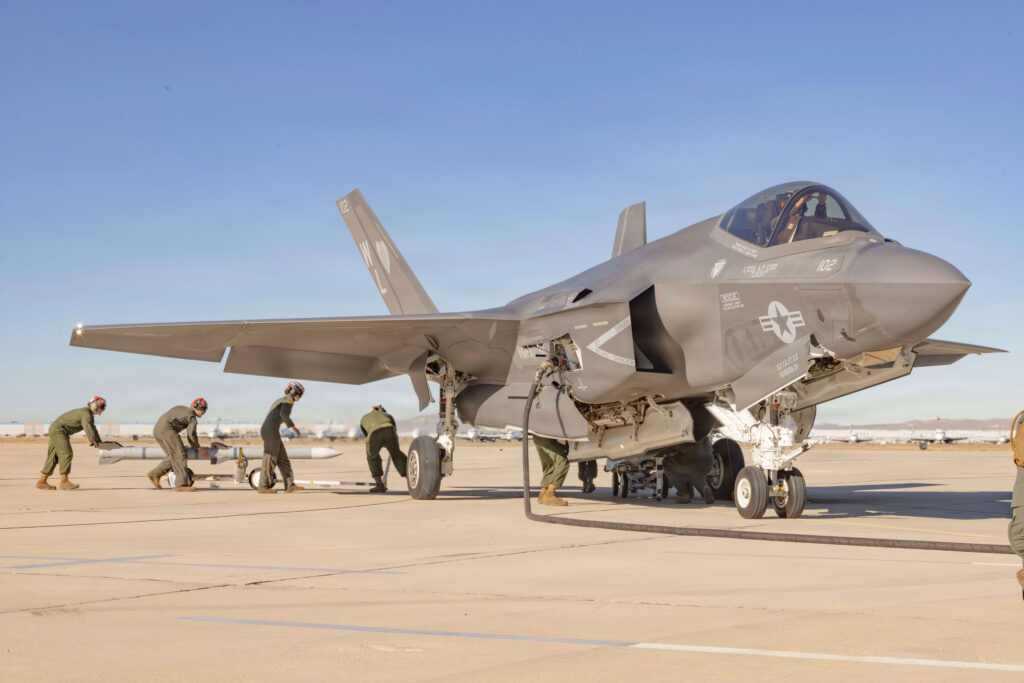
The tactical flexibility extends further. With the Marine Corps’ mobile arresting gear systems, the F-35C can be stopped on runways of reduced length, and its ability to take off with less than a full fuel load and be refueled airborne creates multiple operational pathways. As DeVore noted, these characteristics allow commanders to be “smart about how you configure the aircraft” based on mission requirements and available infrastructure. This flexibility mirrors the carrier-variant’s design heritage but applies it to expeditionary contexts that would have seemed improbable during the aircraft’s development.
Perhaps most importantly, the F-35C serves as a critical node in the distributed kill web that the Marine Corps is building. While it lacks a dedicated Electronic Warfare (EW) suite like the EA-18G Growler, it can perform elements of the airborne surveillance and battle management functions through its sensor suite and extended time on station. The ability to see, sense, and share information across greater distances and for longer periods makes the F-35C an integral component of reach versus range. he idea that an aircraft’s true operational footprint extends far beyond its physical location through networked sensors and communications.
Digital Interoperability and the Kill Web
Throughout the conversation, Colonel DeVore returned repeatedly to the theme of digital interoperability or the ability of platforms to share data seamlessly across the force. This capability represents perhaps the most significant revolution in military aviation since the jet engine, yet it remains poorly understood outside specialized communities. The F-35’s ability to serve as a sensor and data node, not merely as a strike platform, fundamentally changes how commanders can employ airpower.
The integration challenge goes beyond simply connecting platforms. As the Marine Corps fields different block upgrades of aircraft, whether F-35s, F/A-18s, or MV-22s with roll-on/roll-off mission systems, maintaining awareness of what capabilities each configuration brings becomes essential. DeVore expressed confidence that the Marine Corps has solved this problem through active involvement with the Joint Program Office and rigorous configuration management. “I’m 100% confident right now that we’re flying aircraft that are same page, safe, relevant and there’s no confusion about what aircraft has at any given time, and then what capability set that brings,” he stated.
This stands in contrast to challenges observed in other services, where aircraft in different software configurations have created confusion about capabilities at the tactical edge. The Marine Corps’ approach of normalizing and demystifying new capabilities through exercises like the one at Miramar helps ensure that ground combat elements understand what the F-35 can provide, while aviation elements understand what support the ground forces require.
Normalizing Innovation with Ground Forces
A critical observation from the discussion involved the evolution of ground combat element understanding of F-35 capabilities. Colonel DeVore acknowledged that ground forces initially showed limited enthusiasm for the platform, partly because its unique attributes weren’t immediately apparent in the confined battlespaces of Afghanistan and Iraq. However, as the Marine Corps shifts focus to distributed operations across maritime domains where range, persistence, and networked sensing become paramount, ground commanders increasingly recognize the F-35’s value proposition.
“This exercise is doing a great job of normalizing and demystifying these new kind of capabilities,” DeVore explained. The presence of liaison officers between aviation and ground elements facilitates this mutual understanding, ensuring that both communities learn to optimize the allocation of high-end assets like the F-35 versus other available platforms. The process involves determining whether a given mission requires F-35 capabilities or whether other assets might be more appropriate, a crucial decision matrix for commanders managing limited high-demand resources.
The discussion highlighted how the F-35’s reach extends far beyond its physical range through data sharing across the fleet. This networked capability means that F-35s supporting distributed operations can simultaneously monitor multiple ground elements, assess their operational status, and provide information back to command elements about force dispositions and mission progress.
The Weapons Challenge: Magazine Depth and Innovation
When discussion turned to weapons systems, Colonel DeVore’s concerns as a Marine aircraft group commander became apparent. “Magazine depth is something that always concerns me,” he stated plainly. The challenge extends beyond simply having sufficient munitions for it encompasses having the right weapons arriving on time, weapons that remain relevant to evolving combat environments, and weapons flexible enough to be upgraded relatively quickly as threats change.
DeVore’s observation about balancing hardware versus software development represents a crucial strategic question: “Should you prioritize software development that’s modular, agile, that you can put on maybe something that’s not a really expensive [platform]?” This question cuts to the heart of debates about weapons acquisition and employment. The lesson from ongoing conflicts, particularly the global war in Ukraine, demonstrates that sustaining forces with weapons and ammunition exceeds what democracies have proven willing to resource adequately.
The conversation explored the concept of diversifying weapons portfolios or moving beyond the assumption that every engagement requires million-dollar precision munitions. The discussion touched on potential pathways including loitering munitions, weapons from maritime autonomous systems, and more economical solutions that still achieve tactical effects. This represents a fundamental shift from platform-centric thinking to payload-centric thinking, where commanders consider what weapons are available across the battlespace rather than simply what ordnance is physically loaded on their aircraft or ships.
Learning Through Realistic Experimentation
Perhaps the most striking element of Colonel DeVore’s approach involves his commitment to learning through realistic, challenging exercises rather than scripted demonstrations. The exercise at Miramar and Camp Pendleton deliberately created the hardest problem set, taking MAG headquarters Marines and requiring them to build command and control for aviation operations from the ground up in an austere location. This approach consciously avoids highly scripted, predictable exercises that validate existing procedures rather than discovering limitations and innovations.
“We want young lieutenants and sergeants and captains out here just trying things,” DeVore explained, comparing the approach to interwar military experimentation. This creates a productive learning environment where some initiatives will be discarded as unworkable while others prove their value and get incorporated into training and doctrine. The iterative process identifies capability gaps and shortfalls, but more importantly, it reveals what the force can actually accomplish with organic assets and where higher echelon support becomes necessary.
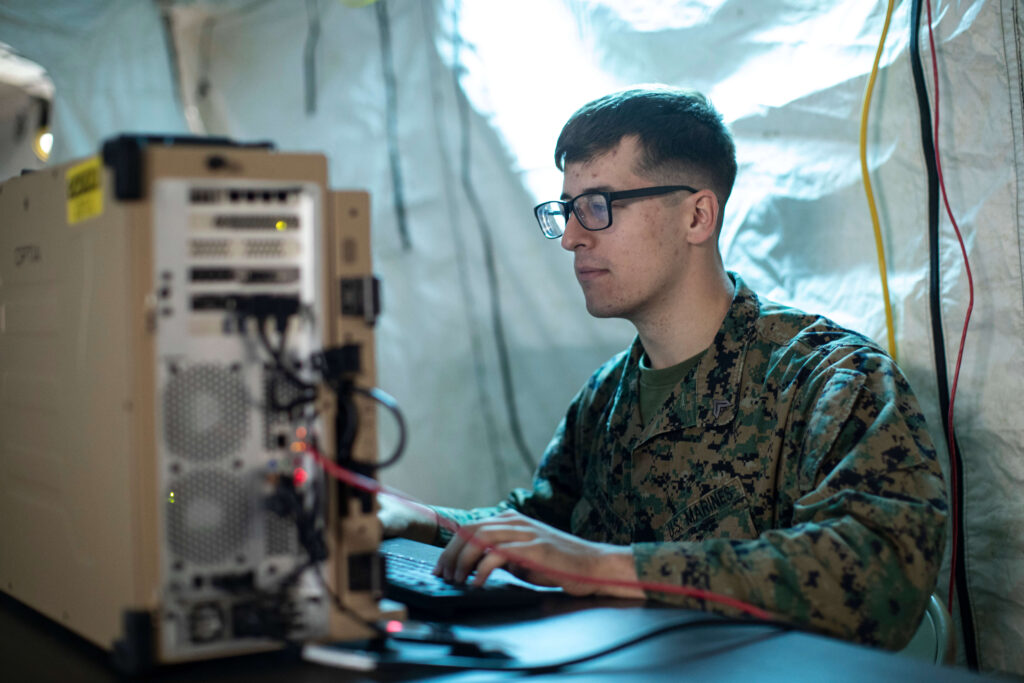
This experiential approach also provides valuable feedback about when tactical commanders at the forward edge might have better situational awareness than higher headquarters, a crucial insight for distributing decision authority in contested environments where communications may be degraded. The exercise structure allows DeVore to determine both where his command needs support from higher headquarters and where his position at the tactical edge provides advantages in understanding and responding to the operational environment.
Conclusion: Innovation as Organizational Culture
When asked about the Marine Corps’ capacity for innovation, Colonel DeVore responded with conviction: “If anybody’s going to innovate, it’s going to be the Marines. I think we kind of dominate that trade space right now.” This confidence stems not from technological superiority but from cultural attributes, a willingness to try new approaches, accept failure as part of learning, and rapidly integrate lessons into operational practice.
The conversation with DeVore revealed an organization grappling seriously with the most difficult questions facing modern militaries: How do you sustain distributed forces in contested environments? How do you balance high-end capabilities with economic realities? How do you ensure different communities within the force understand each other’s capabilities and limitations? How do you create decision frameworks that work when communications are degraded and situations are chaotic rather than controlled?
These questions don’t have easy answers, and DeVore doesn’t pretend otherwise. Instead, he and his Marines are working through them methodically, trying different approaches, measuring results, and building institutional knowledge about what works. This represents a fundamentally different mindset from assuming problems can be solved through better PowerPoint presentations or acquiring the next generation of technology. It acknowledges that military transformation happens through the hard work of experimentation, the honesty to recognize what doesn’t work, and the discipline to incorporate lessons learned into operational practice.
As the Marine Corps continues developing its concepts for distributed operations in contested environments, leaders like Colonel DeVore provide reason for confidence, not because they have all the answers, but because they’re asking the right questions and creating the conditions for their Marines to discover solutions through realistic, demanding experimentation. In an era where military challenges are growing more complex and resources remain constrained, this commitment to learning through doing may prove to be the most valuable