
From Bletchley Park to the AI Age: Machines in Competitive Co-Evolution
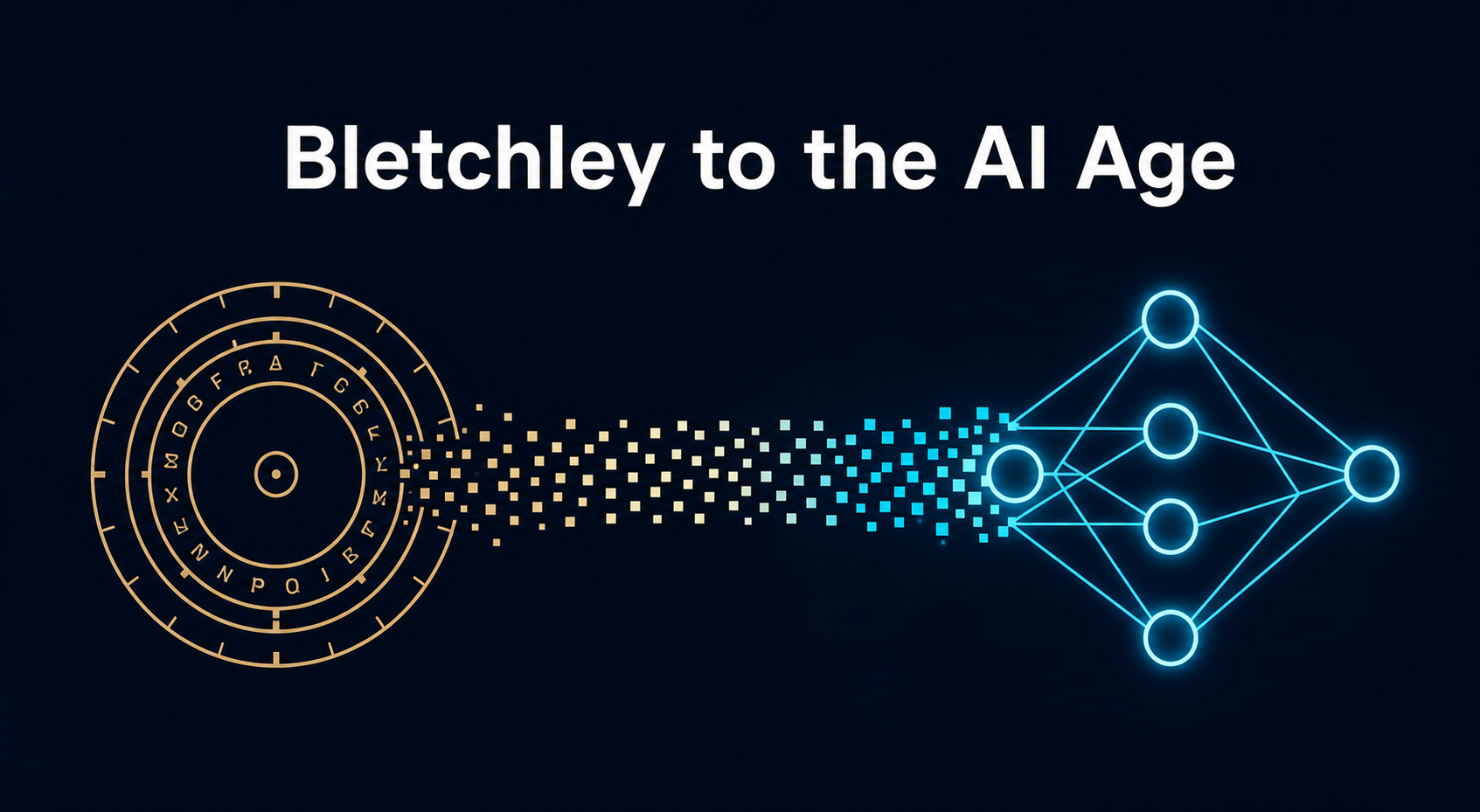
In the middle of the twentieth century, a secretive campus in the English countryside became the site of one of the most consequential contests between human ingenuity and machine capability in modern history. Bletchley Park brought together mathematicians, linguists, engineers, and intelligence officers to wage a continuous campaign against German encryption — the Enigma cipher used by the Wehrmacht, Luftwaffe, and Kriegsmarine, and later the more advanced teleprinter systems protecting Hitler’s highest-level communications. That contest did not simply pit Allied cryptanalysts against German cryptographers. It set machines against machines, with emergent computing technologies designed to outpace ever more sophisticated mechanical and electromechanical ciphers.
This historical episode offers more than a compelling story. It provides a remarkably useful lens on the present AI age, in which states and corporations race to harness machine learning for advantage in economics, politics, and war. The competition at Bletchley Park was an early harbinger of our current moment: a struggle defined by the co-evolution of offense and defense, the fusion of human and machine intelligence, and the centrality of infrastructure and organization in translating technical possibility into strategic effect.
The Machine-vs.-Machine Contest
Bletchley Park was born into a world where encryption had already become industrial. The Enigma machine was not simply a clever gadget. It embodied a philosophy: that complexity, rapid key changes, and disciplined operating procedures could create an effectively unbreakable wall around operational communications. The Allied response had to be equally industrial and systematic. It could not rely on isolated feats of genius. Early Polish work on Enigma, followed by British and later American efforts, converged on one central recognition — breaking these ciphers at war-relevant speed demanded specialized machinery.
The result was the Bombe — first mechanical, then electromechanical — designed specifically to exploit structural features of Enigma and iterate through massive keyspaces far faster than any human team. As the war progressed, the contest escalated. German adoption of more complex teleprinter ciphers demanded still more powerful tools. The Colossus machines, built to attack these higher-level ciphers, went beyond the Bombes: they were electronic, high-speed, and partially programmable — arguably the first large-scale electronic digital computers deployed for an operational mission. In this sense, Bletchley Park was not only a codebreaking factory but a prototyping laboratory for computing itself.
What matters most for our analogy is the dynamic quality of this contest. Each German move — new procedures, altered key schedules, new machines — forced adaptation on the Allied side. Each Allied success, if detected or suspected, risked triggering German countermeasures. The result was a continuous feedback loop of innovation, secrecy, and counter-secrecy. Machines did not replace human intelligence at Bletchley Park; they became indispensable partners, amplifying human insight into operational results.
Human–Machine Fusion as the Real Advantage
Popular mythology tends to center Bletchley’s success on a handful of iconic personalities. The reality is more instructive: the decisive advantage lay in how the Allies organized human and machine capabilities together. The Bombes and Colossus machines were embedded in a broader ecosystem — traffic analysis, intelligence from other sources, exploitation of operator errors, and disciplined workflows that could convert a cryptanalytic breakthrough into timely, actionable intelligence. The machine was necessary, but the architecture around it was what made it decisive.
This is where the analogy to the AI age becomes most compelling. Today’s AI systems — large language models, pattern-recognition engines, decision-support tools — are not autonomous strategists. They sit inside socio-technical systems: organizations, processes, and infrastructures that determine how effectively machine outputs are translated into decisions. Bletchley Park’s experience reminds us that the key variable is never the machine in isolation, but the architecture that integrates machines with skilled human judgment.
At Bletchley, operators and engineers refined their machines based on feedback from cryptanalysts and from operational outcomes. Analysts, in turn, learned to frame problems in ways that exploited machine strengths and worked around machine limitations. This mutual adaptation between people and devices is precisely what AI adopters must master today. A powerful model without the right interfaces, institutional context, and trained human oversight will underperform just as surely as a misused Bombe would have in 1943.
Co-Evolution, Not Revolution
Much AI discourse still leans on the language of revolution: a single, dramatic break with the past in which machines suddenly surpass human capabilities and reshape everything in one stroke. Bletchley Park suggests a different framing — one of co-evolution. German cryptographic practice did not stand still once Enigma was fielded, and Allied cryptanalysis did not end with the invention of the Bombe. The two sides adapted to one another through a series of moves and countermoves sustained across years.
In the AI context, this co-evolution is already visible. As machine learning systems become embedded in intelligence analysis, cyber operations, logistics, and weapons systems, adversaries will adjust. They will probe model vulnerabilities, attack data pipelines, spoof or saturate automated sensors, and design operations to exploit the specific weaknesses of AI-assisted decision-making. The answer will not be a single fix but a continuous process of adjustment, red-teaming, and iterative innovation — much as the engineers of Hut 8 understood there would be no permanent solution to the Enigma problem.
An AI strategy that assumes today’s architectures and training paradigms will remain uncontested makes the same mistake that doomed many prewar cryptographic efforts: treating the adversary as static.
Infrastructure, Secrecy, and Scale
Another dimension of Bletchley Park that anticipates the AI age is the importance of physical and organizational infrastructure. The codebreaking effort required secure facilities, reliable power, specialized manufacturing lines, communications links, and a steady supply of mathematically and linguistically trained personnel. It was not enough to possess a clever design; the Allies had to scale it, sustain it, and protect its secrecy. Industrial capacity and ecosystem coordination mattered as much as algorithmic insight.
AI today is similarly infrastructural. Large-scale models demand vast compute resources, specialized hardware, optimized data centers, and secure communications. They require access to sensitive training data and robust pipelines for continuous updating and evaluation. AI competition, like the Bletchley contest, is fundamentally about industrial capacity and institutional coherence, not only about breakthrough algorithms.
Secrecy plays a parallel role as well. Bletchley’s effectiveness depended on the adversary not knowing when and where communications were compromised. Revealing too much about methods risked prompting countermeasures that would nullify hard-won advantages. In contemporary AI, secrecy takes the form of proprietary model weights, guarded training data, and classified applications. At the same time, the dual-use nature of AI creates genuine tension: states and firms want to reap the economic benefits of broad deployment — which pushes toward openness — even as they wish to preserve specific operational advantages. Managing what to share, what to conceal, and how to compartmentalize has become a strategic lever, just as it was at Bletchley Park.
From Cryptanalysis to Algorithmic Warfare
The Bletchley story is usually told as a triumph of cryptanalysis. It can also be read as an early demonstration of what we now call algorithmic warfare. The Bombes and Colossus machines were executing highly specialized algorithmic tasks — searching keyspaces, testing hypotheses, filtering possibilities — at speeds no human team could approach. Humans set the problems, tuned the search, and interpreted the results; machines performed the bulk computation. The division of labor was clear and deliberate.
Today’s AI-enabled systems extend that division of labor into new domains. Sensor networks with embedded AI perform real-time classification and tracking. Decision-support tools analyze vast data streams to flag anomalies and forecast trends. Autonomous platforms — from drones to unmanned surface vessels to undersea systems — incorporate on-board processing that allows them to navigate, evade, and coordinate with minimal human intervention in the loop.
The crucial continuity is that these systems remain tightly bounded by their training data, their architectures, and their operational constraints. Just as the Bombe could not independently choose a new target without human direction, modern AI cannot spontaneously reframe political or strategic objectives. What it can do is shift the tempo and character of competition in ways that force adversaries to adapt — sometimes faster than they are capable of adapting. Bletchley Park was not merely the birthplace of modern computing in a narrow technical sense; it was an early laboratory for understanding how machine-augmented cognition changes the conduct of conflict.
Strategic Lessons for the AI Age
Treating Bletchley Park as a harbinger of the AI age yields several practical lessons for contemporary policymakers and defense planners.
The first is that advantage lies in integration, not isolated marvels. The Allies did not prevail in the cryptographic contest because they possessed the single best machine. They prevailed because they built an integrated system in which machines, people, and processes reinforced one another. In AI, this translates into a focus on end-to-end operational concepts — how models are trained, deployed, monitored, and iterated within real organizations — rather than on benchmark performance in isolation.
The second is that competitive dynamics are reciprocal and continuous. Just as German cryptography and Allied cryptanalysis co-evolved, AI capabilities will be shaped by the moves and countermoves of multiple state and non-state actors. It is dangerous to treat any snapshot of relative capability as stable. Strategy must assume churn and design for resilience.
Third, secrecy and disclosure must be managed as strategic instruments. Bletchley’s effectiveness depended on carefully controlled secrecy, but also on selective sharing with operational commanders and Allied partners. In the AI realm, states face analogous choices about what to regulate, standardize, and share — including with industry and allies — without eroding the advantages that justify the investment.
Fourth — and perhaps most important — the human dimension remains decisive. The popular caricature of wartime codebreaking as the triumph of solitary genius obscures the reality of a large, diverse workforce — many of them young women — whose disciplined labor and creativity made the machines meaningful. In the AI age, talent pipelines, training, and retention across technical and operational communities matter as much as silicon and algorithms. Without the capacity to understand, critique, and adapt AI systems, organizations will struggle to use them effectively or safely.
Avoiding Misread Lessons
Historical analogies clarify when used carefully, but mislead when oversimplified. Seeing Bletchley Park as a precursor to AI competition can tempt us into thinking that every technological edge is decisive — that a single secret capability can “win the war.” In reality, Bletchley’s contributions were vital but not determinative. They interacted with industrial production, battlefield performance, alliance politics, and many other factors. Intelligence alone, however brilliantly processed, does not win wars.
In the AI age, it is similarly misleading to imagine that a single breakthrough model or autonomous platform will transform the strategic landscape by itself. What matters is how AI interacts with broader trends: demographic pressures, economic competition, climate stress, and political fragmentation. AI is another turn in a long-standing pattern — states harness new information technologies to compete, and their opponents respond in kind.
A second risk is overstating machine autonomy. The framing of “machines versus machines” at Bletchley can make human beings seem incidental. They were not. Human judgment framed the problems, evaluated the outputs, and bore responsibility for how decrypted intelligence was used — including the morally fraught decisions about which convoys to save and which to sacrifice in order to protect the secret of Ultra. Today, rhetoric about “AI agents” and “autonomous decision-making” can obscure the continued centrality of human accountability. Hiding behind machines does not remove responsibility; it merely makes it easier to evade.
Finally, there is the risk of technological determinism. Bletchley Park’s machines were necessary but not sufficient. So too with AI. Political choices, strategic culture, legal frameworks, and ethical norms will shape how these systems are used. The machines are instruments, not destiny.
The Enduring Continuity
With these caveats in place, the core argument can be stated plainly. The competition between the machines of Bletchley Park and the cipher devices of the Third Reich was an early prototype of the AI age’s competitive dynamics. It demonstrated how states mobilize human talent and novel machinery to contest informational advantage, how adversaries co-evolve through cycles of innovation and counter-innovation, and how real leverage comes from integrating machines into broader architectures of organization and strategy — not from the machines themselves.
Bletchley Park offers both inspiration and warning. It demonstrates what becomes possible when a society invests seriously in intelligence, engineering, and organizational adaptation under pressure. But it also reminds us that technical breakthroughs are quickly normalized and contested. Today’s AI advantages will not remain any one side’s monopoly for long. Just as the Germans believed in the impregnability of their cipher systems, actors today can be lulled into dangerous overconfidence about their AI capabilities.
The machines of Bletchley Park did not end competition; they intensified it. They changed its tempo, broadened its scope, and raised the stakes for everyone who chose to compete. The same is true of AI. Understanding that continuity — rather than reaching for the comforting language of revolution — is the beginning of serious strategic thinking about the age we are entering.