Is Australia Missing the Autonomous Systems Revolution in Naval Design?
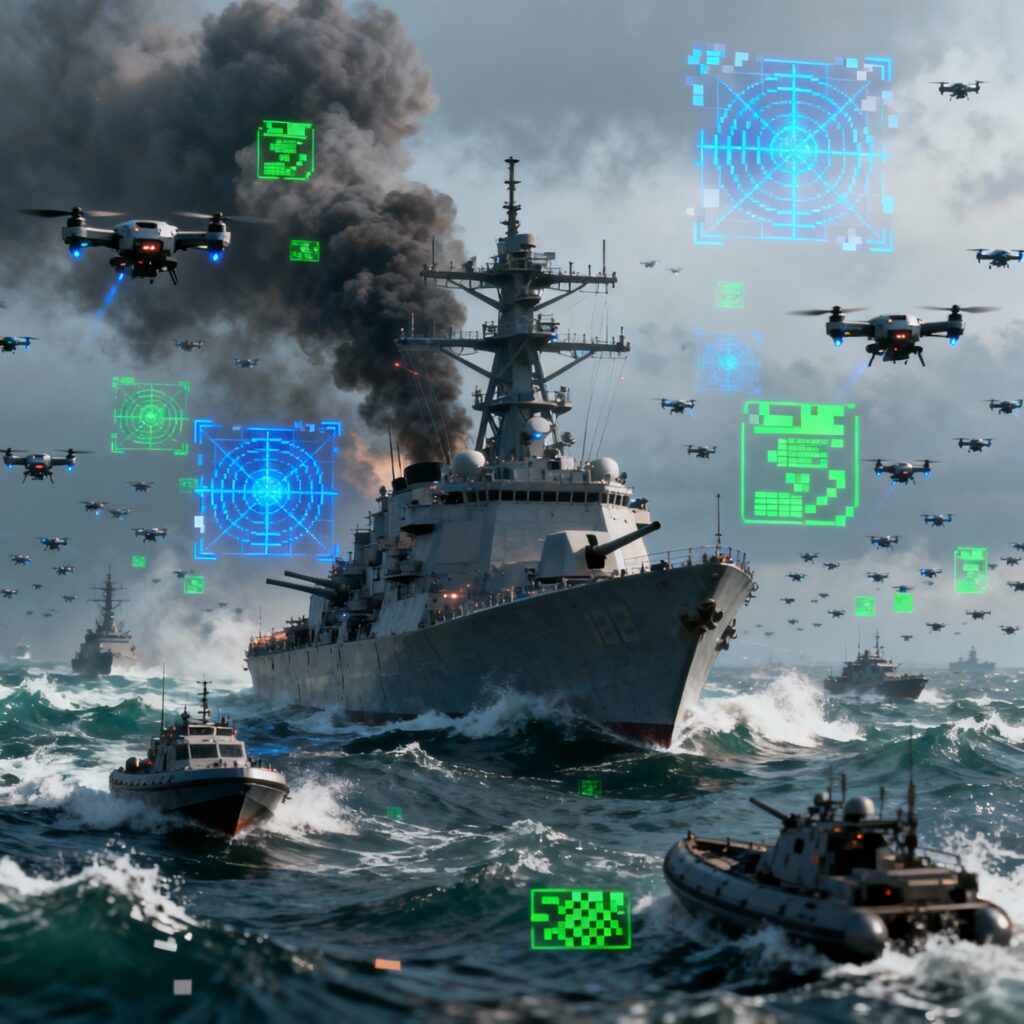
When considering naval fleet design today and into the future, it is crucial to factor in how autonomous systems are fundamentally transforming naval warfare and how smaller nations are already designing capital ships around this revolution while major powers cling to traditional paradigms.
Singapore and Denmark have pioneered an approach to naval design that inverts traditional thinking: design the ship as a mothership for autonomous systems from day one, rather than building traditional warships and hoping to retrofit autonomous capabilities later. This isn’t incremental improvement. It’s a fundamental reimagining of what a warship is and how it generates combat power.
Singapore’s Drone Mothership Revolution
In October 2025, Singapore launched RSS Victory, the first of six Multi-Role Combat Vessels explicitly designed as autonomous systems motherships. At 150 meters length and 8,000 tons displacement, these ships represent a new category of warship: platforms designed from the keel up to deploy, control, and sustain fleets of unmanned aerial, surface, and underwater vehicles.1
The design philosophy is radical. Singapore’s Defense Minister described the operational concept as reminiscent of science fiction: “It isn’t about having a fixed number of drones or unmanned surface vessels. As the mission set evolves, we’ll also evolve the type of weapon system and capabilities that we can have on the ship.”2 One MRCV with its autonomous fleet can execute missions requiring multiple conventional warships.
The technical specifications reveal the depth of integration. The ships feature mission bays capable of holding up to eight standard 20-foot containers for mission modules, autonomous system control rooms, medical facilities, or specialized capabilities can be swapped rapidly. Integrated Full Electric Propulsion systems provide 30 megawatts of power, enough electricity for 50,000 households, enabling flexible distribution between propulsion and combat systems as needed.10 Reduced crew requirements, fewer than 100 sailors, with just two required for bridge operations in emergencies, free up space and resources for autonomous systems.3
Critically, the design deliberately accepts trade-offs that traditional naval architecture would reject. The all-diesel IFEP system limits top speed compared to gas turbine arrangements, but Singapore judged this acceptable because high-speed pursuit missions can be conducted by embarked autonomous systems.4 The ship isn’t trying to do everything itself: it’s a command node and logistics base for systems that conduct the actual missions.
The operational concept is transformative. These vessels will deploy Maritime Security Unmanned Surface Vessels (MARSEC-USVs) that navigate autonomously through congested waters using AI-driven collision avoidance. They’ll control autonomous underwater vehicles for mine detection and submarine tracking. UAVs will extend surveillance and strike envelopes far beyond visual range. All three domains, air, surface, subsurface and operate simultaneously under coordinated AI-enabled command.5
With operational range exceeding 7,000 nautical miles, double that of Singapore’s current frigates, and endurance over 21 days, these ships provide unprecedented reach for a nation of just six million people. They’re designed to remain relevant for 30 years through modular upgrades, with new autonomous systems integrated as technology evolves. Singapore has built adaptability into the architecture itself.6
Denmark’s Modular Design Philosophy
Denmark’s approach, while predating widespread autonomous systems, established the modular design philosophy that Singapore extended. The Absalon and Iver Huitfeldt classes pioneered the StanFlex modular mission payload system, standardized containers with common interfaces that can be installed or removed rapidly, transforming the ship’s capabilities based on mission requirements.7
The two ship classes share 80 percent commonality, enabling massive cost savings and operational flexibility. The same basic hull design supports both classes, with weapons and systems housed in modular containers that plug into standardized slots. “With standardized modularized systems, we are able to reuse design elements,” explained Danish officials. “The stainless steel containers have standardized interface panels so a container can go on any ship in the Danish Navy, plug in and operate.”8
This modularity extends beyond just weapons. Large flexible holds can be reconfigured for mobile field hospitals, detention facilities, or storage for vehicles and equipment. The ships serve as both combat platforms and operational bases, with space for multiple functional contributions. special forces teams, engineering units, or specialized mission packages, all supported by the same basic ship infrastructure.
The Danish model demonstrates that intelligent design choices made at the beginning, embracing modularity, standardization, and flexibility, enable platforms to evolve over their service lives. Rather than locking in capabilities at construction, the ships adapt to changing operational requirements through mission package swaps. This is precisely the philosophy Singapore extended to accommodate autonomous systems.
Australia’s Platform-Centric Paradigm
Against this backdrop of innovation in naval design philosophy, Australia’s approach appears remarkably conservative. The Hunter-class frigates, based on the British Type 26 design, represent traditional frigate concepts optimized for anti-submarine warfare. At over 10,000 tons displacement, they’re expensive, complex platforms designed primarily around conventional ASW missions.
More significantly, there’s little evidence these ships are designed from the outset as autonomous systems motherships. They may accommodate some autonomous capabilities, most modern warships do, but that’s fundamentally different from designing the entire platform architecture around deploying, sustaining, and controlling large numbers of autonomous systems across multiple domains.
The AUKUS submarines embody the same platform-centric thinking at even greater scale. These will be among the world’s most sophisticated submarines, incorporating cutting-edge technology available in the 2020s. But they’re being designed now for delivery in the late 2030s or 2040s, meaning their fundamental concepts and architectures are frozen today for platforms that won’t be operational for 15-20 years.
Consider what this means: By the time AUKUS submarines begin operations, peer competitors may have fielded thousands of autonomous underwater vehicles that fundamentally change submarine warfare. China is already experimenting with unmanned systems across all domains. The nature of undersea warfare could be transformed by the time Australia’s first AUKUS submarine conducts its first patrol.
True kill web architecture, distributed sensors, autonomous systems, AI-enabled coordination, flexible mission packages, requires designing for it from the start. You cannot bolt swarm coordination capabilities onto ships designed around traditional warfare concepts. Singapore understands this; Denmark pioneered the modularity that enables it. Australia is investing hundreds of billions in platforms designed before these lessons were fully appreciated.
The risk is profound: Australia may receive its Hunter frigates and AUKUS submarines only to discover that smaller nations operating autonomous-centric platforms can generate similar or superior combat effects at a fraction of the cost and with far greater operational flexibility. Singapore’s 8,000-ton mothership controlling dozens of autonomous systems could prove more relevant to 2030s naval warfare than Australia’s 10,000-ton anti-submarine frigates designed around 2010s concepts.
The Alternative Path Australia Isn’t Taking
What would a strategy incorporating these lessons look like?
It would fundamentally differ from Australia’s current approach in several key dimensions:
First, maintain diverse, adaptable near-term force structure rather than cutting it. Keep those Infantry Fighting Vehicles, they represent mobile, modifiable platforms that can be adapted as battlefield technology evolves. Maintain more hulls even if individually less capable, because numbers matter in distributed operations and provide redundancy if individual platforms are lost. Platform diversity enables experimentation and adaptation; platform scarcity forces rigidity.
Second, invest heavily in autonomous systems research, development, and rapid fielding. Learn from Ukraine’s drone ecosystem. Build industrial capacity for rapid production and iteration. Establish frameworks for quickly moving from concept to battlefield deployment measured in months, not years. Partner with commercial drone manufacturers. Create incentives for rapid innovation rather than slow, risk-averse acquisition programs.
Third, design new capital ships around autonomous system integration from day one. When Australia eventually builds new major surface combatants to follow the Hunter class, they could be designed as motherships for autonomous systems, following Singapore’s model. This means: dedicated mission bays for multiple 20-foot containers, power generation scaled for autonomous system operations, launch and recovery systems for aerial and surface vehicles, AI-enabled command and control architecture for coordinating swarm operations, and reduced crew requirements enabling more space for systems rather than people.
Fourth, build industrial surge capacity for rapid production and adaptation during crisis. This lesson from Ukraine cannot be overstated: the ability to rapidly scale production of effective systems matters enormously. Australia should identify which capabilities can be surge-produced domestically in crisis, establish baseline production capacity that can expand rapidly, and create stockpiles of critical components and subassemblies that enable quick scaling.
Fifth, embrace ‘good enough’ platforms that can evolve rather than waiting for exquisite platforms that may be obsolete on delivery. Denmark’s approach, 80 percent commonality between ship classes, modular mission packages, open architecture systems, enables continuous adaptation. Singapore’s approach, designing for a 30-year service life with planned technology insertion points, acknowledges that we cannot predict the future perfectly but can design for adaptability. Australia’s approach, locking in platform designs for delivery decades hence, assumes we can predict future requirements with precision. History suggests this is hubris.
Strategic Choices and Their Consequences
Australia’s defense strategy embodies a specific theory of how future conflict will unfold: that major contingencies won’t materialize before the mid-2030s; that platform quality matters more than adaptability and quantity; that traditional capital ships will remain central to naval warfare; and that we can predict technological and operational requirements a decade or more in advance.
Ukraine’s war experience and the autonomous systems revolution both challenge every element of this theory. The Ukraine conflict demonstrates that rapid adaptation, industrial surge capacity, distributed systems, and battlefield innovation matter enormously. Singapore and Denmark’s naval design choices show that peer and near-peer nations are already building around autonomous-centric concepts that may render traditional platforms less relevant.
The strategic choice Australia faces is stark but not yet irrevocable. The country can continue on its current path: sacrifice near-term conventional capability to fund AUKUS, wait for capital ship platforms to arrive in the 2030s and 2040s, and hope the strategic environment cooperates with this timeline.
Australia’s defense planners would argue they’re making hard choices with limited resources.
Strategic bets are unavoidable in defense planning. The question is whether Australia is betting on the right things.
And I would add that maritime autonomous systems are not the same as the cheap drones operated in the global war in Ukraine and that there are a variety of ways to use them that do not require a capital ship at all and can be configured in various ways for MAS themselves to operate as mother ships. These changes are significant and I deal with them in detail in my book The Lessons of the Drone Wars to be published next month.
- https://www.twz.com/sea/singapore-launches-its-biggest-and-most-capable-warship-ever
- https://www.zona-militar.com/en/2025/10/27/first-of-six-new-drone-carrier-mrcv-frigates-launched-for-the-republic-of-singapore-navy/
- https://www.defensenews.com/global/asia-pacific/2025/10/24/singapore-launches-battlestar-galactica-like-warship-with-drones/
- https://www.navalnews.com/naval-news/2024/09/dsta-reveals-origins-of-singapores-mrcv/
- https://breakingdefense.com/2025/10/singapores-navy-launches-first-of-new-class-of-multi-role-drone-motherships/
- https://defense.info/maritime-dynamics/2025/10/singapores-multi-role-combat-vessels-motherships-for-a-new-era-of-naval-warfare/
- https://www.defensemedianetwork.com/stories/denmarks-iver-huitfeldt-class-frigates/
- https://defense.info/maritime-dynamics/2023/10/building-modular-motherships-denmark-and-singapore-lead-the-way/